Introduction
Imagine your sales team calling a prospect in Little Rock. The caller ID shows an out-of-state number. The call goes to voicemail — or the prospect hesitates before answering. Now imagine that same call displaying a 501 number, a code every central Arkansas resident recognizes as local. The phone gets answered.
That's the practical difference a local area code makes, and for businesses targeting central Arkansas, the 501 area code is the most direct route to that kind of trust — the same calculus we walk through in our guide to choosing a local area code. This guide covers everything you need to know: where the code operates, why it matters strategically, and how to get a 501 number even if your company is headquartered elsewhere.
What Is the 501 Area Code?
The 501 area code is one of the original telephone area codes established under the Federal Communications Commission's North American Numbering Plan (NANP), introduced on January 1, 1947. At launch, it covered the entire state of Arkansas — making it the oldest and most recognized phone code in the state.
Over the decades, population growth triggered two splits:
- 1997: Area code 870 was created to serve eastern and southern Arkansas
- 2002: Area code 479 was carved out for northwestern Arkansas, covering Fayetteville, Fort Smith, and the I-49 corridor
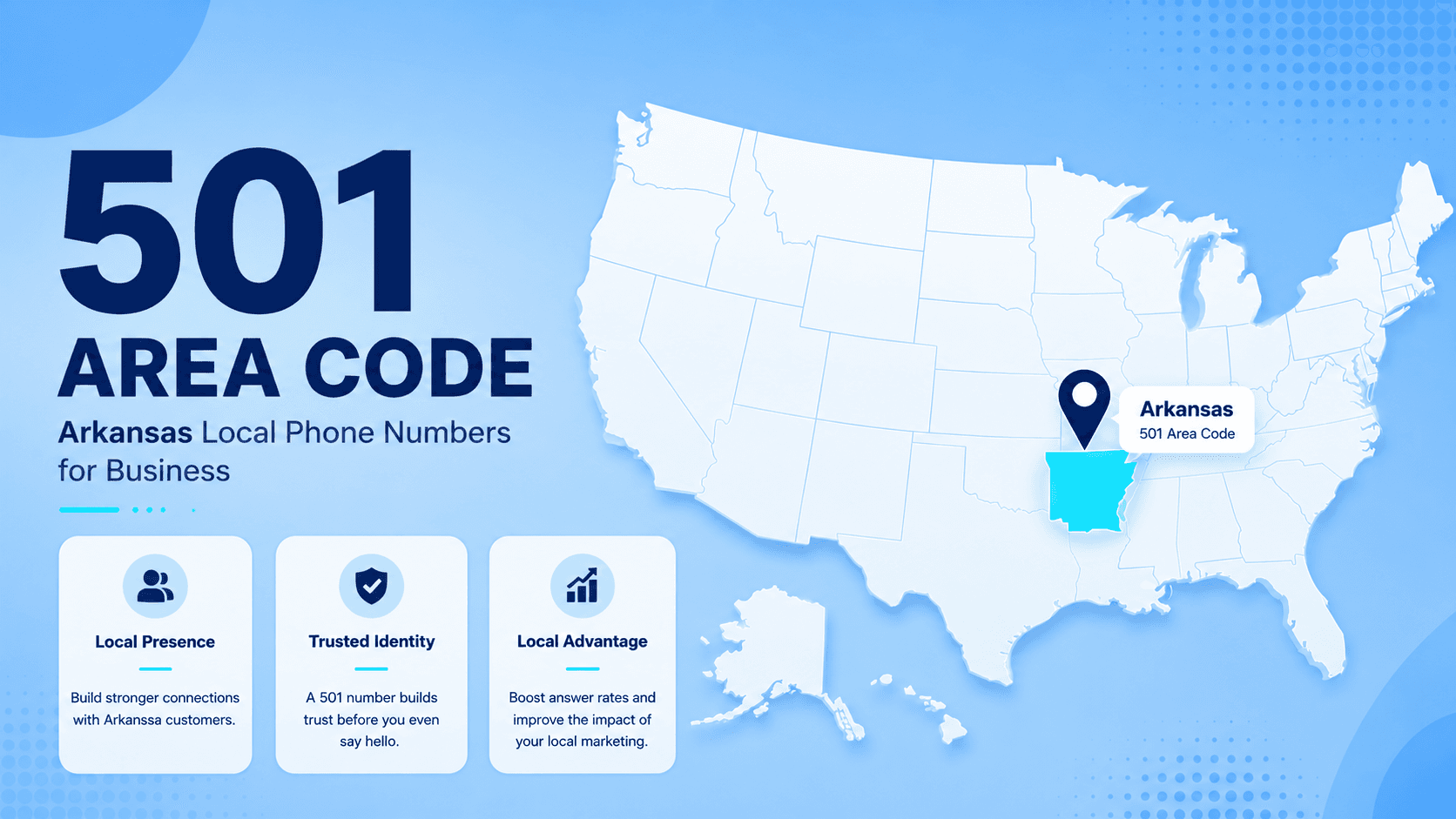
Today, 501 covers central Arkansas, the political and economic core of the state. All calls within the 501 region require ten-digit dialing, and the code operates in the Central Time Zone (CT) — UTC-6 standard, UTC-5 during daylight saving time.
Where Does the 501 Area Code Cover?
The 501 area code spans a broad swath of central Arkansas, from the state capital along the Arkansas River Valley north and west through the Ouachita Mountain foothills.
Major cities served:
- Little Rock (state capital)
- North Little Rock
- Conway
- Hot Springs
- Benton
- Cabot
- Searcy
- Sheridan
- Morrilton
- Arkadelphia
Counties served (all or in part):
Pulaski, Faulkner, Garland, Saline, Lonoke, White, Cleburne, Conway, Hot Spring, Perry, and Van Buren counties.
Population covered: Approximately 1.2 million residents — around 40% of Arkansas's total population. For any business targeting Arkansas consumers, the 501 region is the state's highest-density market.
Is a 501 Area Code Call a Scam?
501 is a real, actively assigned area code — most calls showing a 501 prefix are completely legitimate central Arkansas businesses and residents. Its familiarity is exactly why scammers target it, though: a local-looking number gets answered far more often than an out-of-state one.
- Robocalls and spoofing: Scammers use caller ID spoofing to display a 501 number, even when the call originates nowhere near Arkansas. Medicare/Medicaid impersonation, auto warranty offers, and health insurance pitches are among the most frequently reported categories tied to this area code.
- Government and utility impersonation: Callers posing as state agencies or utility providers threaten fines or service shutoffs unless you pay immediately by gift card or wire transfer. Legitimate organizations send written notice first and never demand a single untraceable payment method.
- Wrong-number text scams: A text that opens like an accidental "wrong number" message, then tries to move the conversation to WhatsApp, is a well-documented 501-linked pattern. Don't reply — forward it to 7726 (SPAM) and delete it.
- One-ring callback scams: A call that rings once and disconnects is designed to bait a callback to a premium-rate number.
If an unexpected 501 call or text pressures you for immediate payment or personal information, hang up and contact the organization directly using a number from its official website or bill.
Why a 501 Area Code Number Matters for Business
A local area code isn't cosmetic. It produces measurable results in three areas most businesses care about immediately:
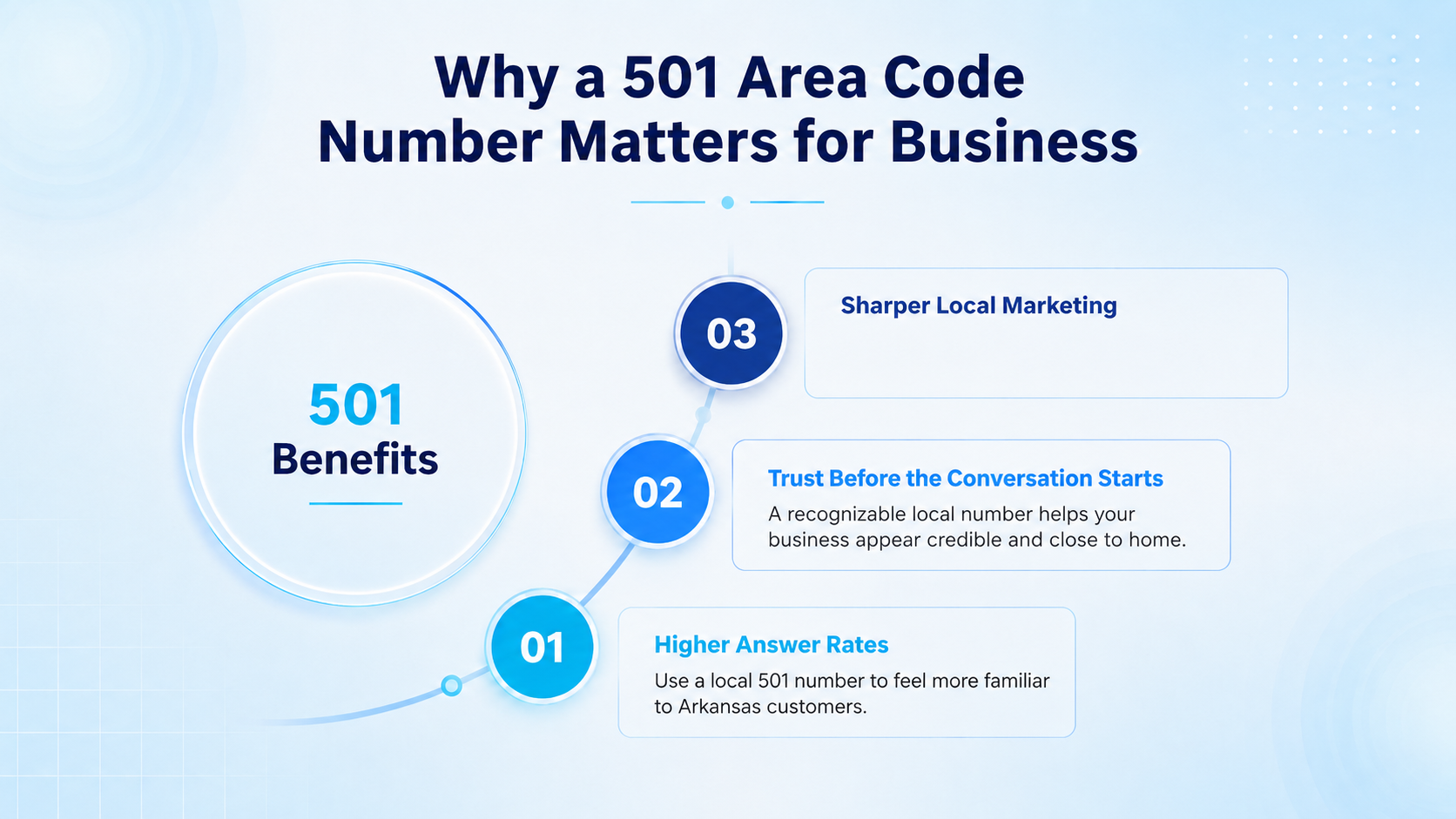
Higher Answer Rates
Consumers across the U.S. are significantly more likely to answer calls from recognized local area codes than from a toll-free number or an out-of-state number. When your outbound calls display a 501 number, central Arkansas prospects see it as local and are more likely to pick up — before your team says a word.
Trust Before the Conversation Starts
A 501 number tells prospects: this business is part of our community. In central Arkansas — where word-of-mouth carries real weight and community ties influence buying decisions — that first impression can determine whether the conversation happens at all.
Sharper Local Marketing
Running a campaign targeting Little Rock or Conway? A 501 number in your ad, landing page, or print material reinforces your local message and lifts response rates. It also keeps your brand consistent across channels — digital, radio, and direct mail — where a local number signals legitimacy and reduces friction.
Understanding the Central Arkansas Economy
To make full use of a 501 number, it helps to understand who your customers actually are in this region.
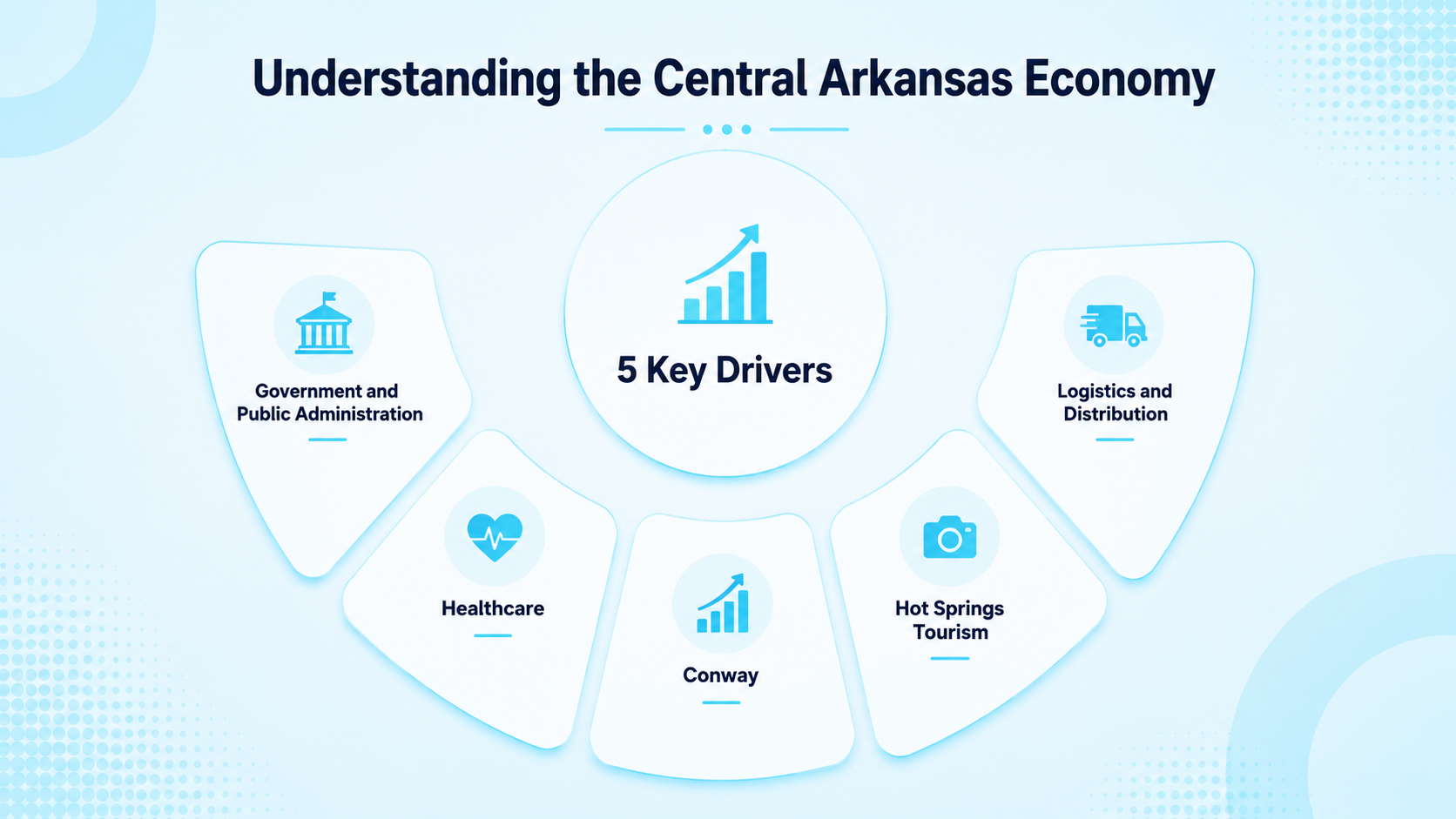
Government and public administration are the economic foundation of Pulaski County. Little Rock serves as the state capital, generating consistent demand from contractors, consultants, vendors, and professional services firms targeting state agencies and regulatory bodies.
Healthcare is the region's largest private-sector employer. The University of Arkansas for Medical Sciences (UAMS), Baptist Health, and CHI St. Vincent are all based in Little Rock. Staffing companies, medical vendors, software providers, and professional services firms targeting this sector gain an immediate trust advantage with a local 501 number.
Conway is Arkansas's fastest-growing city, home to a cluster of financial services companies, tech firms, and three universities — University of Central Arkansas, Hendrix College, and Central Baptist College. The Conway corridor is increasingly a standalone B2B market worth targeting.
Hot Springs draws over 9 million visitors annually, supporting a hospitality, spa, tourism, and retail economy that relies heavily on responsive, accessible phone contact for reservations, inquiries, and customer service.
Logistics and distribution operations along the I-40 and I-30 corridors serve major national retailers and manufacturers, making 501 a relevant code for supply chain, freight, and warehousing companies with Arkansas footprints.
Understanding this mix lets you position your 501 number with precision — whether you're reaching healthcare decision-makers in Little Rock, growing companies in Conway, or service-oriented businesses in Hot Springs.
How to Get a 501 Area Code Number
You don't need a physical office in Arkansas to operate a 501 number. VoIP (Voice over Internet Protocol) technology allows businesses anywhere to use a local central Arkansas number, routing calls to wherever your team actually works.
The process typically takes minutes:
- Choose a VoIP provider that offers 501 numbers with the call features your business needs
- Select your number — search available 501 numbers and choose one that's easy for customers to remember
- Configure call routing — set where calls ring: mobile, desk phone, team queue, or contact center
- Activate and go live — no technician visits, no physical address in Arkansas required
A business based in New York, Chicago, or anywhere with a reliable internet connection can operate a 501 number and handle calls exactly as if they were based in Little Rock. If you're still deciding whether a local prefix fits your strategy, our guide to choosing a local area code walks through the tradeoffs in more detail.
What to Look for in a 501 VoIP Provider
Not all VoIP providers deliver equally. When choosing a platform for your 501 area code number, prioritize these capabilities:
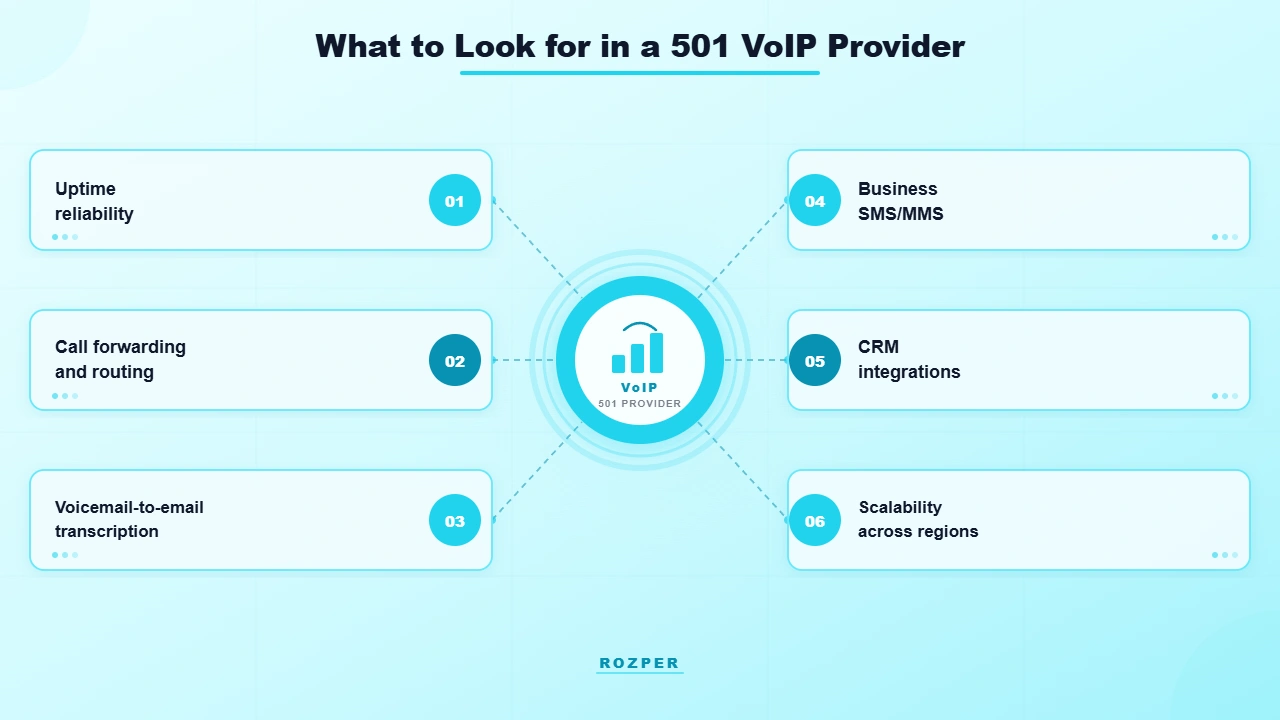
Uptime reliability. Your phone line is a revenue channel. Look for providers guaranteeing 99.999% uptime — meaning your 501 number stays reachable when Arkansas customers call, not just when conditions are ideal.
Call forwarding and routing. Route 501 calls to the right team member, department, or time-based queue. Rozper's call forwarding gives you granular control without configuration complexity, so calls reach the right person every time.
Voicemail-to-email transcription. Convert voicemails into readable text so your team never misses a message, even in noisy environments or during high-volume periods.
Business SMS/MMS. Customers increasingly prefer text for scheduling, confirmations, and quick questions. A provider that supports two-way SMS on your 501 number extends your reach beyond voice calls.
CRM integrations. If your sales or support team uses Salesforce, HubSpot, or Zoho, your VoIP platform should log 501 calls automatically against contact records — no manual data entry.
Scalability across regions. Start with one 501 number and add lines, users, or entirely new area codes as your business expands — without switching platforms.
Rozper is one option worth considering here, maintaining 99.999% uptime and coverage in 150+ countries so a single platform can serve both your local central Arkansas line and any international operations.
Tips to Get More from Your 501 Number
Having the number is step one. Here's how to make it work harder:
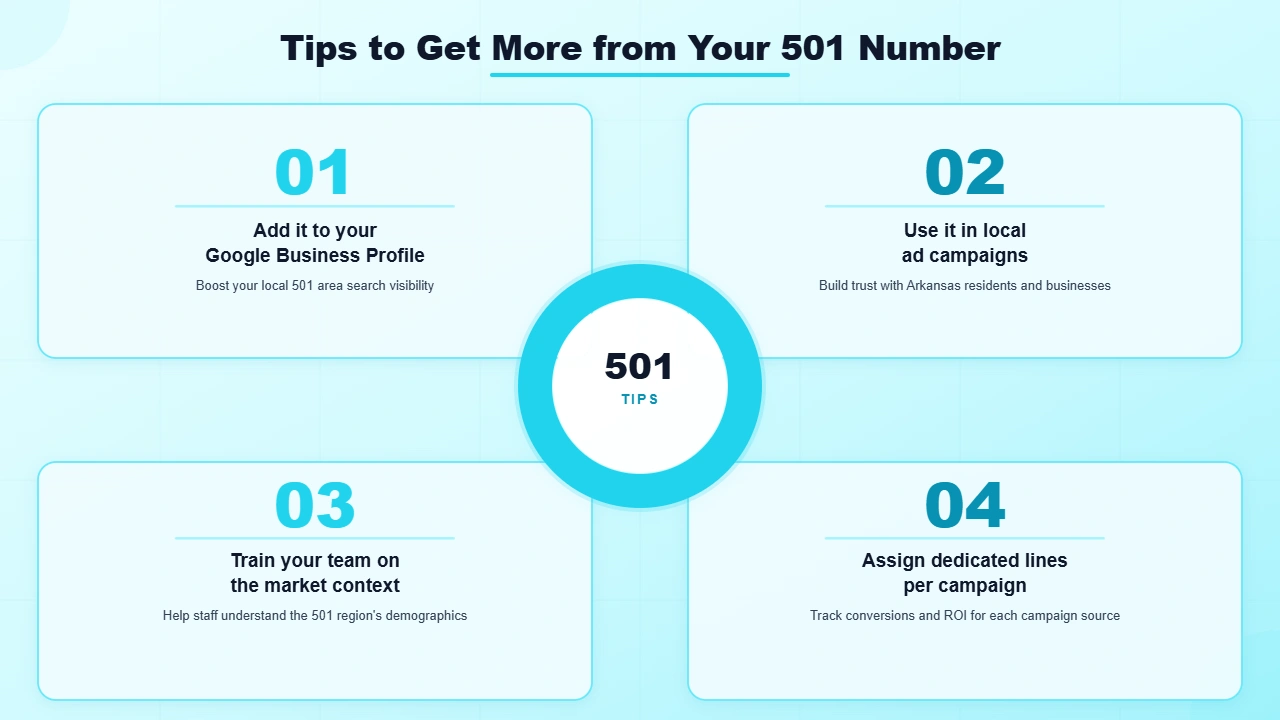
Add it to your Google Business Profile. A 501 number on your GBP listing strengthens your local search relevance for central Arkansas queries. NAP consistency (Name, Address, Phone) across online directories is a recognized local SEO ranking signal.
Use it in local ad campaigns. Whether you're running Google Ads targeting Little Rock or Facebook campaigns reaching Conway, a 501 number in your ad creative reinforces the local message and increases click-to-call conversion.
Train your team on the market context. Knowing that a caller from a 501 number is likely in Pulaski, Faulkner, or Garland County allows your team to personalize conversations — even when they're based in another state entirely.
Assign dedicated lines per campaign. Use different 501 numbers for different marketing channels to track exactly where your central Arkansas calls are coming from, which campaigns drive the most volume, and where to invest next.
Conclusion
The 501 area code has represented central Arkansas since 1947, through two major splits, decades of economic growth, and the shift from analog to digital communication. That 75-year history gives it something no toll-free number or out-of-state code can replicate: immediate, automatic recognition.
For businesses targeting Little Rock's government and healthcare sector, Conway's growing tech economy, or Hot Springs' tourism-driven market, a 501 number is a practical tool — one that raises answer rates, builds trust before the first sentence, and sharpens local marketing effectiveness across every channel.
Getting started is simple. See how Rozper makes it easy to get and manage a 501 area code number at rozper.com.
FAQs
What cities are covered by the 501 area code?
The 501 area code covers central Arkansas, including Little Rock, North Little Rock, Conway, Hot Springs, Benton, Cabot, Searcy, and communities across Pulaski, Faulkner, Garland, Saline, and surrounding counties.
Is 501 the only area code in Arkansas?
No. Arkansas currently has three area codes: 501 (central), 870 (eastern and southern), and 479 (northwestern, including Fayetteville and Fort Smith). The 501 code is the original, established in 1947 under the Federal Communications Commission's numbering plan when a single code served the entire state.
Do I need an Arkansas address to get a 501 number?
No. Through a VoIP provider, any business can obtain a 501 number and route calls to any device or location worldwide. There is no requirement to maintain a physical presence in Arkansas.
Will a 501 number help with local SEO?
Yes. Listing a 501 area code number in your Google Business Profile and local directories signals that your business serves the central Arkansas market, which can improve visibility in local searches for Little Rock, Conway, and Hot Springs.
Is a 501 area code call a scam?
The 501 prefix itself is legitimate and officially assigned. Its familiarity makes it a target for caller ID spoofing, with Medicare/Medicaid, auto warranty, and health insurance impersonation among the most frequently reported scam categories tied to this code. Legitimate organizations never demand immediate payment or personal information over an unsolicited call or text. For your own outbound calls, the most effective counter to spam-wariness is consistent caller ID with a recognizable business name, paired with calling during reasonable hours and following up with a text if calls go unanswered.
Can I use a 501 number for texting as well as calls?
Yes. VoIP providers that support SMS and MMS allow your 501 number to send and receive text messages — increasingly important for customer engagement in retail, healthcare, hospitality, and service businesses throughout central Arkansas.
How quickly can I activate a 501 number?
With a modern VoIP platform, activation typically takes minutes. You choose your number, configure basic routing, and the line is live — no waiting for hardware installation or technician appointments.