Introduction
Imagine your sales team places 400 outbound calls in a morning. Sixty never connect, a dozen connect with garbled audio, and on half the rest your caller ID shows up as an unknown number. Nothing is wrong with your phones, your agents, or your scripts — the problem lives in the layer of the network you've probably never examined: call termination.
Wholesale VoIP termination is the machinery that carries a call from your network to the person who answers it, anywhere in the world. It determines whether calls connect, how they sound, what they cost, and whether your number is trusted or flagged. This guide explains how termination actually works, what separates a dependable termination partner from a cheap one, and where the market is heading in 2026.
Key Takeaways
- Termination is the final leg: The handoff that completes your outbound call on the recipient's network, determining connection rates, audio quality, and caller ID integrity.
- Route type defines quality: Direct, compliant "white" routes preserve CLI and deliver high answer rates; grey routes look cheaper but degrade quality and create compliance risk.
- Cost is more than the rate: Billing increments, short-call surcharges, and failed-call ratios shape your real cost per connected conversation.
- Metrics don't lie: ASR, ACD, PDD, and MOS reveal route quality objectively — test before you commit traffic.
- Authentication is now mandatory: STIR/SHAKEN and global anti-spoofing rules mean non-compliant termination increasingly gets blocked or labeled spam.
Understanding Wholesale VoIP Termination
Before optimizing for cost or quality, it's worth understanding exactly what happens — technically and commercially — when a call terminates on someone else's network.
How a Call Gets Terminated
When a call leaves your network, your termination provider's switch reads the destination number and selects a route from its interconnect portfolio. The call may pass through one or several carrier networks before reaching the destination operator, which completes it to the end device. Each hop adds potential latency and cost — which is why providers with direct interconnects to destination carriers deliver both better quality and better economics than providers reselling someone else's routes.
Termination vs. Origination
The two halves of wholesale voice are easy to confuse. Termination handles your outbound calls — traffic leaving your network for the world. Origination handles inbound calls from the public network arriving at your VoIP system via DIDs. A provider can be excellent at one and mediocre at the other, so evaluate each separately on its own evidence.
White, Grey, and Black Routes
Termination routes fall into three categories. White routes are fully licensed interconnects that pay all regulatory fees and preserve caller ID end to end. Grey routes exploit arbitrage — SIM boxes that disguise international traffic as local calls are the classic example — delivering lower prices with degraded CLI, poor answer rates, and regulatory exposure. Black routes are outright fraudulent. US white-route termination runs around $0.003–$0.004 per minute; quotes far beneath market levels almost always signal a route-quality compromise.
Benefits of Wholesale VoIP Termination
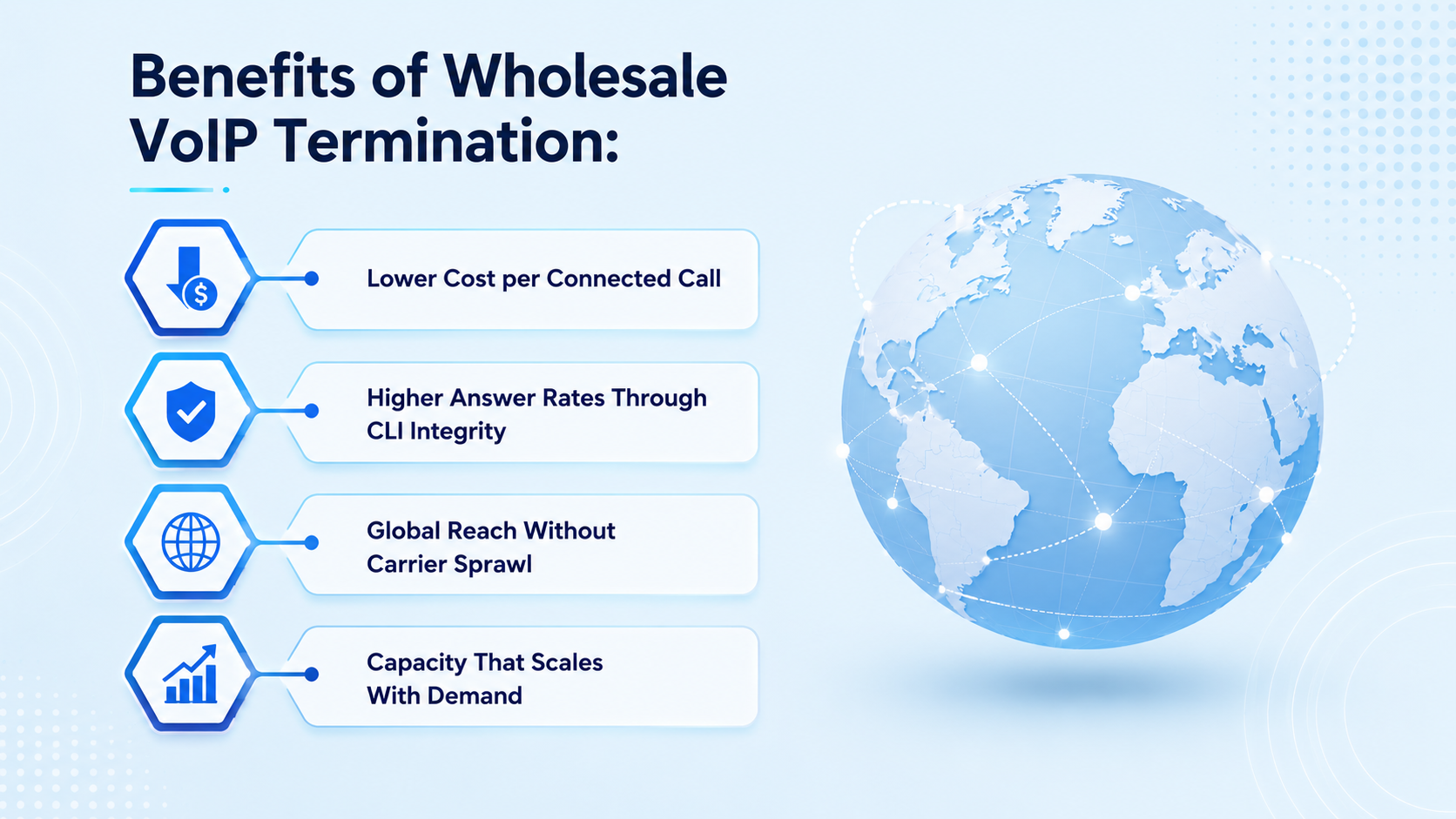
Lower Cost per Connected Call: Wholesale termination rates sit dramatically below retail calling prices because providers aggregate traffic across hundreds of customers and negotiate carrier interconnects at scale. But the real economic win is subtler: high-quality routes convert more attempts into conversations. A route that's 20% cheaper but connects 30% fewer calls costs you more per actual conversation — and cost per connected call is the metric that matters, not cost per minute.
Higher Answer Rates Through CLI Integrity: When termination preserves your caller ID correctly, recipients see a recognizable local or business number and answer more often. For businesses running high call volumes to markets like the 281 area code in Houston or other major US metros, CLI accuracy on every dial directly translates to more connected conversations and lower cost per outcome.
Global Reach Without Carrier Sprawl: Building direct relationships with carriers in every destination country is impractical for most operators. A wholesale termination partner consolidates that complexity into one interconnection — one contract, one rate deck, one support channel — with completion capability across the globe.
Capacity That Scales With Demand: Termination capacity is provisioned in software, not hardware. Campaign-driven businesses can scale from hundreds to thousands of concurrent calls in hours, then scale back down, paying only for the traffic sent. No legacy telephony arrangement matches this elasticity.
The Metrics That Define Termination Quality
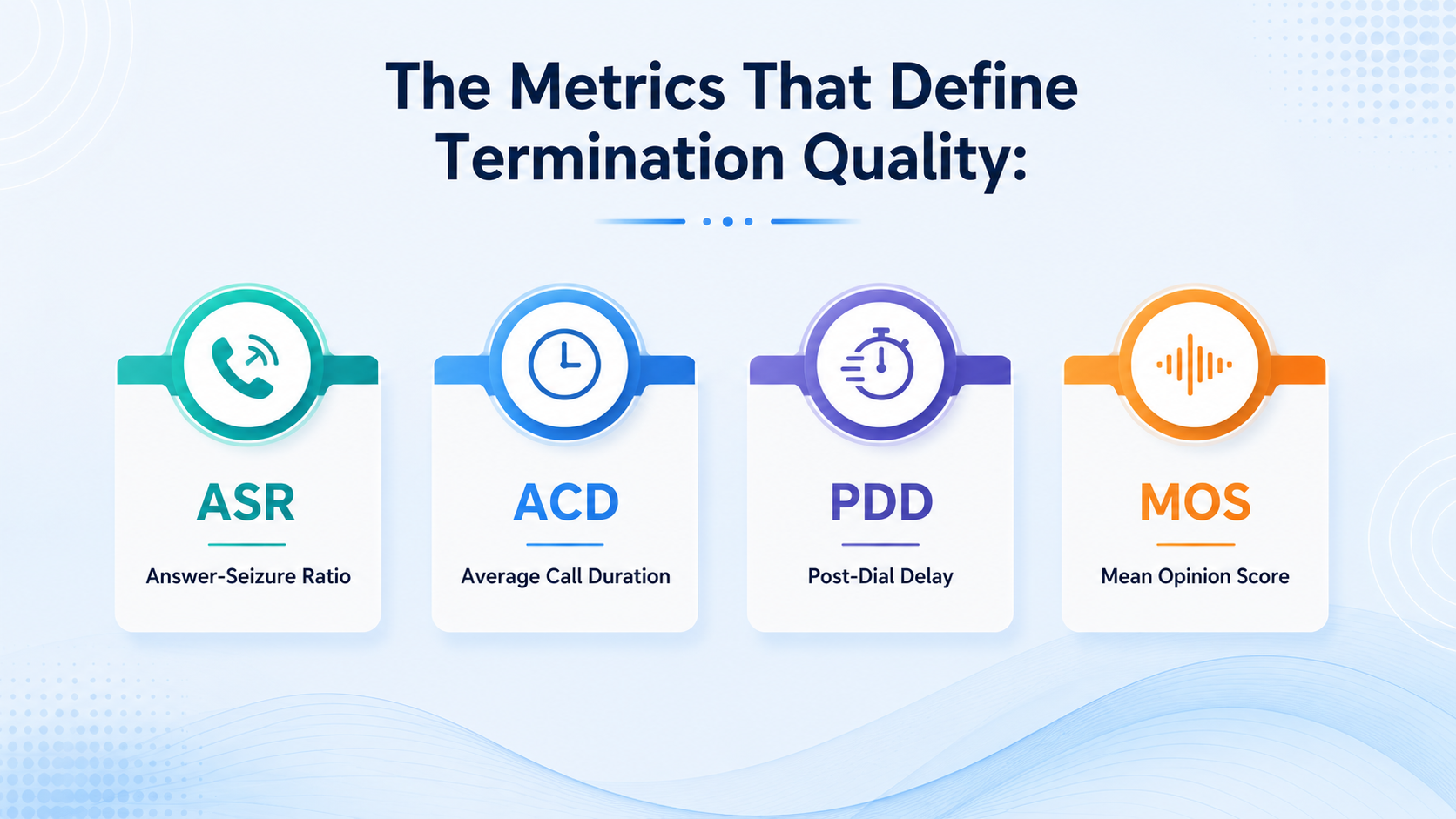
ASR — Answer-Seizure Ratio: Measures the percentage of call attempts that result in an answered call. Healthy conversational traffic on quality routes typically shows ASR in the 40–60% range depending on destination. Persistently low ASR signals congestion, poor interconnects, or CLI problems suppressing answer rates. For high-volume domestic routes — including busy markets like the 602 area code in Phoenix — ASR benchmarks above 50% are consistently achievable on strong white routes.
ACD — Average Call Duration: Reflects how long answered calls last. Routes with degraded audio show shortened ACD because people abandon calls they can't hear properly. Very short average durations also suggest dialer traffic, which is priced and routed differently from conversational business calls.
PDD — Post-Dial Delay: The silence between dialing and ringback. Beyond about five seconds, callers start abandoning attempts and called parties grow suspicious. Long PDD usually means a call is hopping through too many intermediate carriers — a hallmark of resold or grey routing.
MOS — Mean Opinion Score: Scores audio quality from 1 to 5; above 4.0 is the benchmark for business-grade voice. Modern platforms compute MOS continuously from network telemetry, so a serious provider can show you live quality data per route rather than just assurances.
Choosing a Wholesale VoIP Termination Provider
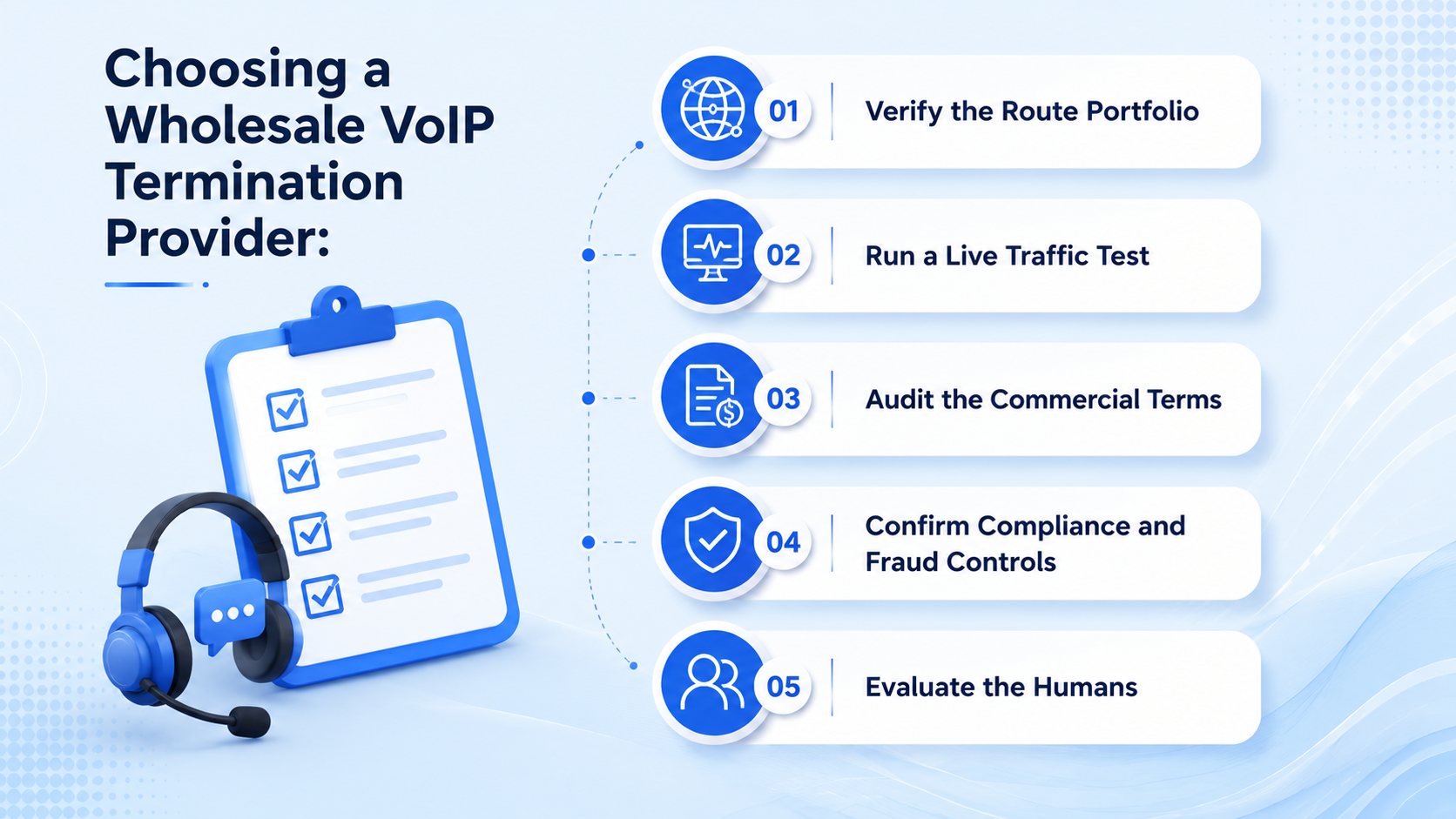
Verify the Route Portfolio: Ask which of your key destinations are served by direct interconnects versus third-party routes, and how many redundant paths exist to each. Any credible provider should be willing to state specifics: direct routes across 150+ countries, automatic failover capability, and a documented uptime commitment backed by SLA terms.
Run a Live Traffic Test: Route quality cannot be evaluated from a rate deck. Send two weeks of real traffic to your actual destinations and measure ASR, ACD, PDD, and CLI display against your current provider. Providers confident in their network welcome testing; resistance to a trial is itself a data point worth noting.
Audit the Commercial Terms: Check billing increments — per-second billing materially reduces costs on short calls versus per-minute rounding. Also review short-duration surcharges, minimum commitments, and rate-change notice periods. Termination rate decks change frequently and you want contractual transparency about when and how those changes apply to your account.
Confirm Compliance and Fraud Controls: Verify STIR/SHAKEN attestation practices for US traffic, E911 handling where relevant, and built-in fraud protections like destination blocking and real-time spend alerts. For the regulatory framework governing call authentication standards in the US, the FCC's call authentication resources are the authoritative reference. Toll fraud costs the industry billions annually, and your termination provider is your first line of defense.
Evaluate the Support Quality: When a route to a key market degrades before your biggest campaign, the question is who picks up and whether they can read a SIP trace. Ask how escalations actually work: who answers, how fast, and with what authority to reroute traffic.
Termination Cost Optimization
Getting termination spend under control rarely means chasing lower headline rates. Start by measuring cost per connected conversation rather than cost per minute — it exposes routes that are cheap but underperforming on completion. Insist on per-second billing for international traffic. Review your destination mix quarterly against current rate decks, since rates shift constantly. Watch short-duration call ratios closely, as they can indicate quality problems or fraud activity inflating your bill without delivering real conversations.
Conclusion
Wholesale VoIP termination is the invisible layer that decides whether your outbound calls become conversations. The fundamentals reward diligence: understand the route types beneath the rates, measure quality with ASR, ACD, PDD, and MOS rather than promises, and price your traffic by what a connected call actually costs. The cheap-and-opaque corner of the termination market is disappearing — businesses that partnered for quality early will consistently outperform those that didn't.
FAQs
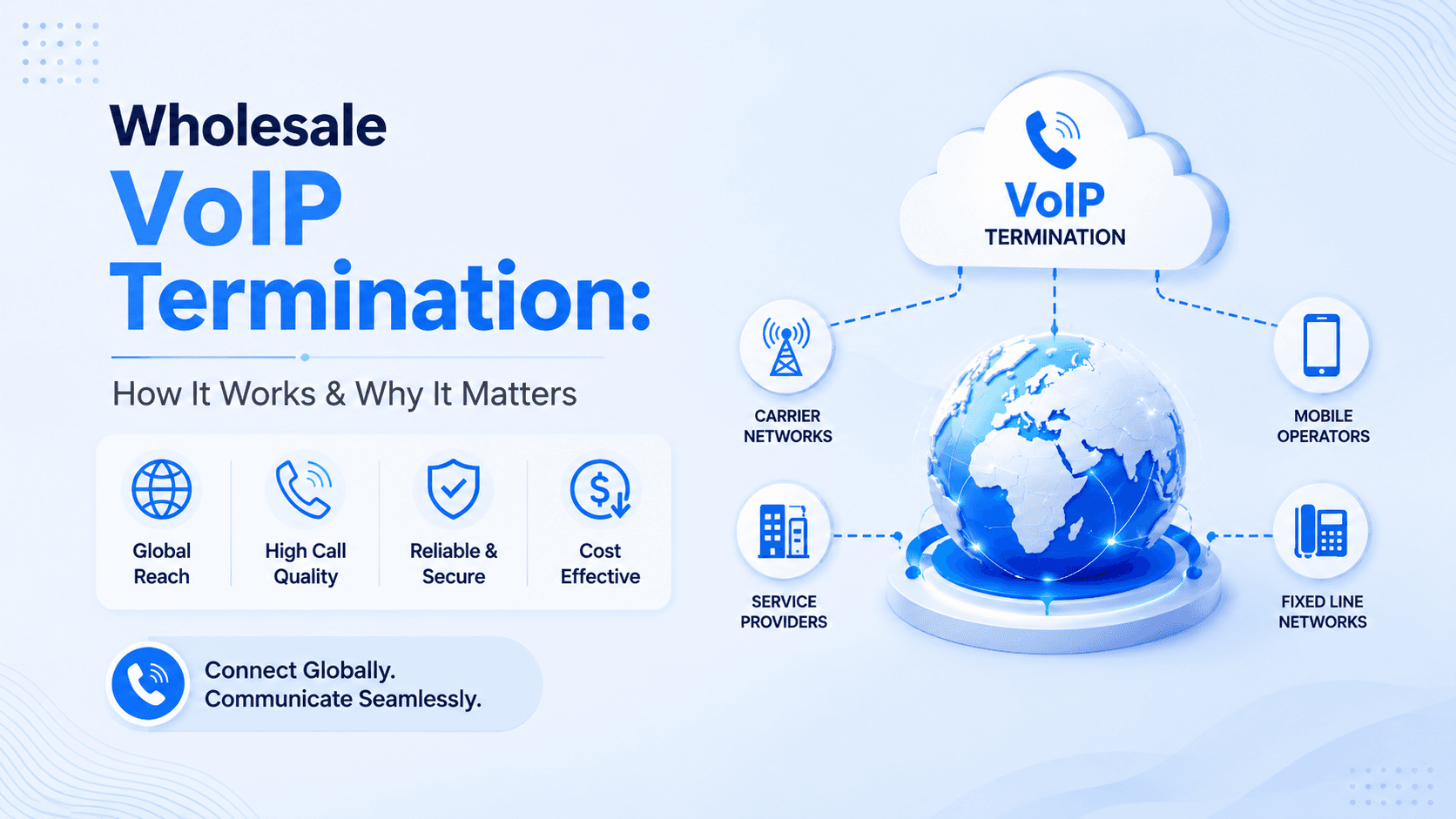
What does "termination" actually mean in VoIP? Termination is the final leg of a call's journey — the handoff that completes your outbound call on the recipient's network, whether that's a mobile carrier, landline operator, or another VoIP network. A wholesale termination provider sells this completion capability in bulk, routing your calls through its carrier interconnects to destinations worldwide.
How is wholesale VoIP termination different from SIP trunking? SIP trunking is the connection method — the virtual phone lines linking your PBX to the outside world. Termination is the service that completes the calls those trunks carry. A SIP trunk delivers your traffic to a provider, and the provider's termination network finishes the job. Many providers bundle both, but they're distinct layers worth evaluating separately.
What ASR should I expect on a good termination route? Conversational business traffic on quality routes typically shows ASR between 40% and 60%. Comparing the same traffic across two providers is more meaningful than absolute numbers: if a new route shows materially lower ASR on identical campaigns, the route — not your dialing — is usually the problem.
Why was my caller ID showing incorrectly on some calls? That's the signature symptom of grey-route termination. When calls travel through arbitrage paths like SIM boxes, the original caller ID is stripped or replaced, so recipients see unknown or random numbers. Beyond hurting answer rates, this can violate caller ID regulations. The fix is moving traffic to CLI-guaranteed white routes.
Is the cheapest termination rate ever the right choice? Occasionally — for traffic where answer rates and caller ID don't matter, such as some automated notification use cases. For any revenue-generating calling, cost per connected conversation beats cost per minute as the deciding metric, and quality routes win that comparison far more often than rate decks suggest.