Introduction
For organizations that move large volumes of outbound calls, understanding voice termination is the difference between a communication system that performs and one that drains budget. Wholesale voice termination routes and completes outbound voice calls from one network to another at scale — sitting at the heart of every contact center, carrier, and enterprise making calls in volume. How well it is managed determines call quality, cost efficiency, and fraud exposure.
Key Takeaways
- Core Function: Wholesale voice termination connects outbound calls from your network to their destination — the essential last mile of every outbound call.
- Quality Metrics: ASR, ACD, NER, and PDD are the industry-standard metrics for evaluating termination quality.
- Cost Control: Least-cost routing (LCR) and volume-based pricing are the two primary levers for reducing termination costs.
- Fraud Risk: IRSF, CLI spoofing, and Wangiri attacks target termination infrastructure and require dedicated mitigation.
- Provider Selection: Network coverage, route quality, SLA commitments, and fraud protection are the four non-negotiable evaluation criteria.
What Is Wholesale Voice Termination?
Wholesale voice termination is the delivery of outbound voice calls from a business or carrier's network to the receiving party's network. For a closer look at how this fits within the broader VoIP layer, see our wholesale VoIP termination guide. The call travels through one or more intermediary carriers until it reaches the recipient's device — "termination" means completing the call at its destination, and the terminating carrier's rate is the termination rate.
At the wholesale level, termination is purchased in bulk by businesses and carriers routing high call volumes. Wholesale providers aggregate hundreds of destination routes under a single commercial relationship, eliminating the need for individual carrier agreements per country.
Termination vs. Origination
Origination is inbound calls entering your network; termination is outbound calls leaving your network to reach external destinations. Businesses with both inbound and outbound operations need both; a purely outbound contact center focuses almost exclusively on optimizing termination.
How Wholesale Voice Termination Works
Understanding the routing architecture lets you evaluate quality, diagnose problems, and negotiate effectively.
The Termination Path
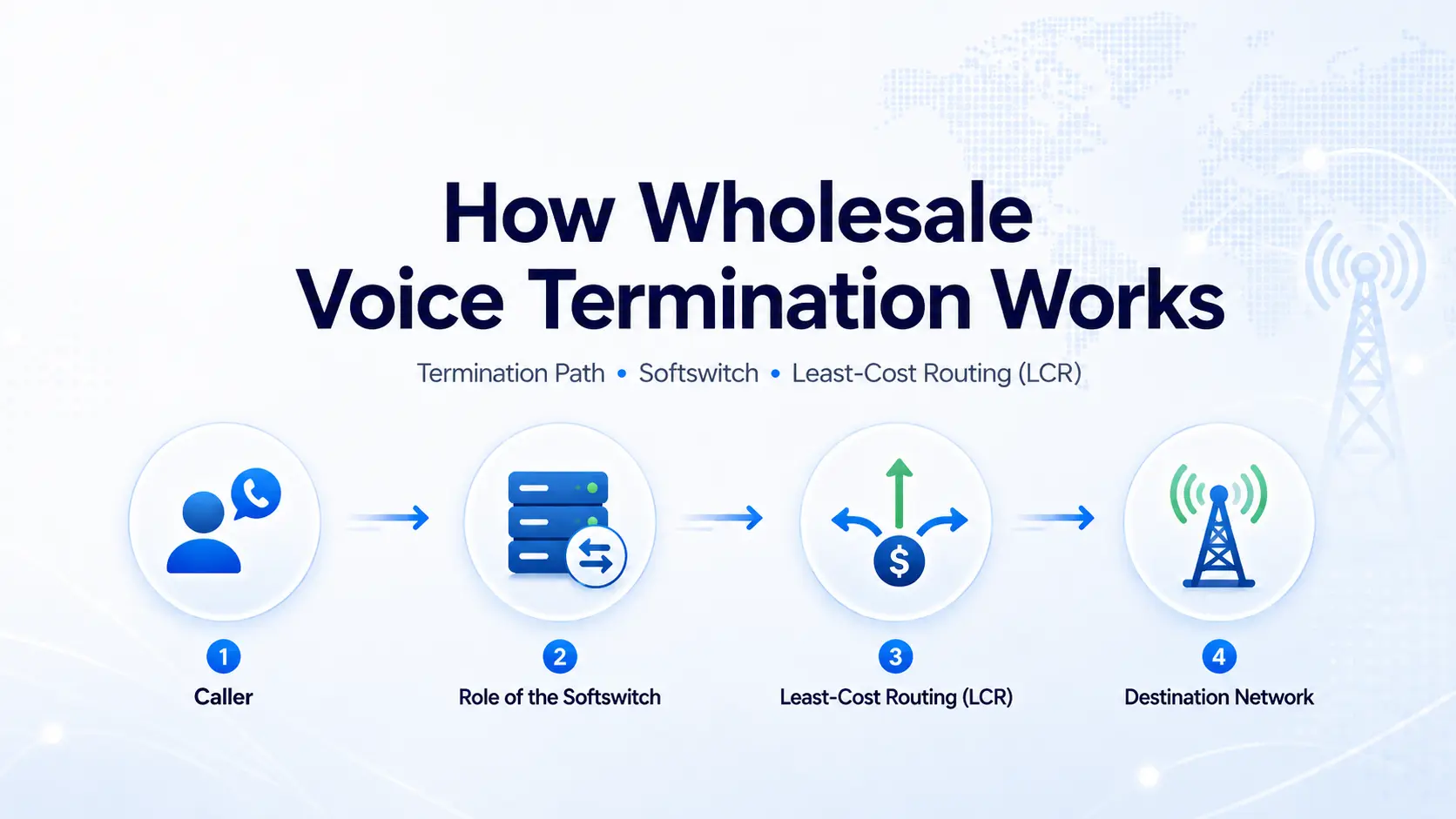
The originating system sends the call to the wholesale provider's switching infrastructure, which analyzes the destination number, selects the optimal path, and forwards the call to the appropriate downstream carrier. Direct interconnection routes the call in a single hop; otherwise it transits through intermediate carriers, each adding latency and quality variation.
The Role of the Softswitch
The softswitch manages call setup and teardown via SIP or SS7, applies routing logic, enforces fraud controls, and generates CDRs for billing. The sophistication of a provider's softswitch directly determines how reliably it routes termination traffic.
Least-Cost Routing (LCR)
LCR maps destination prefixes to available carrier routes and selects the cheapest route meeting the configured quality threshold. When that route degrades, the system falls back automatically. LCR requires active management; a stale routing table produces suboptimal decisions.
Types of Wholesale Voice Termination
CLI Routes preserve caller ID throughout the termination path — essential for outbound sales and customer service where caller recognition affects answer rates. They typically command a premium.
Non-CLI Routes don't guarantee CLI presentation. They suit use cases where caller ID is irrelevant — automated notifications or OTP delivery.
Premium Routes are direct-connect paths to destination carriers offering the best completion rates, audio quality, and low latency — appropriate for customer-facing operations.
Standard Routes involve more hops and variable quality — suited for internal communications or low-priority outbound traffic.
Grey Routes bypass local regulations and carrier agreements. Reputable providers don't use them; implausibly low pricing for a destination is a warning sign.
Call Quality Metrics: What to Measure and Why
Wholesale termination quality can't be evaluated on price alone. These four metrics provide an objective framework.
Answer-Seizure Ratio (ASR)
ASR is the percentage of call attempts that successfully connect. Quality routes deliver ASR above 45–55% for consumer destinations and higher for business destinations. Consistently low ASR signals poor route quality, incorrect number formats, or congestion.
Average Call Duration (ACD)
ACD measures the average length of completed calls. Acceptable ASR combined with unusually low ACD often indicates premature call drops — a sign of route instability rather than user behavior.
Network Effectiveness Ratio (NER)
NER measures call attempts that reach their intended destination — including voicemail, busy signals, and ring-no-answer — filtering out user behavior to isolate network performance. NER above 90% is typical for quality routes.
Post-Dial Delay (PDD)
PDD is the time between when a call is sent to the provider and when ringback is received. PDD above 5–6 seconds is perceived as the call "hanging" and reduces answer rates. High PDD typically indicates too many network hops or intermediate carrier congestion.
Benefits of Wholesale Voice Termination
Quality wholesale termination delivers more than low per-minute rates — it improves connection rates, protects caller ID, and gives businesses global reach to scale without compromise.
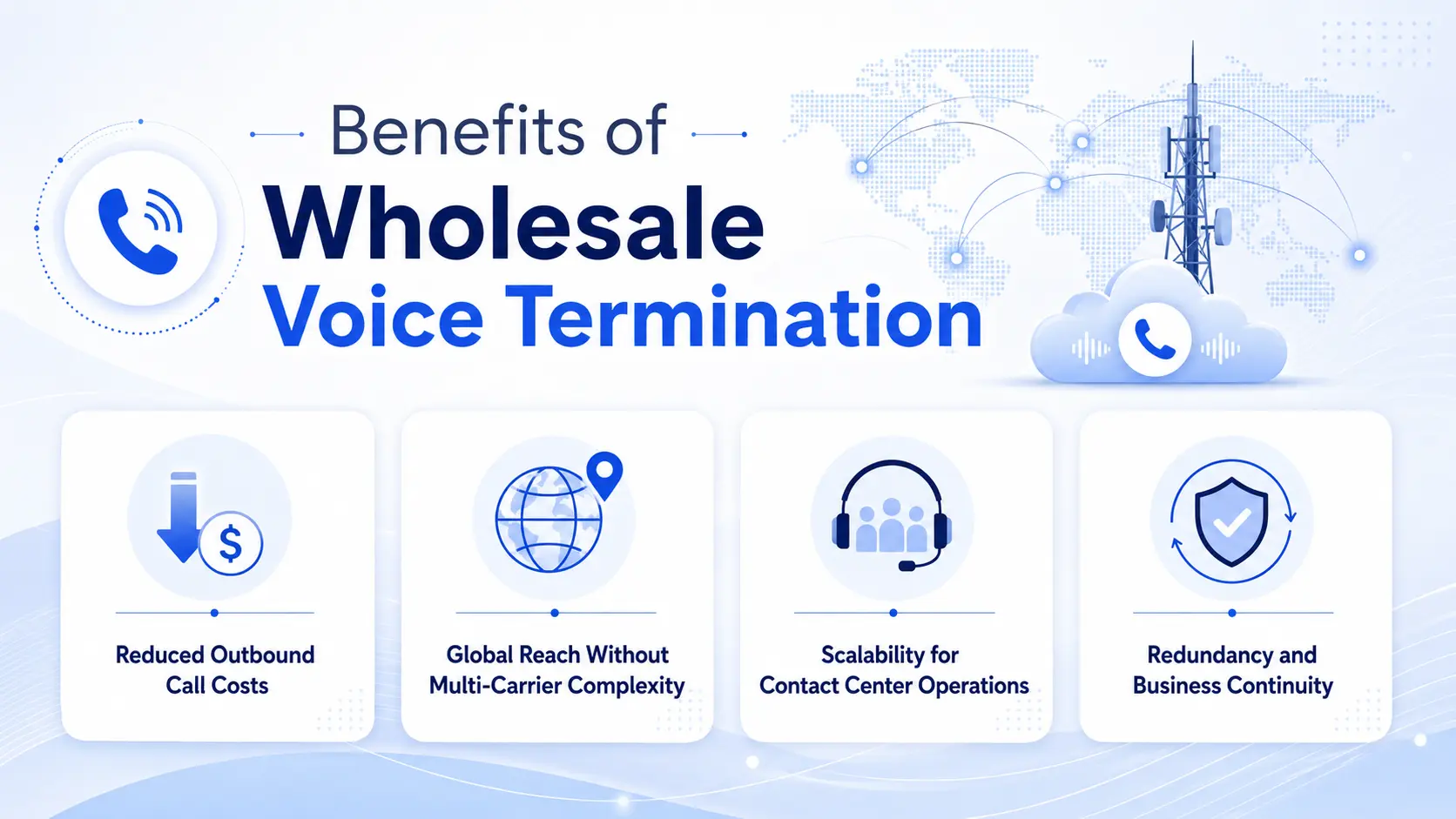
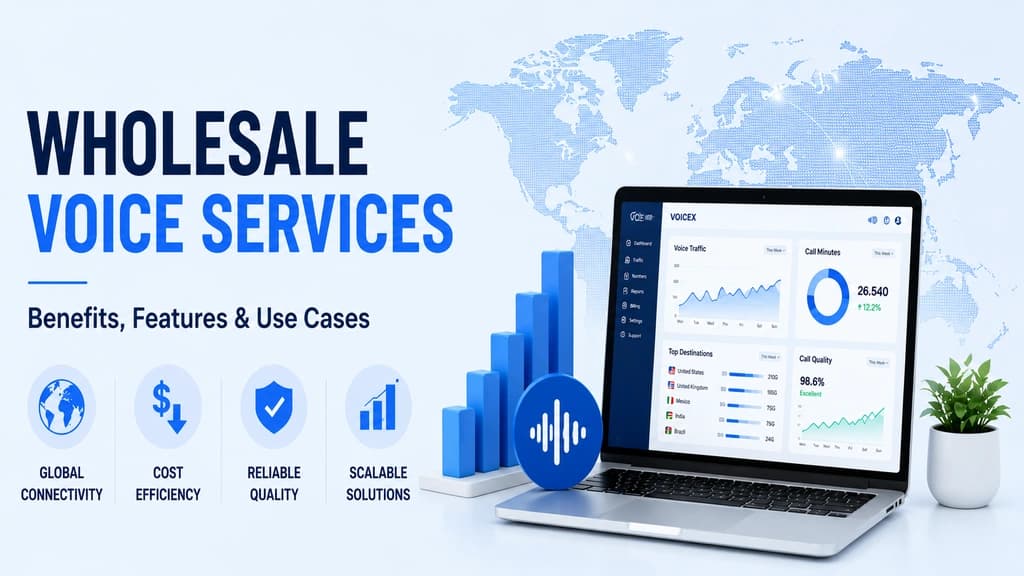
Wholesale termination rates are substantially lower than retail pricing at high volumes, and volume commitments amplify savings further. For the broader services landscape, our wholesale voice services overview breaks down the full picture. A single wholesale provider delivers competitive rates across 150+ countries — without the procurement burden of individual carrier agreements — backed by redundant routing that reroutes around failures, invisible to agents and customers.
Key Features to Evaluate in a Provider
Evaluate routing depth per top destination — not just country coverage. Require real-time CDR access for proactive quality and fraud monitoring. Test CLI delivery accuracy independently before committing volume. Confirm fraud detection covers real-time anomaly detection, per-prefix spend caps, and proactive blocking. Demand SLAs that specify minimum ASR and NER thresholds, maximum PDD, and clear breach remedies.
Wholesale Voice Termination Pricing Models
Understanding how termination is billed — not just what it costs — is key to accurately comparing providers and controlling your real cost per conversation.
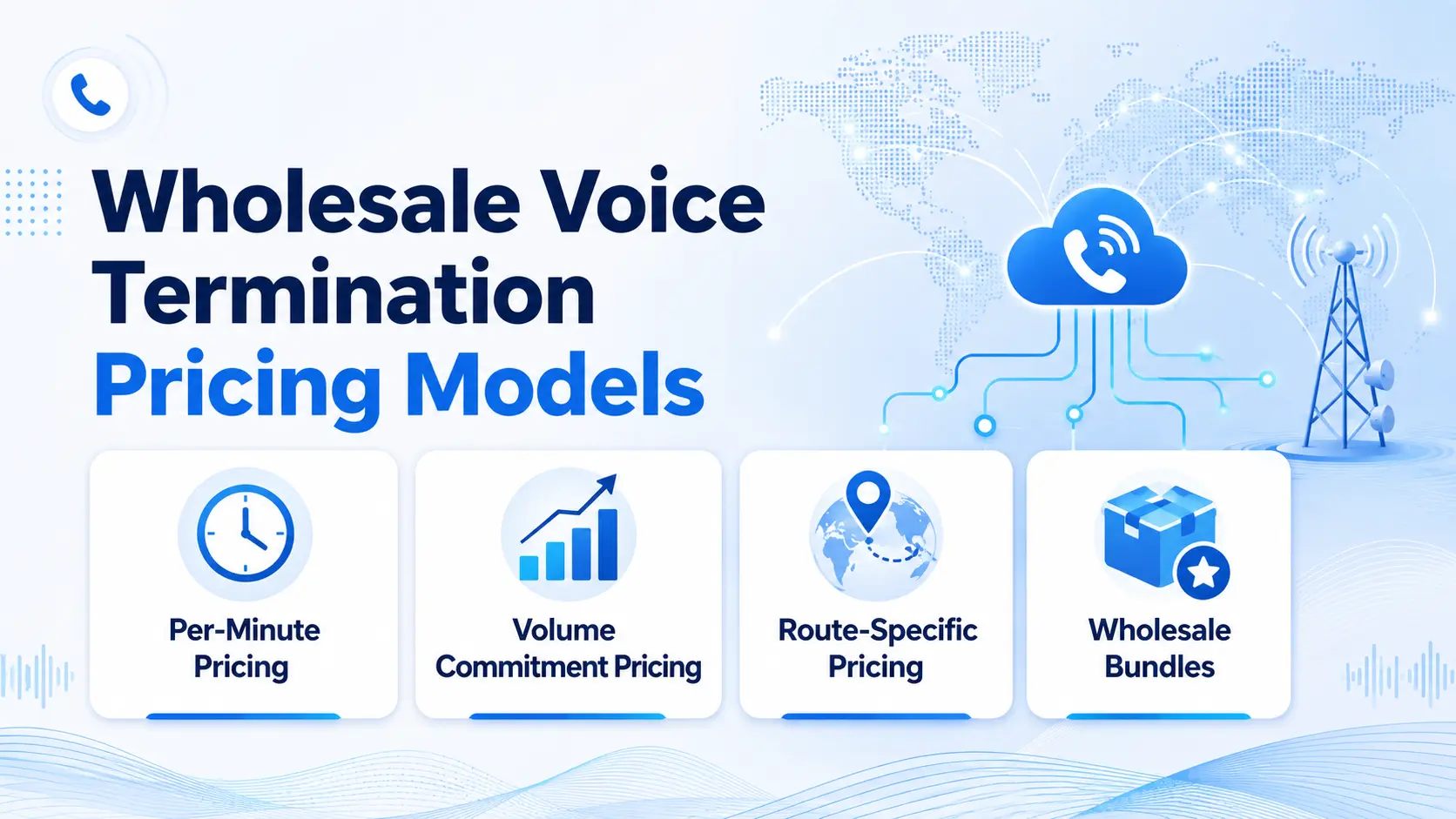
Per-Minute Pricing charges based on actual call duration per destination — suited for businesses with variable traffic patterns where commitment models would create unused capacity.
Volume Commitment Pricing offers reduced per-minute rates for a monthly minimum minute commitment. Meaningful discounts typically start at 500,000+ minutes per month and deliver the lowest per-minute costs for high-volume, predictable operations.
Route-Specific Pricing delivers competitive rates for your highest-traffic destinations — ideal for operations concentrated on a limited set of routes.
Wholesale Bundles package termination with SIP trunking, DID numbers, or contact center infrastructure — simplifying vendor management, though quality across all bundled components must be evaluated carefully.
Security: Termination Fraud and How to Prevent It
IRSF (International Revenue Share Fraud) — attackers gain unauthorized SIP access and generate large call volumes to premium-rate numbers they control, often over weekends when monitoring is reduced. Mitigation requires IP whitelisting, SIP authentication, per-destination spend caps, and real-time monitoring with automatic cutoff.
CLI Spoofing falsifies the caller ID presented to recipients. Businesses must ensure their provider supports STIR/SHAKEN attestation, which cryptographically verifies that a caller has the right to present the number displayed.
Wangiri Fraud generates high volumes of very short calls to prompt callbacks to premium-rate numbers. Real-time anomaly detection flagging spikes to specific destination ranges with near-zero ACD is the primary defense.
Choosing the Right Wholesale Voice Termination Provider
The evaluation process should be methodical rather than reactive to sales conversations.
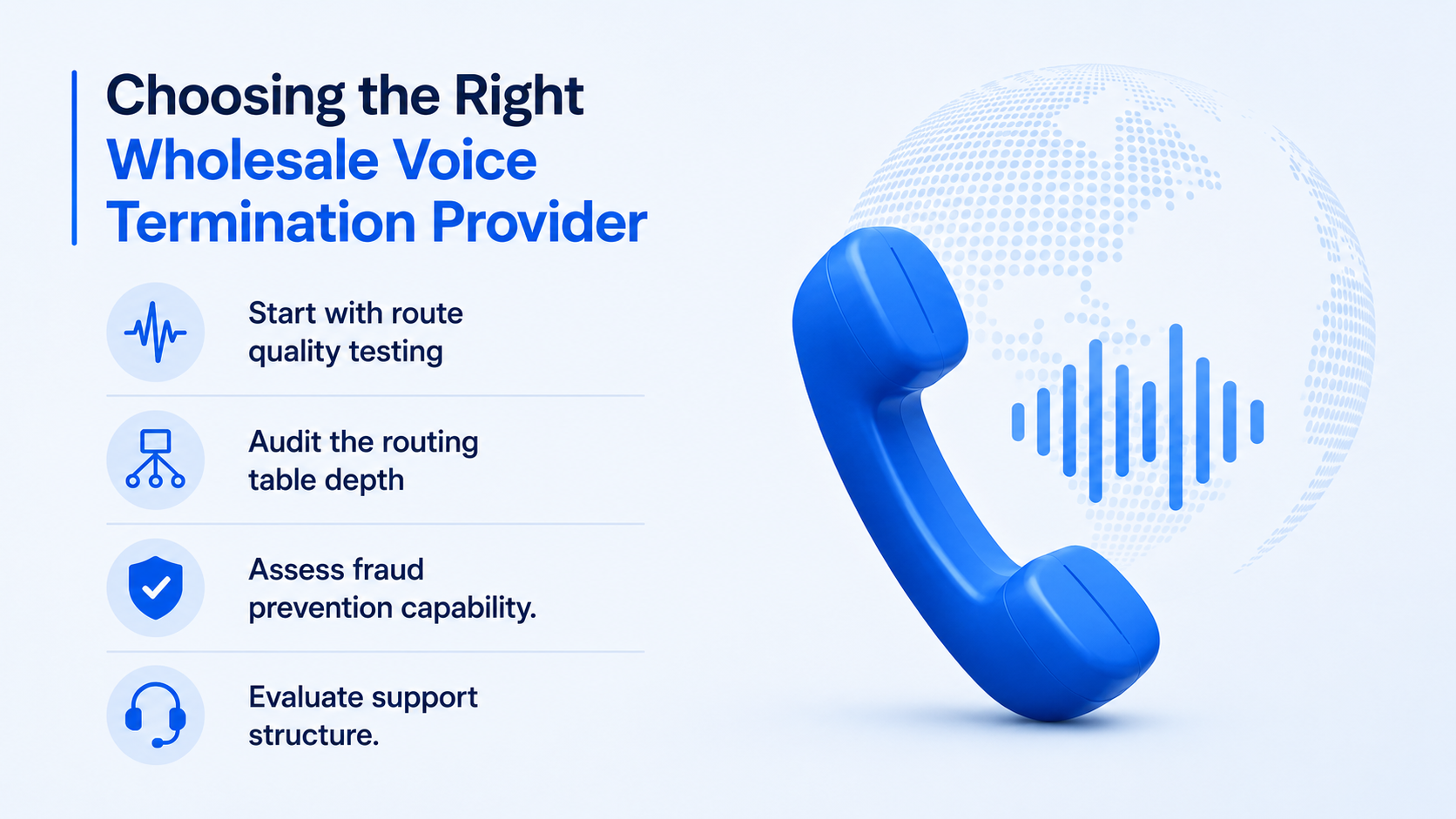
Request test access and independently measure ASR, NER, and PDD for your top destinations. Audit routing table depth — ask how many active routes exist per key destination and how frequently the table is updated. Review SLA terms for metric specificity and meaningful breach remedies. Confirm fraud prevention includes automated protections, not just reactive dispute processes. Evaluate support structure: 24/7 availability and defined escalation paths are essential when termination issues need fast resolution.
The FCC's VoIP overview is the authoritative regulatory reference for US-based organizations. Providers like Rozper combine competitive global rates, active fraud prevention, and human-first technical support for enterprises and growing businesses.
Future Trends in Wholesale Voice Termination
AI-Driven Route Optimization — ML models that continuously rebalance traffic based on real-time quality data — is moving from differentiator to table stakes, consistently outperforming static LCR tables.
STIR/SHAKEN Rollout is expanding beyond the US. Providers supporting full attestation standards protect customers from spam labeling and call blocking, directly improving outbound calling effectiveness.
5G Network Expansion will reduce latency on mobile termination routes, improving PDD and call quality — widening the gap between providers with and without direct mobile carrier relationships.
Regulatory Evolution around call authentication and robocall mitigation will reshape compliance requirements. Providers with proactive compliance frameworks will adapt more smoothly than those operating reactively.
Conclusion
Wholesale voice termination is the operational backbone of every high-volume outbound calling program. When it works well, calls connect reliably and cost per minute reflects the value of the traffic. When it works poorly, every problem surfaces: failed connections, degraded audio, fraud-inflated bills, and unanswered calls.
The difference lies in provider selection, quality monitoring, fraud prevention, and routing management. Businesses that invest in understanding their termination infrastructure — not just optimizing on price — consistently deliver better customer experiences and lower operational costs. Know your metrics, audit your routes, and monitor continuously.
FAQs
What is wholesale voice termination and why does it matter for businesses? Wholesale voice termination routes and completes outbound calls from a business's network to the recipient's network at scale. Termination quality and cost directly affect every outbound call — influencing completion rates, audio quality, per-minute costs, and fraud exposure. Organizations that manage it strategically reduce costs and improve customer outcomes.
What are ASR, NER, and PDD, and why should I track them? ASR measures the percentage of calls that successfully connect. NER isolates network performance from user behavior by measuring calls that reach their destination. PDD measures how long callers wait before hearing ringback. Tracking these metrics lets you objectively compare route quality and identify degradation before it significantly impacts operations.
What pricing model works best for high-volume outbound contact centers? Volume commitment pricing delivers the best economics for contact centers with predictable monthly outbound volumes. Committing to a monthly minute floor in exchange for reduced per-minute rates consistently outperforms spot pricing at scale. Accurate traffic forecasting is essential — over-committing creates stranded spend while under-committing leaves savings unrealized.