Introduction
Most businesses treat voice communication as a commodity — something to procure once and ignore. That assumption is expensive. Organizations that treat wholesale voice services as a strategic asset consistently communicate more reliably, serve customers better, and spend less doing it.
Wholesale voice services are the infrastructure layer that enables bulk voice communication across networks, geographies, and platforms. They power contact centers, global enterprises, telecom resellers, healthcare networks, and financial institutions — any organization that moves significant volumes of voice traffic and needs it to arrive reliably, affordably, and at quality.
Key Takeaways
- Core Function: Wholesale voice services enable bulk purchase and delivery of voice communication across carrier networks — the infrastructure behind every high-volume calling operation.
- Technology Foundation: VoIP, SIP trunking, softswitches, and media gateways are the key components; understanding each helps you evaluate provider capabilities accurately.
- Industry Versatility: Contact centers, healthcare, and financial services derive the most measurable operational value from wholesale voice.
- Provider Selection: Reliability, scalability, security, and support quality are the four pillars — price matters, but not in isolation.
- Competitive Advantage: Businesses that manage wholesale voice proactively consistently outperform those that treat it as a set-and-forget utility.
What Are Wholesale Voice Services?
Wholesale voice services refer to the bulk provisioning and delivery of voice communication capabilities — purchased by businesses, carriers, and resellers, then deployed or resold at scale. Unlike retail voice designed for individual consumers, wholesale voice operates on volume economics: higher quantities at lower per-unit costs, with far greater configurability.
The market encompasses four interconnected service types: voice termination (outbound call delivery to recipient networks), voice origination (inbound calls entering a business's network), SIP trunking (connecting PBX systems to the PSTN via IP), and transit services (routing calls between carrier networks). Together, these form the voice infrastructure backbone businesses rely on without ever seeing — until something goes wrong.
How Wholesale Voice Services Work
When an outbound call is initiated, the originating system transmits a SIP INVITE to the wholesale provider's network. The provider's softswitch authenticates the request, applies routing logic to determine the optimal path, and forwards the call through the selected carrier route. Media flows as RTP packets; at call end, SIP handles teardown and generates a call detail record for billing.
Three core technologies underpin this: VoIP converts analog voice signals into digital packets for IP transmission at dramatically lower costs than circuit-switched telephony. SIP manages call setup, modification, and teardown — the universal signaling language of modern voice infrastructure. Softswitches and media gateways execute routing logic and handle protocol translation, enabling seamless interconnection across disparate networks at scale.
Key Features of Wholesale Voice Services
The best wholesale voice platforms combine network depth, intelligent routing, and operational transparency.
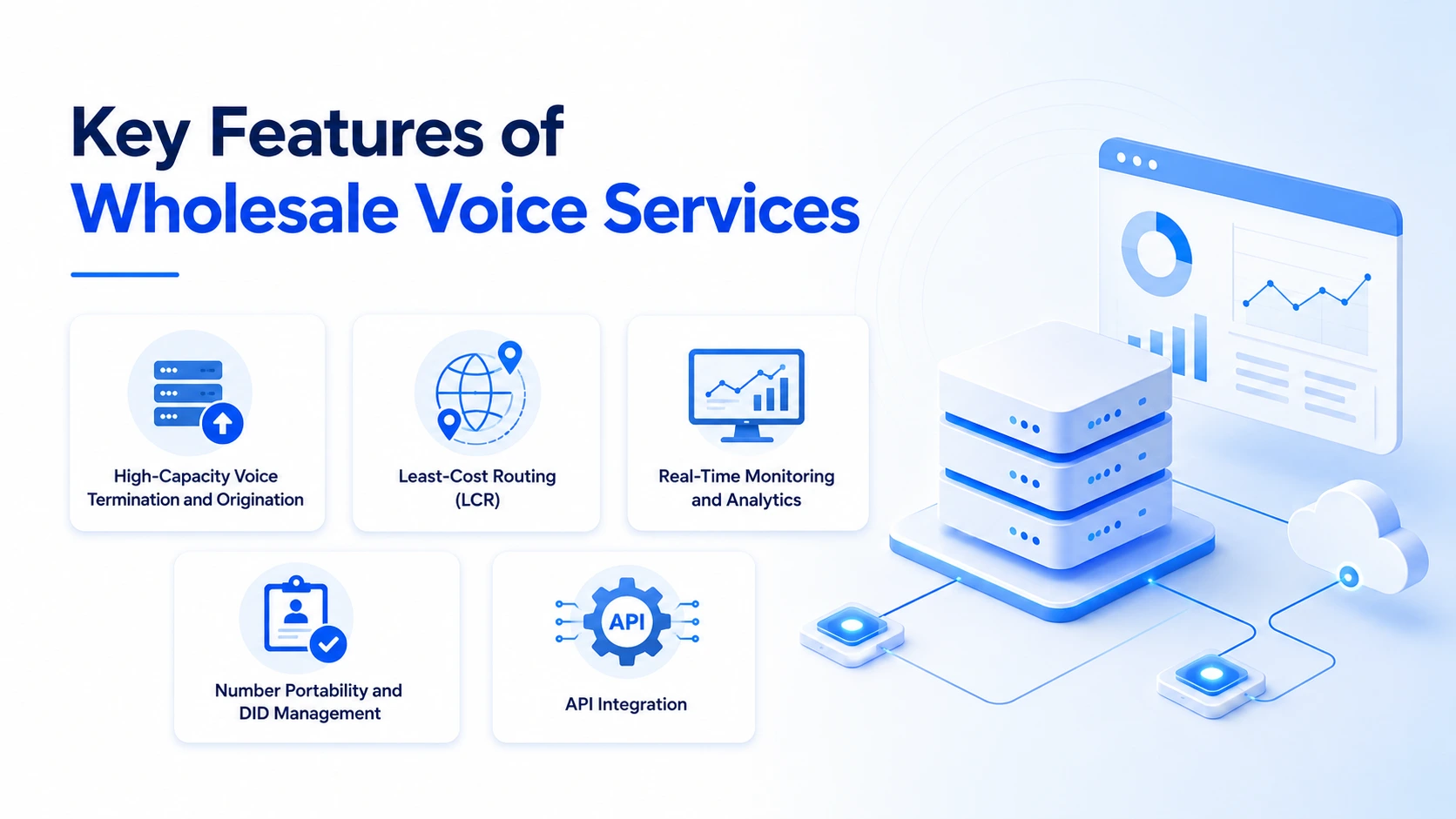
High-Capacity Termination and Origination: Enterprise-grade platforms handle thousands of simultaneous calls through redundant infrastructure and dynamic load balancing. For businesses routing high volumes to dense markets — such as those terminating calls across the 213 area code in Los Angeles — this capacity headroom is what separates reliable service from outage risk during peak demand.
Least-Cost Routing (LCR): Automatically selects the cheapest route meeting configured quality thresholds, with automatic failover when routes degrade. Routing tables must reflect current market rates and quality data to function effectively; providers that actively maintain these tables consistently outperform those operating as black boxes.
Real-Time Monitoring and Analytics: Live dashboards showing ASR, NER, PDD, and CDRs enable quality issues to be identified as they emerge rather than through customer complaints. Real-time CDR access — not just end-of-month billing summaries — should be a baseline requirement when evaluating providers.
Number Portability and API Integration: Provisioning DIDs across geographic markets, porting existing numbers, and managing number inventories programmatically via RESTful APIs lets businesses scale voice infrastructure as code rather than through manual portal interactions.
Benefits of Wholesale Voice Services
Wholesale voice services deliver advantages that go well beyond per-minute cost savings.
Substantial Cost Reduction: Bulk volume commands significantly lower per-minute costs than retail. Volume commitment pricing compounds savings further — providers consistently offer additional discounts to customers committing to monthly traffic minimums. Beyond per-minute rates, shifting to IP-based voice eliminates per-line hardware costs and physical circuit maintenance overhead entirely.
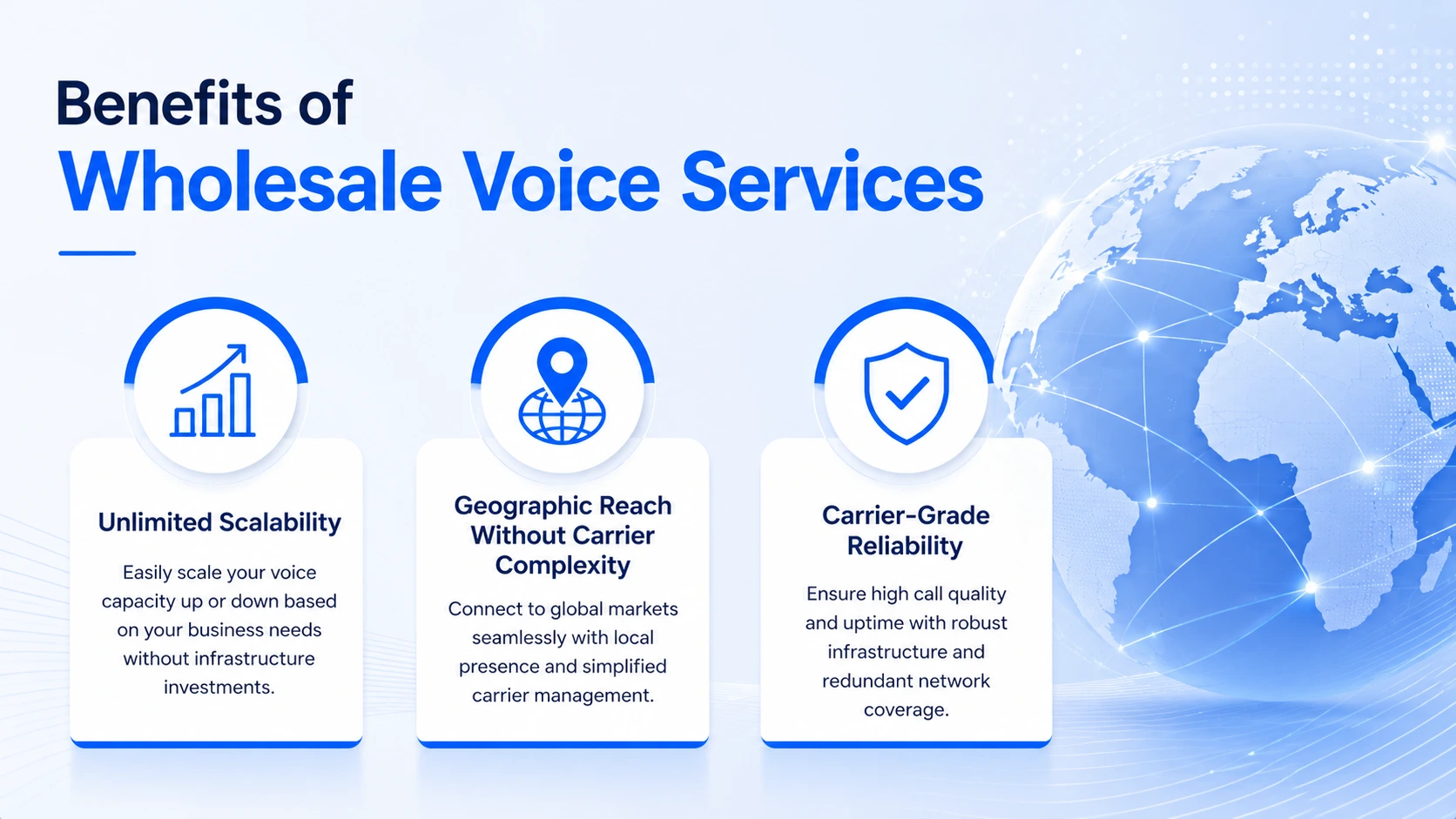
Unlimited Scalability: Adding capacity is a configuration change, not an infrastructure project. Contact centers scaling for a campaign or enterprises adding headcount can expand voice channels within hours. Downward scaling is equally frictionless — businesses pay for capacity used, not excess fixed infrastructure carried through slow periods.
Global Reach and Carrier-Grade Reliability: A single wholesale provider relationship delivers competitive routing across 150+ countries, consolidating what would otherwise require dozens of bilateral carrier agreements. Providers maintaining 99.999% uptime SLAs back that commitment with redundant network paths and automated failover — ensuring voice services remain available even through component failures.
Industry Use Cases: Where Wholesale Voice Services Create the Most Value
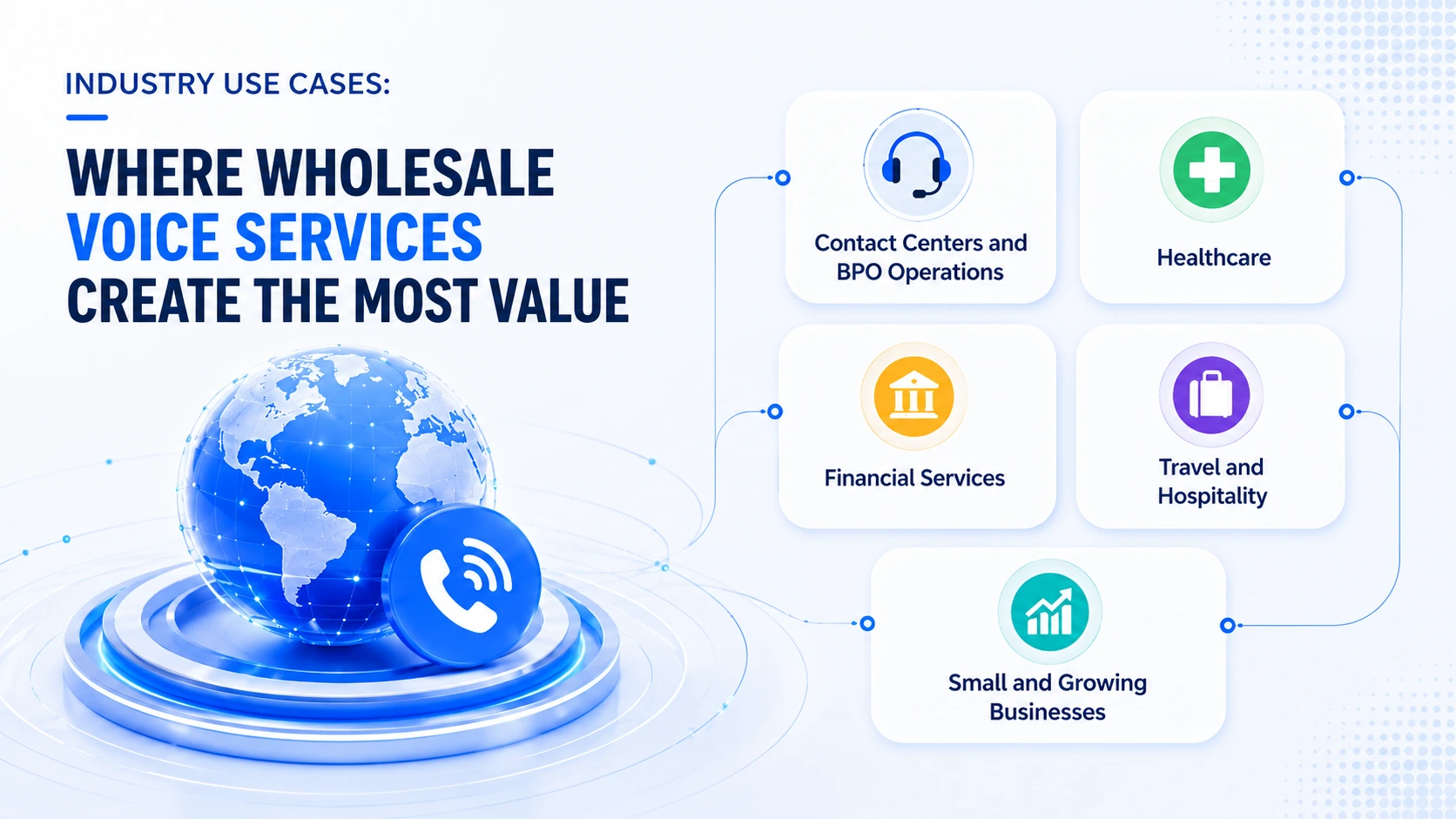
Contact Centers and BPO Operations: The highest-volume consumers of wholesale voice. Outbound operations depend on termination quality — ASR, NER, and CLI delivery rates determine how many calls connect and whether recipients trust the caller ID they see. BPOs serving multi-regional clients, including those handling high-volume outreach to markets like the 678 area code in metropolitan Atlanta, need deep international coverage and local number presentation to sustain answer rates.
Healthcare: Patient-facing communication — appointment reminders, care coordination, prescription notifications — must connect reliably and clearly. Healthcare organizations also operate under strict data protection regulations (HIPAA in the US) governing voice communication handling and storage. Providers that treat compliance as an afterthought create regulatory exposure far exceeding any per-minute savings.
Financial Services: High-volume outbound programs (collections, sales, advisory) combined with stringent security requirements make this a demanding segment. Encryption, strong SIP authentication, and proactive fraud prevention are non-negotiable. Small improvements in ASR on outbound programs translate to meaningful revenue differences at scale.
Choosing the Right Wholesale Voice Service Provider
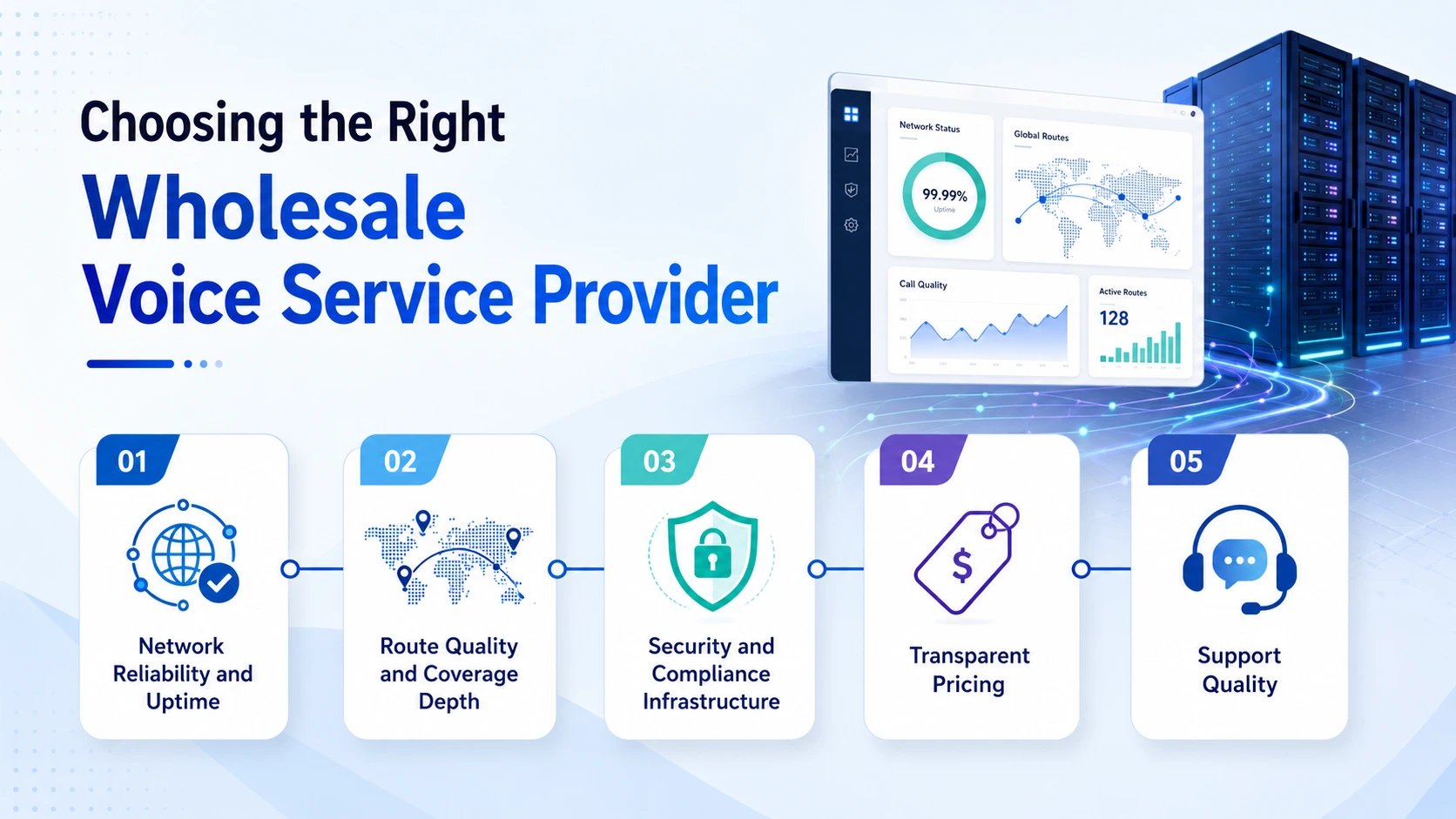
Network Reliability and Uptime: Ask for SLA documentation with measurement methodology behind uptime claims. A provider claiming 99.999% uptime should supply historical performance data — not just marketing language. Evaluate redundancy architecture: how many independent network paths exist for your key destinations, and how quickly does automatic failover trigger?
Route Quality and Coverage Depth: Coverage quantity and coverage quality are different things. Request test access and independently measure ASR, NER, and PDD for your specific destination mix before committing. Ask how many active routes exist per destination — depth determines routing resilience when individual routes degrade.
Security and Fraud Prevention: Evaluate toll fraud mitigation, encryption standards, and compliance with relevant regulations. For businesses in regulated industries, ask about compliance certifications and how the provider supports your compliance obligations. Reactive security — helping dispute fraudulent charges after the fact — is insufficient. For the regulatory framework governing voice services, the FCC's VoIP overview is the authoritative reference.
Transparent Pricing and Support Quality: Rate decks should be available on request with no hidden fees. Equally critical: technical issues in voice infrastructure require fast, qualified resolution. Evaluate escalation processes, response times by incident severity, and dedicated technical account management availability. The sales team will always describe support as excellent — ask for references from customers who have experienced incidents.
Conclusion
Wholesale voice services are not infrastructure to be procured once and forgotten — they are a strategic lever that, when managed well, reduces costs, improves customer experience, supports compliance, and enables geographic expansion. When managed poorly, they become a source of quality problems, fraud exposure, and budget waste.
The businesses that extract the most value share a common approach: they understand the technology, monitor quality proactively, negotiate on volume and value, and treat their wholesale voice provider as a business partner. Whatever your industry — contact center, healthcare, financial services, or growing enterprise — invest in understanding your voice infrastructure and manage the relationship actively.
FAQs
What are wholesale voice services and who are they designed for? Wholesale voice services involve the bulk provisioning and delivery of voice capabilities — termination, origination, SIP trunking, and transit — primarily for businesses, carriers, and resellers handling large volumes. They differ from retail voice in pricing structure (volume-based), flexibility (customizable routing), and technical depth (API access, real-time CDRs). Organizations making tens of thousands of calls monthly should evaluate wholesale options.
How do wholesale voice services differ from traditional phone lines? Traditional phone lines are circuit-switched physical infrastructure requiring installation and one-line expansion. Wholesale voice operates over IP networks via VoIP and SIP, provisioned in software. Capacity scales instantly, geographic constraints disappear, and per-minute costs are substantially lower. The trade-off: quality depends on IP network performance, requiring adequate bandwidth and QoS configuration to prioritize voice traffic.
What industries benefit most from wholesale voice services? Contact centers and BPO operations, healthcare, and financial services are where wholesale voice delivers the most measurable value. Contact centers depend on termination quality for completion rates. Healthcare requires reliable communication with strict compliance requirements. Financial services combines high-volume outbound programs with stringent security obligations. Any business handling significant voice volumes benefits from the cost and quality advantages of wholesale.
What should a wholesale voice services SLA actually specify? A meaningful SLA defines minimum ASR and NER thresholds by route category, maximum PDD, uptime percentage with clear measurement methodology, support response times by incident severity, and specific remedies when commitments aren't met. Vague language like "best efforts" without defined metrics and remedies provides no real contractual protection.