Introduction
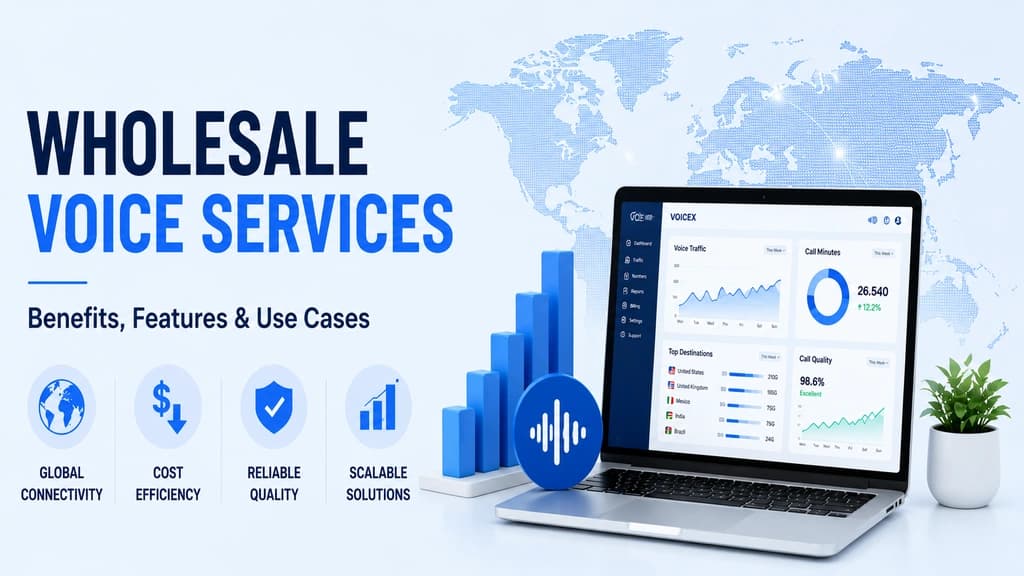
Wholesale VoIP decisions should start with business outcomes, not technology. What does your business need voice infrastructure to accomplish — cut per-minute costs by 50%, build a reseller product at 60% margins, or scale a contact center from 50 to 500 agents? The answer determines which wholesale VoIP service and provider actually fits. The global wholesale voice market reached $44.5 billion in 2026. This guide covers what wholesale VoIP is, how it works, key benefits, essential features, and how to choose the right provider.
Key Takeaways
- Wholesale VoIP is the bulk purchase of Voice over Internet Protocol services on a B2B basis, delivering voice communication over IP networks at volume pricing unavailable in retail.
- It serves four primary business types: enterprises reducing communication costs, resellers building products, contact centers scaling operations, and developers building voice into software.
- The economics are significant: businesses switching to wholesale VoIP typically reduce voice costs by 30–60%, with resellers accessing margins of 50–70% on white-label arrangements.
- Provider selection should be driven by business model alignment, compliance requirements, and service quality — not per-minute rate alone.
What Is Wholesale VoIP?
Wholesale VoIP (Voice over Internet Protocol) is a telecommunications model in which voice services are purchased in bulk from a carrier or platform provider on a business-to-business basis, then used internally or resold to end customers. Rather than acquiring individual phone lines at retail pricing, wholesale buyers access bulk capacity — paying volume-based rates for voice termination, origination, SIP trunking, and associated services.
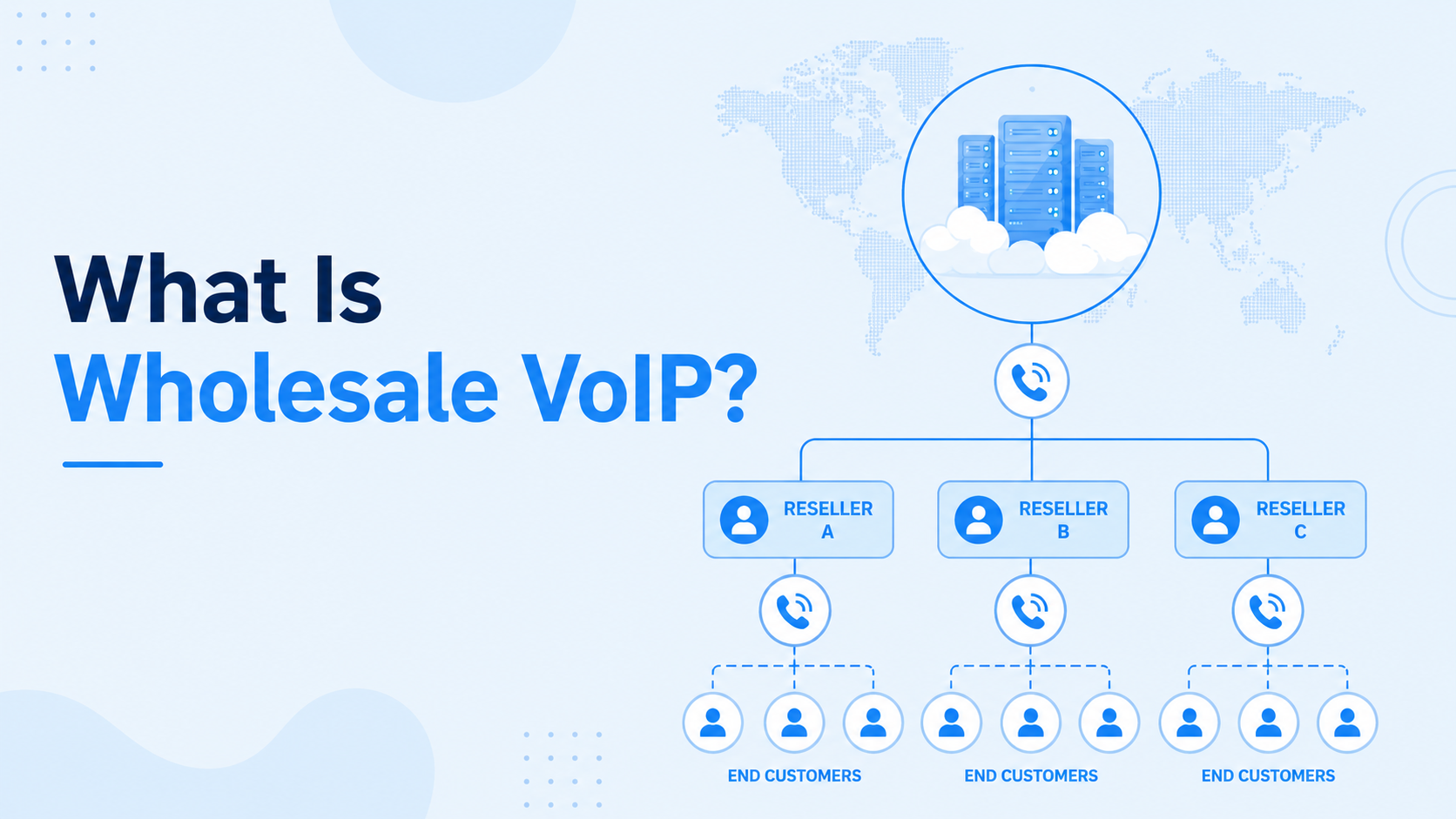
The "wholesale" distinction matters. Retail VoIP products are standardized plans with fixed pricing and limited customization. Wholesale VoIP is designed for organizations that need volume, control, API access, and commercial terms structured for high usage or resale. Buyers include enterprises managing thousands of concurrent calls, resellers building communication products, and contact centers running outbound campaigns at scale. Businesses serving dense metro markets — such as those using a 917 area code for New York City presence — rely on wholesale infrastructure to handle high local call volumes cost-effectively.
Wholesale VoIP vs. Retail VoIP
Wholesale accounts have negotiated pricing that scales with volume, carrier-grade infrastructure via API, and configurable routing and quality parameters. Retail accounts get a portal, a rate card, and a support ticket queue — the commercial relationship is fundamentally different.
How Wholesale VoIP Works
Wholesale VoIP converts voice signals into digital data packets transmitted over IP networks. When a call is placed, voice is compressed using a codec (G.711, G.722, G.729, or Opus), transmitted across the IP network, and reassembled at the receiving end — all in real time with latency measured in milliseconds on quality routes.
SIP Protocol and Session Management
Most wholesale VoIP infrastructure uses the Session Initiation Protocol (SIP) to manage call signaling. SIP trunks connect a business's PBX or UCaaS platform to the wholesale provider's network. Session Border Controllers (SBCs) handle protocol normalization, security, and NAT traversal, ensuring compatibility across diverse PBX platforms.
Termination, Origination, and Hosted PBX
Voice termination routes outbound calls through the wholesale carrier network to any endpoint — VoIP, mobile, or PSTN. Voice origination delivers inbound calls via Direct Inward Dialing (DID) numbers. Many providers also offer hosted PBX — cloud-based phone systems with auto-attendant, call routing, voicemail, and call recording — eliminating on-premises hardware entirely.
Key Benefits of Wholesale VoIP
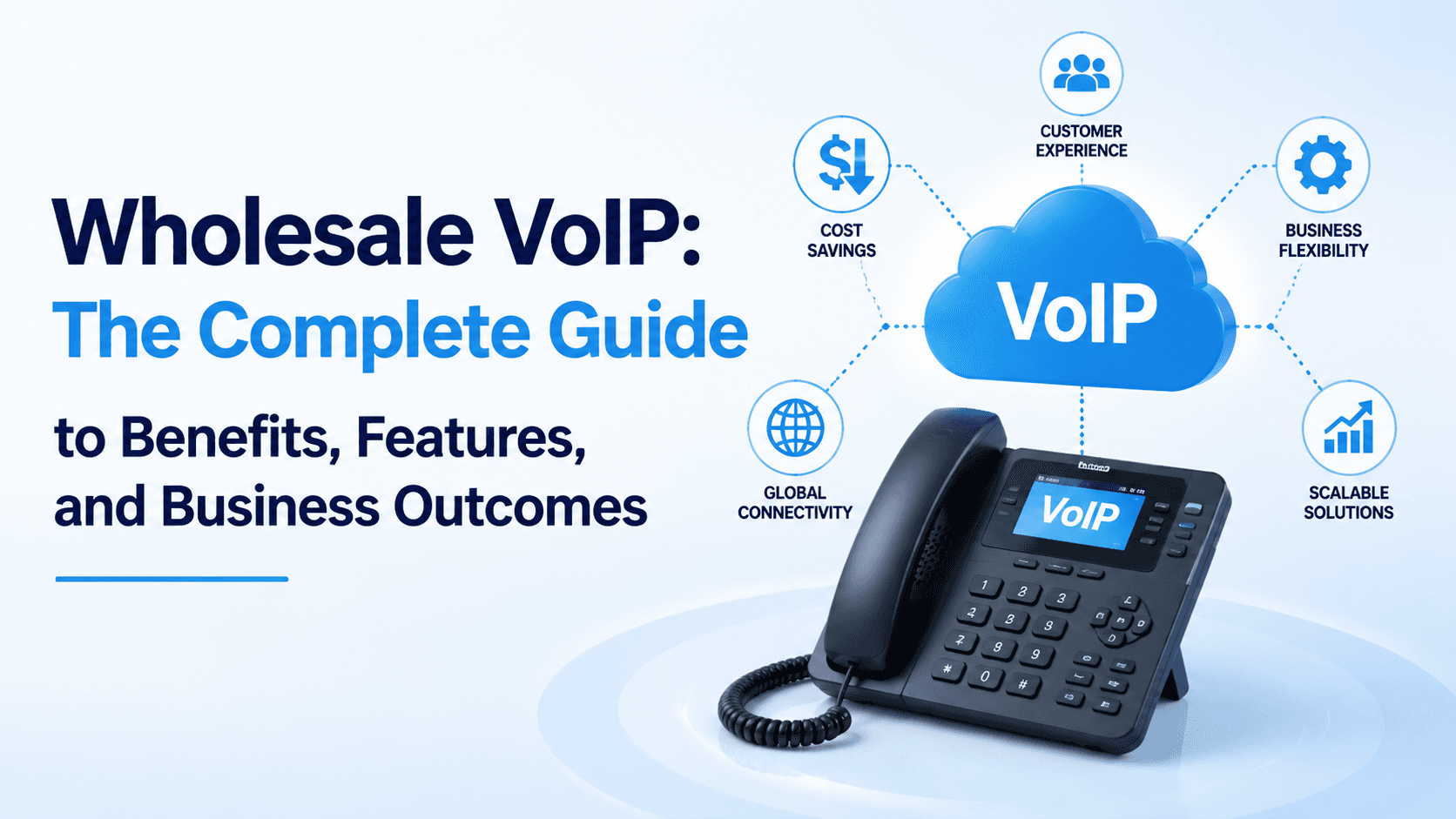
Wholesale VoIP delivers tangible advantages across cost, quality, scalability, and global reach — making it the infrastructure backbone for any business serious about voice.
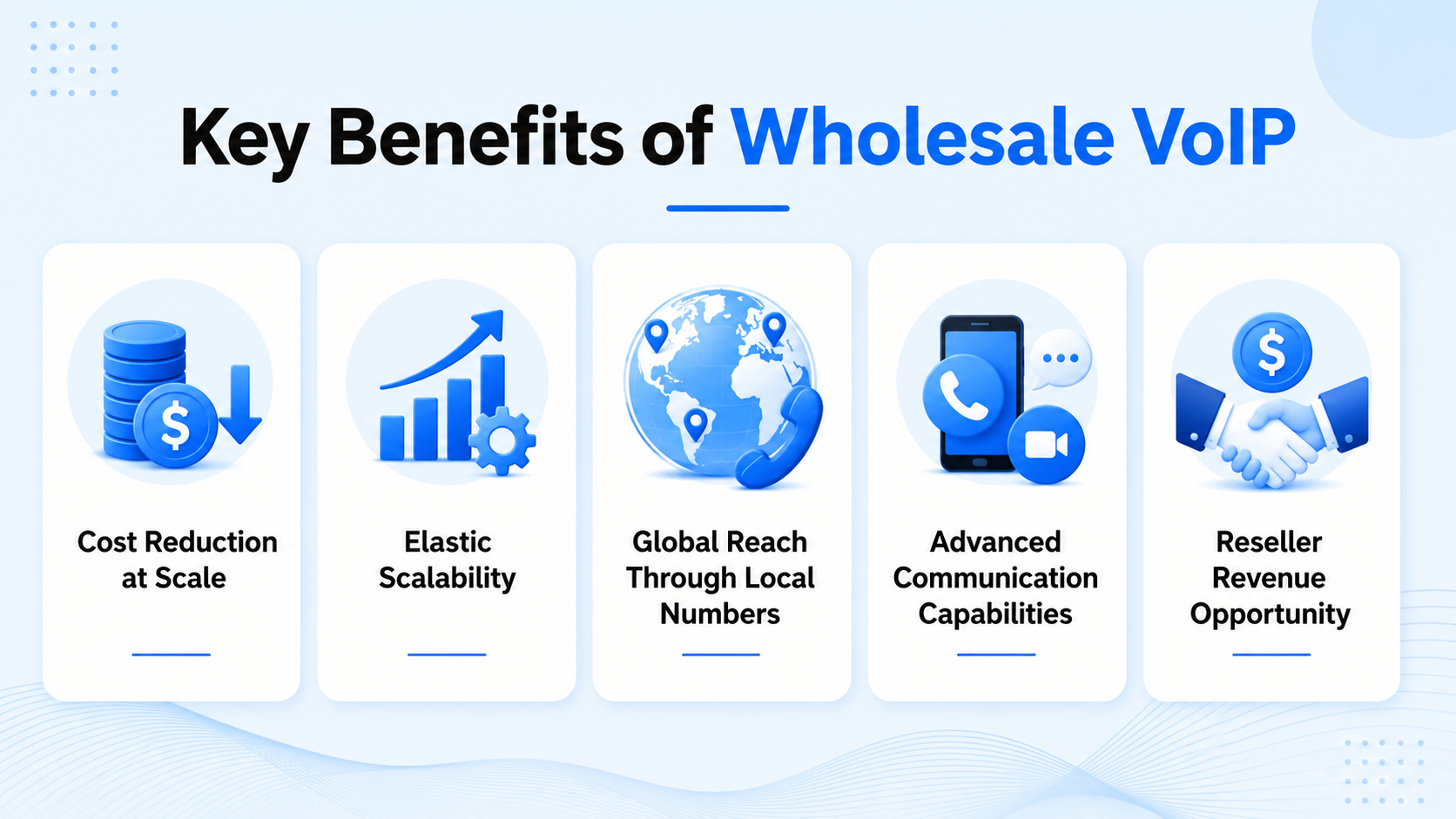
Cost Reduction at Scale
Wholesale VoIP eliminates per-line charges, infrastructure maintenance, and premium international rates. Businesses typically reduce voice costs by 30–60% migrating from legacy systems. International calls show the largest savings, sometimes exceeding 70% on specific routes.
- Reduced per-minute costs for both domestic and international traffic
- No dedicated circuit infrastructure or hardware maintenance
- Volume-based pricing that improves as call volumes grow
Elastic Scalability
Adding voice capacity requires no hardware, no installation, and no lead time. SIP channels and DID numbers are provisioned digitally in minutes through a portal or API — supporting contact center growth, multi-site expansion, and seasonal demand spikes without infrastructure delays.
Global Reach and Reseller Margins
DID origination across 150+ countries lets businesses present local numbers in any market they serve — boosting answer rates without physical offices. For resellers, white-label wholesale arrangements deliver margins of 50–70%, substantially higher than traditional agent commissions.
Essential Features of Wholesale VoIP Services
Voice Termination with Route Quality Tiers
A-Z international voice termination with multiple route types — CLI, Non-CLI, and CC routes — serves different traffic profiles. CLI routes transmit accurate caller ID and are essential for outbound sales. Non-CLI routes suit high-volume lower-priority traffic. CC routes serve high-CPS contact center operations.
DID Origination and Number Management
Inbound call capability through virtual phone numbers spanning local, mobile, and toll-free types across global markets. Businesses covering West Coast markets — such as those using an 818 area code for Los Angeles — benefit from seamless DID provisioning that maintains regional identity at scale. Number porting support enables smooth migration without service disruption.
SIP Trunking, API Access, and Security
SIP trunking connects existing PBX and UCaaS platforms to the provider's carrier network with elastic channel capacity. TLS/SRTP encryption secures both signaling and media. RESTful APIs for number provisioning, routing, CDR retrieval, and analytics enable programmatic control. Real-time monitoring for toll fraud and IRSF — with geo-restriction controls — protects businesses from financial exposure, while call recording supports compliance and quality assurance.
Wholesale VoIP by Business Type
Enterprises use wholesale VoIP to replace expensive PSTN circuits, typically achieving 30–60% reductions in monthly voice spend. Contact centers gain carrier-grade termination with high ASR and the CPS capacity to handle burst traffic. Resellers and MSPs build white-label communication products with 50–70% gross margins, while software companies integrate programmable voice APIs to deploy voice features as fast as any other software capability.
Wholesale VoIP vs. Traditional Phone Systems
Side by side, the gap between wholesale VoIP and legacy phone infrastructure is clear — in cost, flexibility, and what each can support at scale.
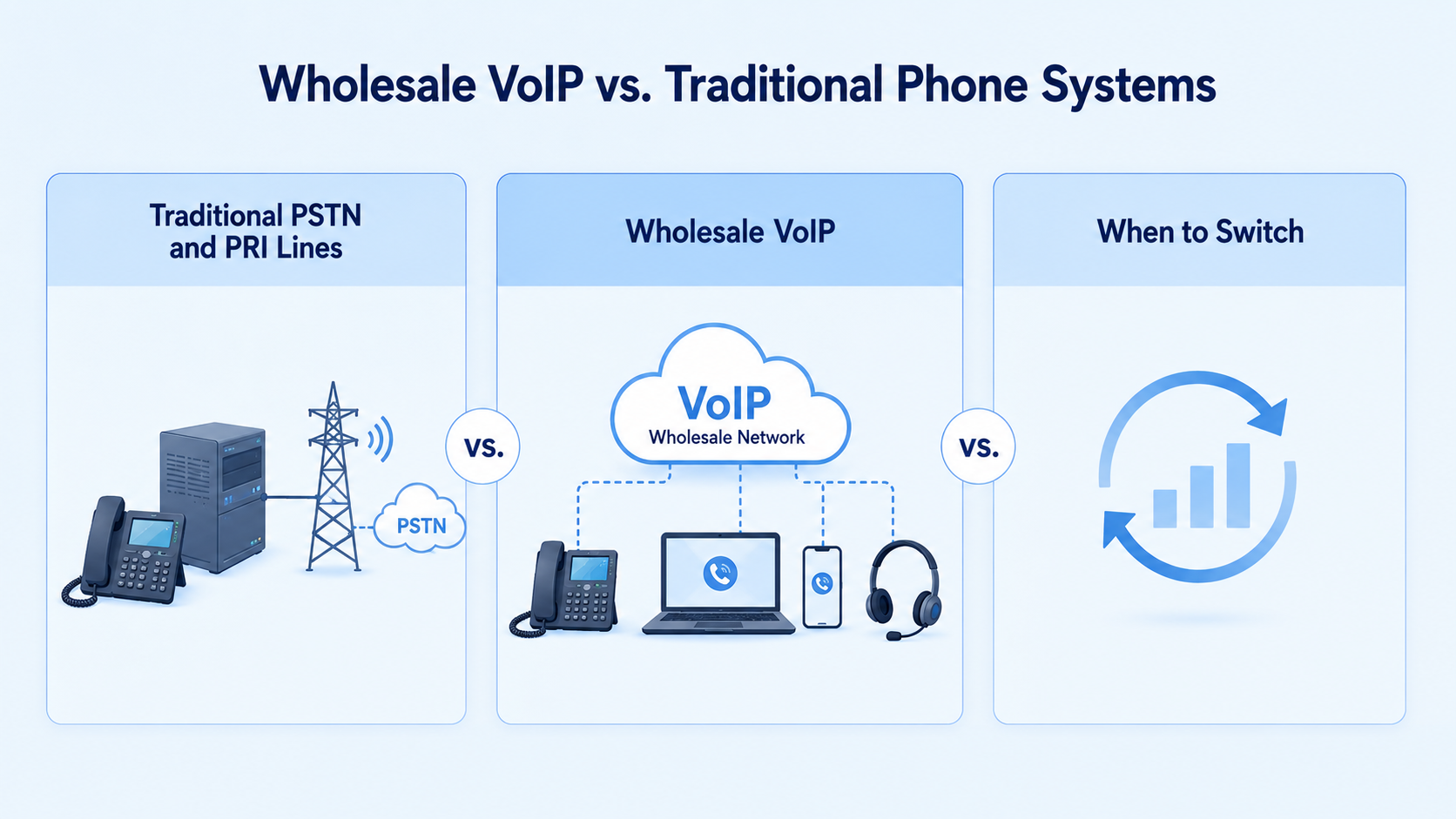
Traditional PSTN and PRI Lines
Traditional telephony uses circuit-switched technology and physical lines. Adding capacity requires physical installation. International calls carry premium per-minute rates. Routing is static, there is no API, and the infrastructure is capital-intensive and increasingly expensive as TDM networks approach end-of-life.
Wholesale VoIP
Wholesale VoIP runs over IP networks with elastic capacity, dynamic routing, and API management. International rates are a fraction of PSTN equivalent. Scaling is instantaneous. Features are software-configured rather than hardware-dependent, and total cost of ownership is consistently lower at any significant call volume.
When to Switch
At a few thousand outbound minutes per month, wholesale VoIP economics consistently outperform traditional alternatives. The migration — number porting, SIP configuration, testing — is a one-time project. The savings are permanent.
Common Wholesale VoIP Challenges
Call quality depends on network conditions — choosing a provider with direct Tier-1 carrier interconnects and real-time quality monitoring addresses the most common degradation issues. For security, TLS/SRTP encryption, SBC-level access controls, and real-time fraud monitoring are the standard defensive stack — confirm these are included, not priced as add-ons. In the US market, STIR/SHAKEN, E911 compliance, and FCC registration requirements apply; verify compliance documentation before deployment.
Choosing the Right Wholesale VoIP Provider
Your wholesale VoIP provider is a long-term infrastructure decision — these criteria help you move past marketing claims and evaluate what matters in production.
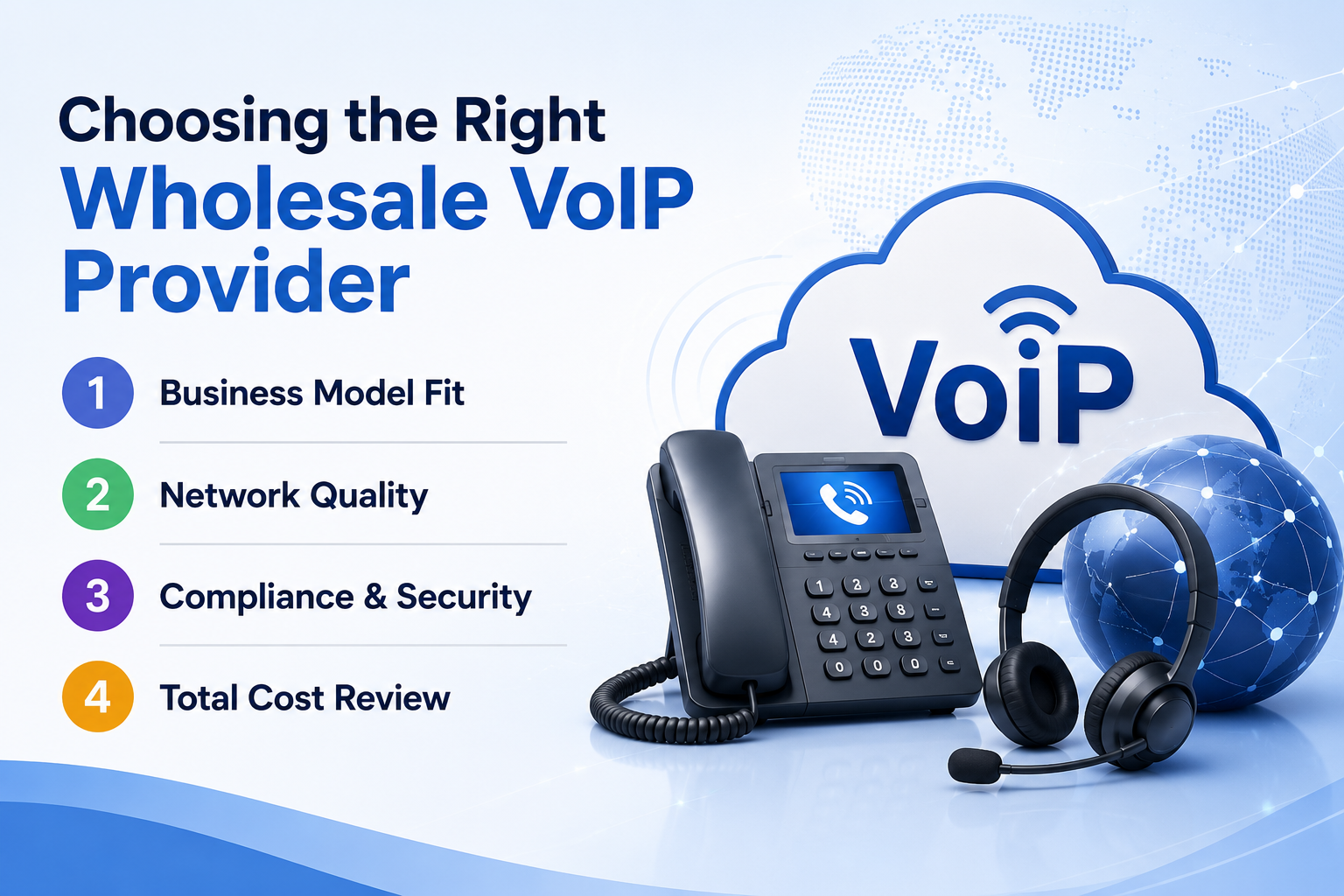
Match the Provider to Your Business Model
Enterprises and carriers need deep carrier interconnects and volume pricing. Resellers need white-label capability, partner portals, and billing tools. Developers need comprehensive APIs and SDKs. Not every provider excels at all three — choosing a provider built for a different buyer profile wastes both money and operational effort. The FCC's VoIP overview outlines the regulatory framework all US-market providers must operate within, which is a useful baseline for evaluating compliance claims.
Evaluate Quality and Compliance Directly
Run a real-traffic proof-of-concept before committing — test call quality across priority geographies, validate API functionality, and test support responsiveness. Request STIR/SHAKEN attestation, E911 compliance confirmation, and FCC registration details. Verify TLS signaling and SRTP encryption are standard, not add-ons. On cost, request full fee disclosure including E911 fees, porting charges, and minimum commitment terms — headline per-minute rates rarely capture total ownership cost.
Conclusion
Wholesale VoIP powers cost-efficient, scalable voice communication for enterprises, resellers, contact centers, and developers. The provider you choose directly shapes call quality, operational costs, compliance posture, and — for resellers — margin potential. Businesses that extract the most value approach the decision from a business outcomes perspective: identifying what they need voice infrastructure to accomplish, selecting the provider archetype that matches their model, and holding that provider to quality, compliance, and commercial commitments rather than selecting on rate alone.
FAQs
What is the minimum call volume that makes wholesale VoIP worthwhile? The economics become compelling at roughly 5,000–10,000 minutes of outbound calling per month. Contact centers and enterprises with higher volumes see proportionally larger benefits; resellers can justify wholesale at lower personal volumes since they price for downstream customers.
How long does it take to migrate from traditional phone lines to wholesale VoIP? A SIP trunking integration with an existing IP-capable PBX can be completed in one to three business days. Full migrations — number porting, PBX replacement, multi-site configuration — typically take two to six weeks. Domestic porting takes three to ten business days; international porting can take longer.
Does wholesale VoIP work with my existing PBX system? Most wholesale VoIP services are SIP-based and compatible with Asterisk, FreePBX, 3CX, Cisco CUCM, and hosted UCaaS systems. Some older systems require a SIP-to-PRI gateway. Ask for your specific PBX on the provider's supported list and request configuration documentation before deploying.