Introduction
More than 500,000 people go to work in Downtown Los Angeles every day, filling the towers of Bunker Hill, the studios along Sunset, the civic center courts, and the Arts District warehouses — nearly all reachable through a 213, 323, or 738 number. The 213 area code is the original California area code, the one that preceded every other in the state and still carries the address of the West Coast's most iconic city.
This guide covers 213's geographic coverage, the split that created the 323 area code, the 2017 recombination into a shared overlay, the 738 addition in 2024, mandatory 10-digit dialing, common scam patterns, and how to get a local LA business number.
What Is the 213 Area Code?
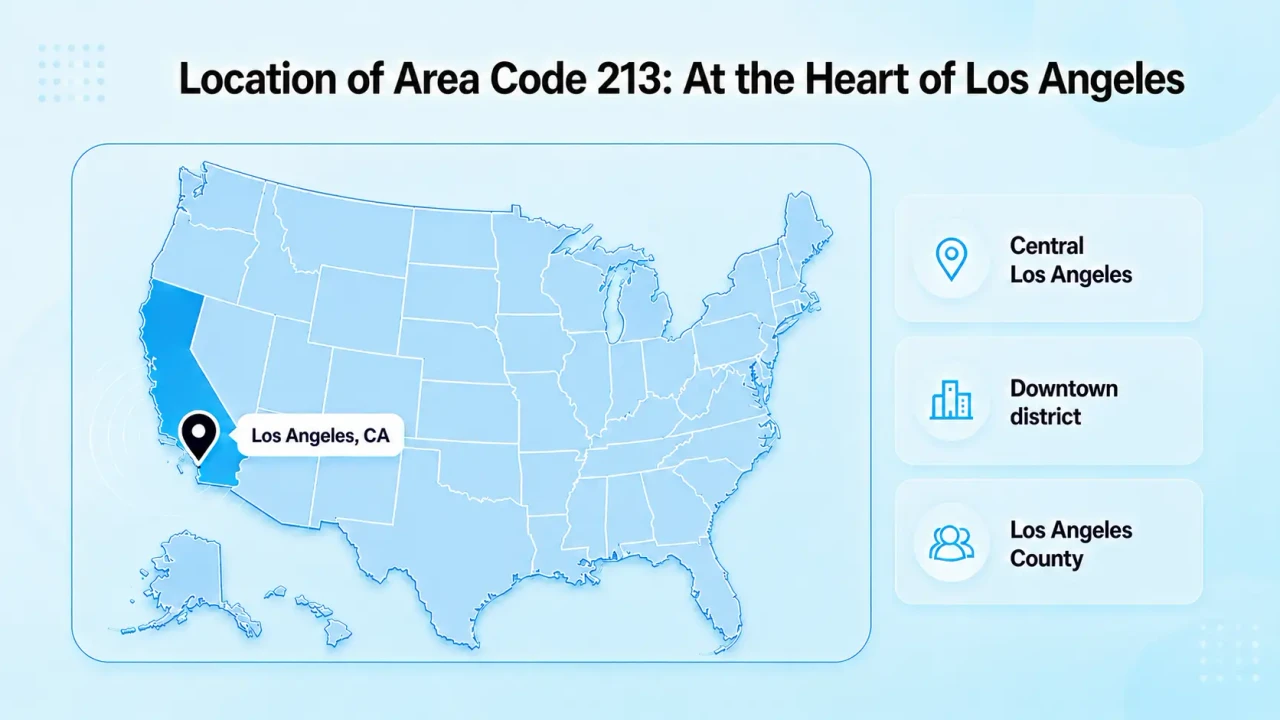
The 213 area code is one of the most historically significant telephone codes in North America. When the NANP launched in 1947, 213 covered the entire state of California — every city from San Diego to San Francisco operated under a single code. As California's population exploded, the state was subdivided repeatedly, leaving 213 as the inherited code of Los Angeles's core downtown district and its immediate neighborhoods.
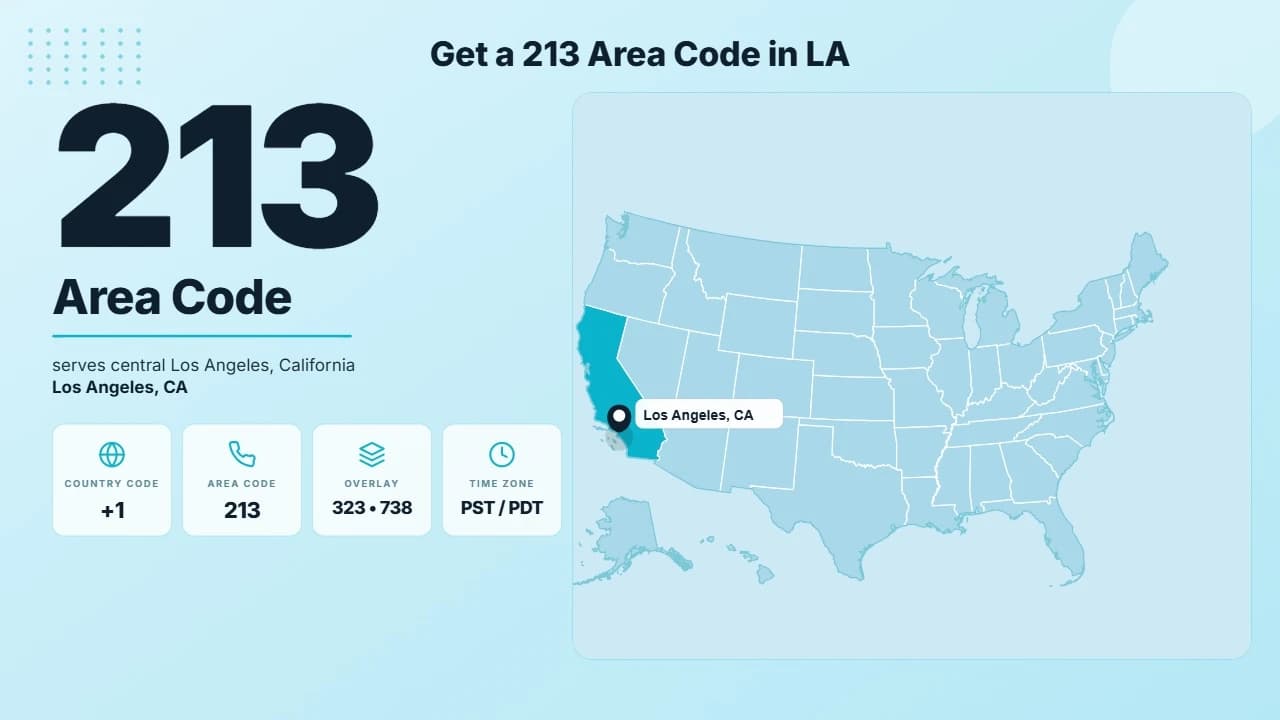
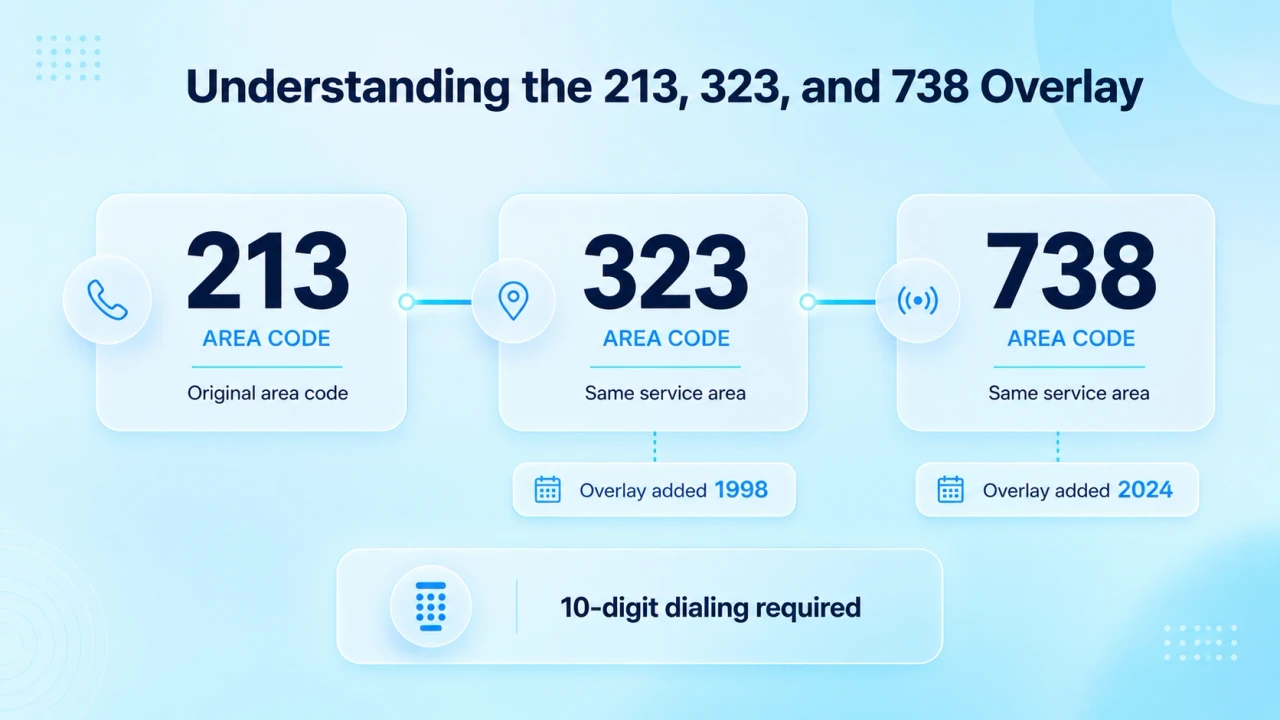
Today, 213 operates as part of a three-code overlay with 323 and 738, all serving the same geographic territory in and around central Los Angeles.
Quick Facts:
| Detail | Info |
|---|---|
| Area Code | 213 |
| Overlay Codes | 323 (1998 → recombined 2017), 738 (launched November 1, 2024) |
| State | California |
| Region | Downtown LA, Central LA, Hollywood, Koreatown, SE LA County |
| Time Zone | Pacific Time (PT) — UTC−8/UTC−7 |
| Dialing | 10-digit mandatory (since July 8, 2017) |
| Established | 1947 (original statewide CA code) |
| Regulatory Body | CPUC (California Public Utilities Commission) |
| Adjacent Codes | 310, 424 (Westside/South Bay), 818 (San Fernando Valley), 626 area code (San Gabriel Valley) |
Area code 213 covers the core of the City of Los Angeles, anchored by Downtown, and extends into several of the city's most distinctive neighborhoods and a number of independent cities in Southeast Los Angeles County. Because 213, 323, and 738 are all overlays for the same territory, any reference to this zone applies equally to all three codes.
Where Does the 213 Code Cover?
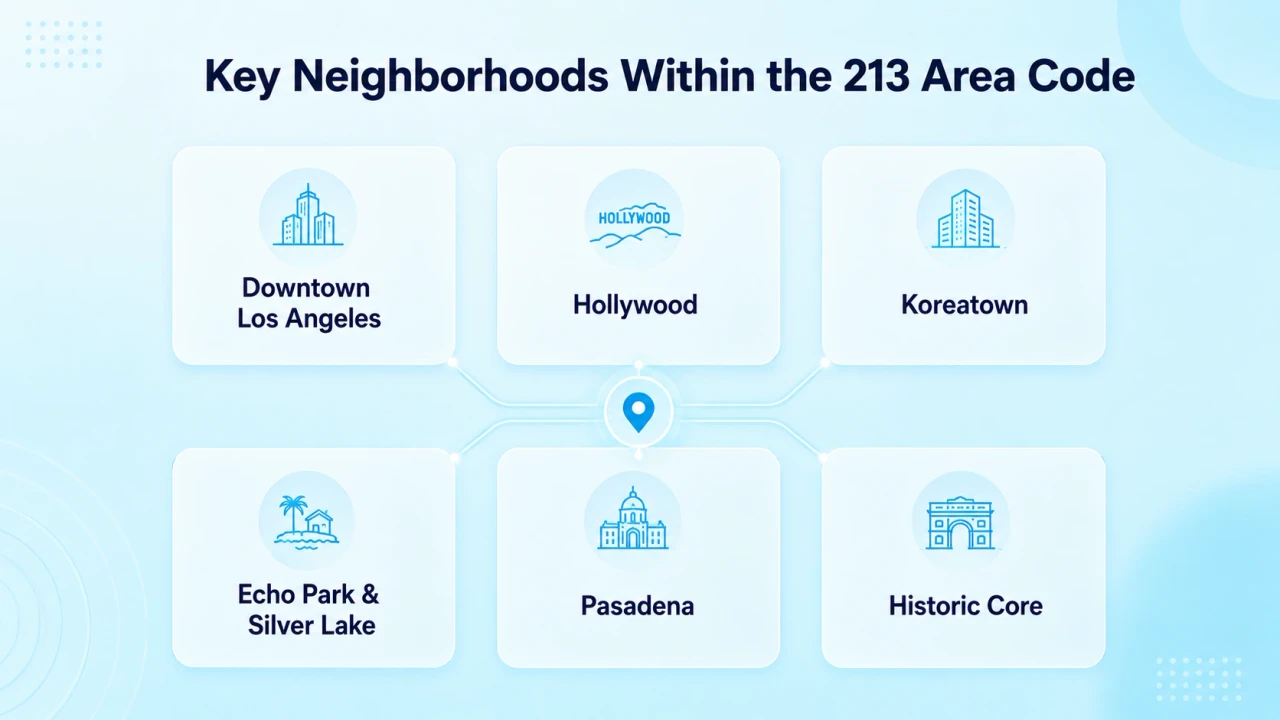
The 213/323/738 overlay zone covers the core of Los Angeles, anchored by Downtown, and spreads across several of the city's most distinctive neighborhoods and independent cities in Southeast LA County.
Downtown Los Angeles (DTLA)
Downtown LA is the commercial, civic, and cultural center of the overlay zone — and one of the most economically concentrated districts on the West Coast.
Bunker Hill is the financial core. Its towers house the regional offices of major financial institutions, law firms, and consulting practices. The Wells Fargo Center, Aecom headquarters, and the AT&T Center anchor the corporate identity of the district. Downtown LA as a whole contains more than 500,000 jobs — a concentration that rivals comparable districts in any US city.
The Civic Center surrounds City Hall and houses LA County's court system, federal offices, and municipal government — generating enormous professional services demand in the immediate area.
The Arts District is Downtown's eastern creative frontier, now home to tech companies, design studios, media production operations, and a dense cluster of hospitality businesses. It is one of the most rapidly developing commercial neighborhoods in the city.
Little Tokyo is the historic center of Japanese American life on the West Coast and a destination for retail, hospitality, and cultural tourism.
Chinatown sits at the northern edge of Downtown and connects the historic immigrant community to the growing restaurant and gallery scene that has developed around it.
The Financial District, South Park neighborhood, and the area around Crypto.com Arena — home to the Los Angeles Lakers and Kings — add density of entertainment venues, hotels, and sports-adjacent retail and hospitality businesses.
Central LA Neighborhoods
Koreatown is one of the largest and most commercially active Korean communities outside of South Korea. Its dense mix of retail, hospitality, professional services, and residential uses makes it one of the highest-revenue commercial zones per square mile in Los Angeles.
Westlake borders Koreatown and MacArthur Park, with a predominantly Latin American commercial corridor serving one of the city's densest residential neighborhoods.
Echo Park and Silver Lake extend the 213/323 zone into some of the city's most creative and culturally active neighborhoods, with strong music, food, and tech-adjacent business communities.
Boyle Heights is a historic Mexican American community on the east side of the LA River, with strong local retail and community services.
Hollywood and Surrounding Areas
Hollywood — the global symbol of the entertainment industry — falls within the 323 portion of the overlay. Major production lots, talent agencies, and entertainment-adjacent businesses operate throughout the Hollywood, East Hollywood, and Los Feliz communities.
Silver Lake, Los Feliz, and East Hollywood extend the creative economy along the Sunset corridor.
Southeast Los Angeles County Cities
The overlay zone also covers a cluster of independent cities in Southeast LA County, including Bell, Huntington Park, Maywood, Bell Gardens, Cudahy, Commerce, Montebello, and South Gate — communities heavily driven by proximity to the Port of LA logistics corridor.
Other Cities in the Overlay Zone
West Hollywood, Glendale, Pasadena, Alhambra, Monterey Park, Rosemead, and South Pasadena round out the 213/323/738 overlay coverage, bringing a diverse mix of suburban commercial activity, healthcare, and education into the zone.
History of the 213 Area Code
The 213 area code holds a distinction that no other California code can claim: it was the original. In 1947, when the Bell System introduced the North American Numbering Plan, California was assigned a single area code — 213 — to cover the entire state. In the seven decades that followed, that single code would be split five times to accommodate one of the fastest-growing telecommunication markets in the world.
For decades, area code 213 served the entire state of California before being progressively refined through a series of splits as population and telephone demand surged through the postwar boom.
The Five Splits of 213
714 (1951): The first split carved out Southern California — Orange County and the Inland Empire — as postwar suburban development pushed the region's phone demand past what a single code could handle.
805 (1957): Ventura, Santa Barbara, and the Central Coast split off to form 805, stripping another segment of the original statewide footprint.
818 (1984): The San Fernando Valley — Burbank, Glendale, Pasadena, and the suburbs north of the Hollywood Hills — was reassigned to 818, removing one of the most populous suburban zones.
310 (1991): The Westside and South Bay — Beverly Hills, Santa Monica, El Segundo, Torrance, and the coastal cities — moved to 310. This is the same territory where the 424 area code later became an overlay, extending number capacity for the Westside alongside 310.
323 (1998): The fifth and final split separated Hollywood, East LA, and Southeast LA County cities from 213, creating the 323 area code. After this split, 213 served only Downtown Los Angeles and a narrow band of immediately adjacent neighborhoods.
2017: The 213/323 Recombination as an Overlay
By 2017, the pace of new number demand from mobile devices, VoIP lines, and IoT services was pushing both 213 and 323 toward exhaustion. Rather than a sixth split — which would have required massive customer number changes — the California Public Utilities Commission (CPUC) eliminated the geographic boundary between 213 and 323.
Effective July 8, 2017, 213 and 323 became a full overlay. Telephone companies could assign any available 213 numbers in the former 323 zone and vice versa. The operational consequence for all subscribers was mandatory 10-digit dialing for every local call across the entire overlay territory. The CPUC carries out these decisions within the numbering administration framework that governs area code planning nationwide.
2024: The 738 Area Code Added
As mobile, VoIP, and connected device growth continued, a third code was needed. The CPUC approved 738 as a new overlay on March 16, 2023. Starting November 1, 2024, new subscribers in the 213/323 region began receiving 738 numbers. The 738 addition changed nothing operationally — 10-digit dialing was already mandatory, and no existing numbers changed.
213 Area Code Time Zone
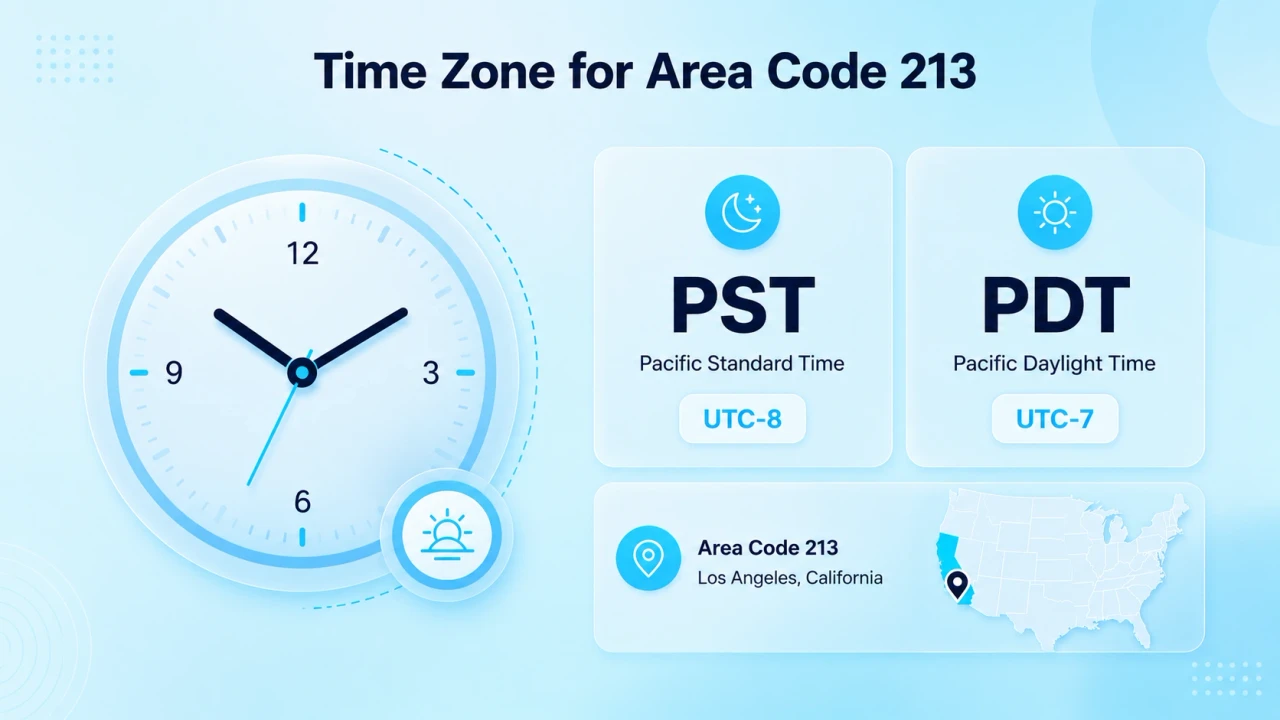
The 213/323/738 zone operates in the Pacific Time Zone (PT):
- Pacific Standard Time (PST): UTC−8 — observed from early November to mid-March
- Pacific Daylight Time (PDT): UTC−7 — observed from mid-March to early November
Cross-Timezone Calling Guide
East Coast calls (ET → PT): New York and the Eastern Time Zone are 3 hours ahead of Los Angeles. A Downtown LA business receiving a 9 AM ET call gets it at 6 AM PT — before business hours. Morning calls to East Coast clients should go out before 3 PM PT to reach them before 6 PM ET.
Central Time (CT → PT): Chicago and Central Time are 2 hours ahead. A noon CT call reaches LA at 10 AM PT — comfortable business hours for both.
Mountain Time (MT → PT): MT is 1 hour ahead. Note that Arizona (outside Navajo Nation) does not observe Daylight Saving Time, which can create a 2-hour gap during DST periods.
International calls to 213: From the UK, dial 00 + 1 + 213 + 7-digit number. From Australia, dial 0011 + 1 + 213 + 7-digit number. Globally via mobile: +1-213-XXX-XXXX.
Because 213, 310, and 424 all share Pacific Time, businesses managing calls across all three LA-area codes face no time zone complexity within the metro.
Is a 213 Call a Scam?
The 213 prefix is legitimate — it covers real businesses and residents throughout Downtown LA and Central Los Angeles. However, it is also the #1 reported code for scam calls in California, with the FTC logging 49,476 complaints from thousands of unique phone numbers using spoofed caller IDs. The August of the most recent reporting year saw the highest single-month complaint volume.
Scammers prefer local LA numbers for a direct reason: in California, a familiar prefix signals Los Angeles — and local calls get answered at far higher rates than out-of-state or toll-free numbers.
Fake Job Offer Scams
One of the most prevalent scam types targeting this code involves fraudulent employment offers, aimed at job seekers in LA's entertainment, tech, and media industries. Victims get a text or call offering an audition, content contract, or remote role, then are asked to pay for background checks or training materials. No legitimate employer requests upfront payment during hiring.
Text Message Scams ("Conversational" Style)
The FTC has flagged a high volume of text scams opening with casual, personal-seeming messages: "Hello," "Are you busy?", "Didn't we meet at the conference?" These are engineered to steer toward a request for money, personal data, or cryptocurrency. If a text from an unknown local number seems personal but you can't place the contact, do not engage.
IRS and Government Impersonation
Callers spoofing local numbers claim to be IRS agents, Social Security Administration representatives, or Homeland Security officers. They assert that a warrant or account freeze is imminent unless immediate payment is made via wire transfer, gift card, or cryptocurrency. The IRS does not initiate contact by phone call, and no real government agency demands immediate cryptocurrency payment.
Tech Support Fraud
Victims receive a call or text from a "Microsoft," "Apple," or "Google" support agent claiming their device has been compromised. They are directed to a remote access tool that gives the scammer control of their screen and banking applications. Legitimate technology companies do not call consumers to report device infections.
Staying Protected
- Never send money, provide account numbers, or install remote access software based on an unsolicited call or text from an unfamiliar LA number.
- Legitimate employers, government agencies, and tech companies do not demand upfront payment by phone.
- If you run a business with an LA phone number, using a STIR/SHAKEN-compliant VoIP provider helps your callers see your number as verified rather than potentially spoofed — important in a market where scam rates are the highest in the state.
- Report suspicious calls and texts at reportfraud.ftc.gov.
The 213 Economy: What Drives Central Los Angeles
Downtown Los Angeles and the broader 213/323 zone make up one of the most economically diverse urban cores in the United States, anchored by four dominant sectors.
Finance and Professional Services
Bunker Hill's tower district is the West Coast's most concentrated financial address outside San Francisco. Los Angeles County's GDP exceeds $1 trillion, and a large share of the financial infrastructure managing that output operates in the Downtown core. Major national banks and regional institutions maintain headquarters-level offices here, and the legal and consulting services supporting them make the civic center one of the highest-billing corridors in the country.
Entertainment and Media
The 213/323 zone is the operational center of the global entertainment industry. Hollywood's major studios, talent agencies, post-production facilities, and streaming platform offices are concentrated throughout the overlay territory. Anschutz Entertainment Group (AEG), owner of Crypto.com Arena, is headquartered in Downtown LA. The sector's economic multiplier — production spending, talent, hospitality, and technology — drives demand for professional communications across the zone.
Technology and Innovation
Los Angeles has emerged as one of the country's most active technology markets, with more than 1,340 fintech startups in the greater metro having raised $1.4 billion in 2025 alone. DTLA and the surrounding neighborhoods serve as a growing node for tech companies, media-tech hybrids, and digital agencies. BYD Company, one of the world's largest EV and technology manufacturers, maintains its North American headquarters in Downtown LA.
Logistics and International Trade
The Southeast LA County cities in the overlay zone — Bell, Huntington Park, Commerce, and their neighbors — benefit directly from proximity to the Port of Los Angeles and Port of Long Beach, the busiest port complex in the Western Hemisphere. The industrial and logistics businesses concentrated in this corridor handle an enormous volume of trans-Pacific trade.
Why a 213 Business Number Works in Los Angeles
A local LA number carries weight in the Los Angeles market that no toll-free prefix can replicate.
Instant Downtown Credibility
In a city where address signals status, a 213 number communicates that you are based in the commercial core of LA. For law firms, financial practices, entertainment companies, and tech businesses pitching major clients, a Downtown LA prefix positions you at the center — not on the periphery — of the city's professional economy.
Answer Rates in a Scam-Saturated Market
The same dynamic that makes LA numbers attractive to scammers — local numbers get answered — works in your favor when your number is legitimate. A verified, STIR/SHAKEN-compliant VoIP number from a reputable carrier signals authenticity to the local contacts most likely to answer a Downtown LA prefix.
Local SEO in the Nation's Second-Largest Market
Los Angeles is the second-largest city in the United States. A consistent 213 number in your Google Business Profile, local directory citations, and website creates NAP (Name, Address, Phone) consistency that boosts local search visibility for Downtown LA, Koreatown, Hollywood, and Central LA searches — some of the most competitive search markets in the country.
Remote LA Presence Without a DTLA Lease
A Bunker Hill office address costs far more per square foot than nearly any commercial real estate in the country. A virtual 213 number routes calls to any device — mobile, softphone, or desktop — from any location, letting a firm in Austin, London, or anywhere project a credible Downtown LA presence without that overhead.
Multi-Number Campaign Attribution
Los Angeles's media and entertainment market generates enormous inbound call volume. Assigning dedicated 213 numbers to individual campaigns — digital ads, industry directories, podcast sponsorships, event promotions — gives precise per-channel attribution for the LA market that drives accurate marketing investment decisions.
How to Get a Local 213 Business Number
1. Select a VoIP or virtual number provider with live 213 inventory Because 213, 323, and 738 cover identical territory, confirm your provider stocks 213 specifically if that prefix matters for your brand positioning. Availability varies by provider.
2. Browse and select your number Most platforms surface available numbers by pattern or vanity sequence. In a competitive LA market, a memorable number supports recall in high-volume communication environments.
3. Verify 10-digit dialing compliance everywhere Since the July 8, 2017 recombination with 323, all calls within the 213/323/738 zone require 10-digit dialing (area code + 7 digits). Update your IVR configurations, CRM dial-out strings, and any stored contact formats to the full 10-digit format — 7-digit calls do not connect.
4. Configure call routing Set how incoming calls are handled: direct to mobile, through an IVR menu, to a call queue, or to a softphone app. For high-volume entertainment and finance environments, skills-based routing ensures calls reach the right team member immediately.
5. Activate SMS Two-way SMS on your 213 number is increasingly expected in the LA market, particularly for entertainment, hospitality, and creative industry clients who default to text for short-cycle communication.
6. Port an existing number if needed Local Number Portability (LNP) regulations allow you to transfer an existing 213 number from any carrier. Work with your new provider to schedule the port date and confirm uninterrupted service during the transition.
What to Look For in a Provider
When selecting a platform for a local LA business number, prioritize:
- Reliability — In a city that never stops, downtime is not recoverable. Rozper maintains 99.999% uptime, ensuring your LA line is available for every inbound call including during peak entertainment industry and financial services hours.
- Call quality — HD Voice codec support and Tier-1 carrier connections are essential for the high-stakes professional calls common in LA's legal, financial, and entertainment sectors.
- Full feature set — IVR, call recording, voicemail-to-email, call forwarding, real-time analytics, and SMS as standard capabilities rather than paid add-ons.
- Global reach — Los Angeles is the United States' gateway to Pacific Rim markets. A provider covering 150+ countries lets your number integrate with international business operations without a separate platform.
- Transparent pricing — No term commitments that penalize growth.
Rozper is one option worth considering here, maintaining 99.999% uptime and coverage in 150+ countries so a single platform can serve both your local Downtown LA line and any international operations.
Common 213 Business Number Challenges and Solutions
| Challenge | Solution |
|---|---|
| 7-digit dial-out in legacy CRM or IVR | Update all stored numbers and dial-out rules to 10-digit format — mandatory since July 2017 |
| High scam call rate affecting brand trust | Use STIR/SHAKEN-compliant provider + add number to Google verified listings |
| Remote team needs unified LA line | Call forwarding + softphone app routes any device; clients always see 213 on outbound |
| East Coast clients calling outside LA business hours | After-hours IVR with voicemail-to-email or call forwarding to on-call mobile |
| Confusing 213 vs 323 vs 738 for brand consistency | All three cover identical territory — choose 213 for brand recognition value |
| High inbound volume from entertainment industry | Skills-based routing + call queue analytics via integrated VoIP dashboard |
| Multiple campaign numbers for LA market | Centralized analytics dashboard tracks per-number inbound calls in real time |
What's Next for the 213 Region
738 adoption is growing. Launched November 1, 2024, the 738 code is beginning to appear in new business and consumer activations across the overlay zone. For established businesses, this has no operational impact — 10-digit dialing already covers all three codes — but brand guidelines should confirm 213 as the preferred public prefix if legacy recognition matters.
DTLA's next development cycle. Downtown Los Angeles has seen sustained investment in residential conversion of office towers and expansion of mixed-use developments in the Arts District, South Park, and around the Convention Center. This is driving new business formation and population growth in the core.
LA's 2028 Olympics infrastructure. Los Angeles is preparing to host the 2028 Summer Olympics. Infrastructure spending, hospitality expansion, and corporate sponsor operations are already generating significant commercial activity across the 213/323 zone, particularly around venues in the central city.
UCaaS adoption in entertainment and media. Hollywood's production and post-production ecosystem is rapidly modernizing its communications infrastructure, moving from studio PBX systems to cloud-based UCaaS platforms that integrate voice, video, and AI-assisted call management.
Conclusion
The 213 area code is where California's telephone history begins and where some of the world's most consequential industries operate today. From Bunker Hill's financial towers to the studio lots along Sunset, Koreatown's commercial density, and Southeast LA County's logistics corridors, the 213/323/738 zone punches far above its square mileage in economic output and cultural influence.
For businesses, a 213 number is one of the clearest statements of Downtown LA identity available. It establishes market presence before a conversation begins, supports local search in one of the most competitive digital markets in the country, and scales with distributed teams who need to project LA credibility without the overhead of a Bunker Hill lease. Every overlay and split described here — from the 1947 statewide assignment to the 2024 addition of 738 — was carried out under the same numbering administration framework that governs area code planning nationwide.
FAQs
What cities does the 213 area code cover?
As part of the 213/323/738 overlay, this code covers Downtown Los Angeles, Koreatown, Westlake, Echo Park, Silver Lake, Boyle Heights, Hollywood, Los Feliz, and East Los Angeles within the city, as well as independent cities in Southeast LA County including Bell, Huntington Park, Maywood, Montebello, Commerce, South Gate, and Bell Gardens. It also covers parts of West Hollywood, Glendale, Pasadena, Alhambra, Monterey Park, and South Pasadena.
What is the difference between 213, 323, and 738?
All three are overlay codes serving the exact same geographic territory in and around central Los Angeles. 213 is the original code, dating to 1947. 323 was split from 213 in 1998, then recombined as a full overlay in July 2017. 738 was added by the CPUC in November 2024 as a third overlay to meet growing number demand. All three require 10-digit dialing for local calls.
Do I need to dial the area code for local calls in the 213 zone?
Yes. Since the 213/323 overlay took full effect on July 8, 2017, 10-digit dialing (area code + 7-digit number) is mandatory for all calls within the 213/323/738 zone. A 7-digit call will not connect.
Is a 213 call a scam?
Many legitimate businesses and residents use 213 numbers — but the prefix is heavily targeted by scammers using spoofed caller IDs. Common scam types include fake job offers, conversational text scams, IRS impersonation, and tech support fraud. Legitimate businesses using STIR/SHAKEN-compliant providers help their calls appear verified to recipients.
What time zone does the 213 code use?
Area code 213 is in the Pacific Time Zone (PT). It observes Pacific Standard Time (PST, UTC−8) from early November through mid-March and Pacific Daylight Time (PDT, UTC−7) from mid-March through early November. The 213 zone shares its time zone with all other Los Angeles-area codes including 310, 424, and 323.
Can I get a 213 number if I'm not located in Los Angeles?
Yes. Virtual 213 numbers route calls to any device — mobile, softphone, or desktop — regardless of your physical location. A business anywhere in the US or internationally can maintain a credible Downtown LA presence with a 213 number.
Does Rozper offer 213 business phone numbers?
Yes. Rozper provides local 213 numbers with full VoIP features — call forwarding, IVR, voicemail-to-email, call recording, SMS, and analytics. With 99.999% uptime and service in 150+ countries, Rozper is built for businesses managing a Downtown LA presence alongside broader national or international operations.