Introduction
Here's a fact that surprises most callers: while nearly every other state has split, overlaid, or exhausted its original phone numbering, Vermont has answered every call with the exact same three digits since the system began. The 802 area code has covered the entire state without a single change since 1947, making it one of the rarest survivors in American telecom history. This guide explains why that single prefix has been enough for eight decades, which towns and communities it reaches today, why a matching number still carries weight for a Vermont-facing business, and how you can claim one no matter where you're actually based. By the end, you'll understand this prefix better than most people who've lived under it their whole lives.
Key Takeaways:
- The 802 area code covers the entire state of Vermont, the only prefix it has ever had.
- It was one of the original 86 area codes created in 1947 and has never been split or overlaid.
- Vermont's comparatively small, slow-growing population is why one code has always been enough.
- Businesses can request a matching number through a cloud phone system without opening a local office.
Understanding the 802 Area Code
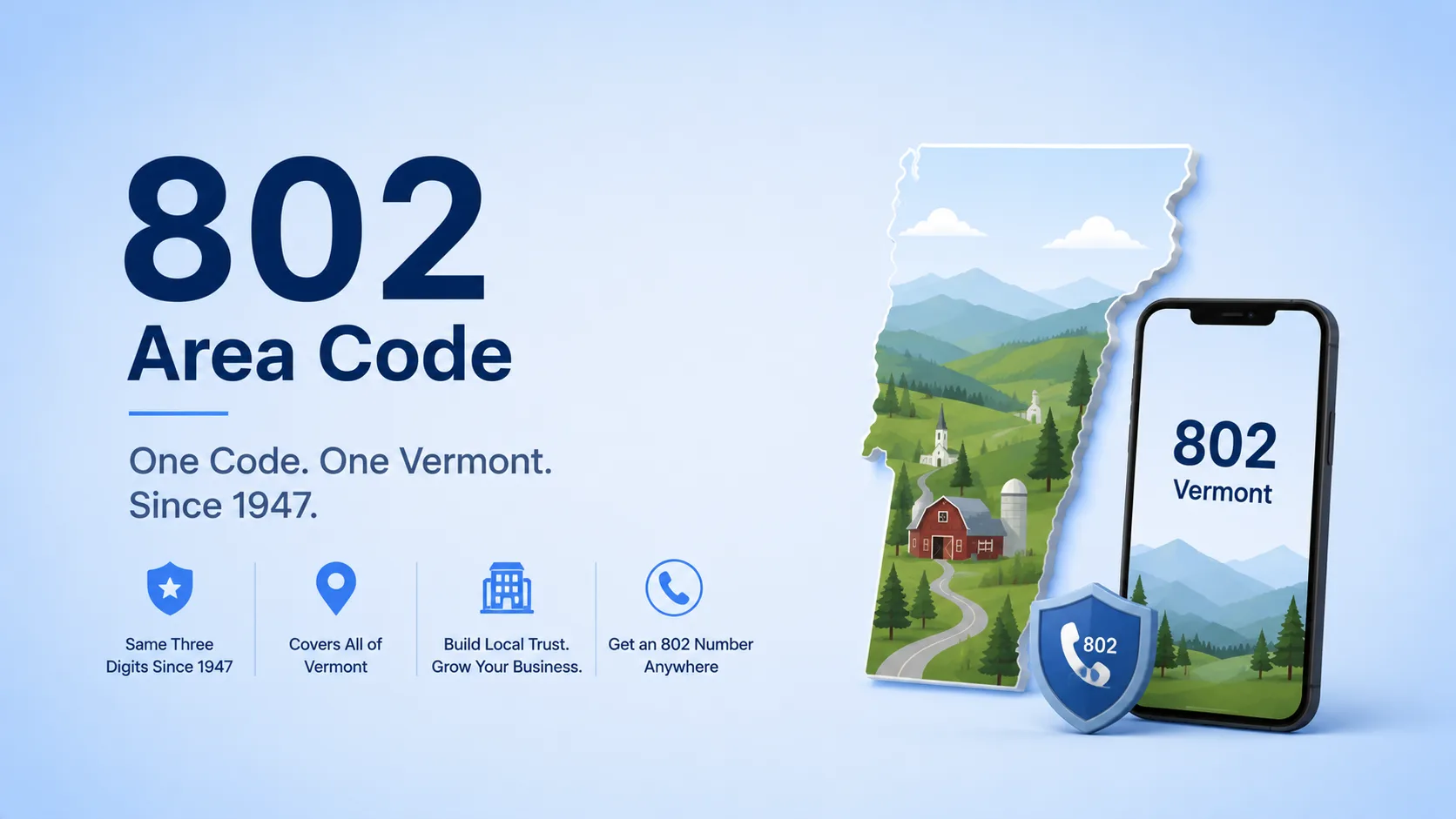
The 802 area code is the sole telephone area code assigned to the entire state of Vermont. It was one of the original 86 area codes created in 1947, when the North American Numbering Plan first divided the continent into calling regions, and it remains one of only a small handful of codes still serving an entire state without ever being split or overlaid. Every landline, mobile number, and business line in Vermont — from the Canadian border to the Massachusetts line — falls under this same prefix.
That kind of numbering stability is unusual. Most states saw rapid population and business growth strain their original codes decades ago, forcing splits or overlays like the ones covering neighboring New England markets. Vermont's comparatively small and slow-growing population, however, has kept demand for new numbers low enough that area code 802 has never come close to exhausting its supply, even after nearly 80 years in service.
Every Vermont Town, One Code
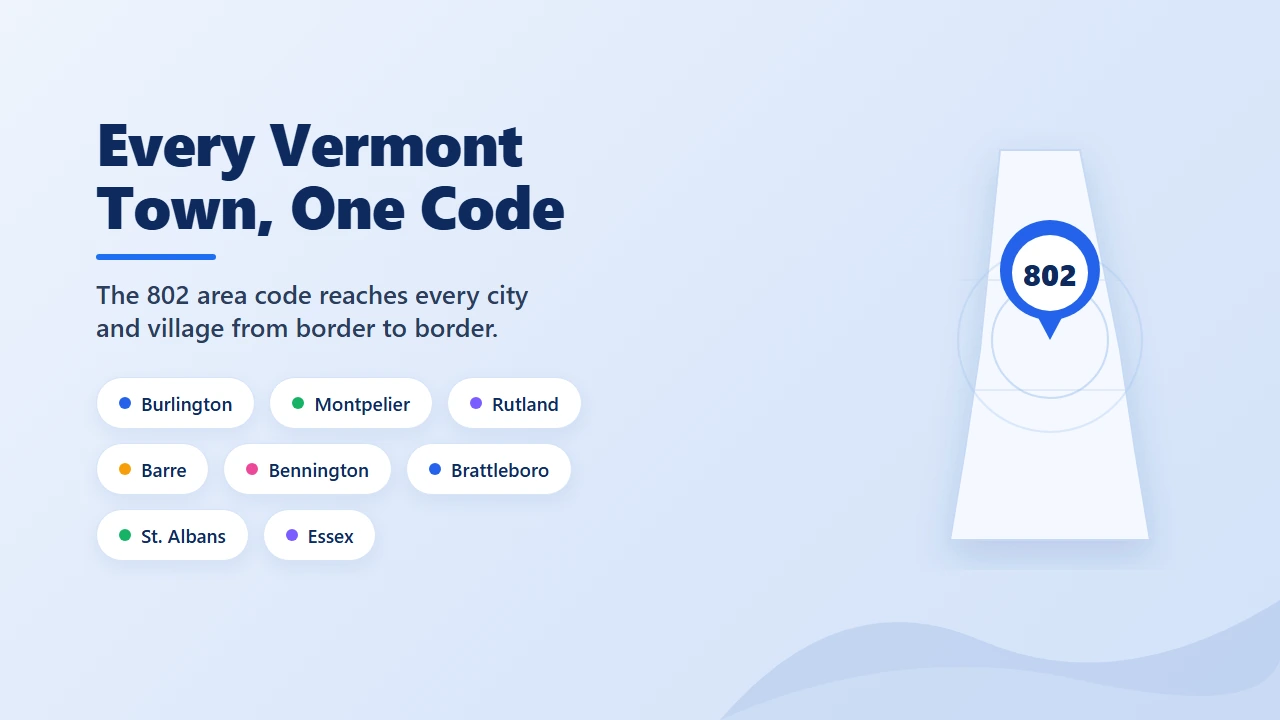
Because it is a statewide code rather than a regional one, the 802 area code covers every corner of Vermont at once. Cities and towns served by this single prefix include Burlington, South Burlington, Montpelier, Rutland, Barre, Bennington, Brattleboro, St. Albans, Essex, and Middlebury, along with the countless smaller villages that define the state's character. Ski towns like Stowe and Killington ring under the same digits as the capital and its surrounding farmland.
This universal coverage means the 802 area code carries a different kind of signal than a big-city prefix. Rather than pointing to one neighborhood or metro, it identifies a caller as connected to Vermont itself — its dairy farms, maple producers, ski resorts, and small-town main streets. For a business trying to build trust with Vermont customers, that statewide association is arguably a bigger asset than a hyper-local number would be in a bigger state.
Why Vermont Never Needed a Second Area Code
Area codes typically split or overlay once the original numbering pool runs low, but that threshold depends entirely on population and business density. Vermont remains one of the least populous states in the country, and its number of active phone lines has simply never approached the ceiling that forces regulators to intervene. Where a fast-growing metro might exhaust an area code in a decade, Vermont has kept area code 802 in continuous, uninterrupted service for nearly eighty years.
This is also why Vermont is often cited alongside a short list of states — including Wyoming and a few others — that have never required a second area code. It's not a matter of the state being overlooked by numbering administrators; it's simply a reflection of steady, modest growth that hasn't demanded more numbering capacity. For residents and businesses, that stability means one less thing to think about when setting up phone service.
The Business Case for an 802 Area Code Number
Local numbers still influence whether people pick up the phone. Industry surveys consistently find that most consumers are more likely to answer a call from a number sharing their own regional prefix, and roughly 60% of shoppers say they prefer working with a business that looks local. For any company selling into Vermont, holding an 802 area code number can meaningfully improve answer rates compared with an out-of-state or toll-free line.
The effect works both ways. Outbound sales calls placed from an 802 area code number tend to see better pickup rates than calls from an unfamiliar prefix, since Vermont residents are less likely to assume the call is a distant robocall. For contractors, inns, farms, and service businesses spread across the state's rural towns, a matching number reinforces the sense that help is coming from someone who actually understands the community — a meaningful edge in a state where word-of-mouth still carries real weight.
Claim a Vermont Line From Anywhere
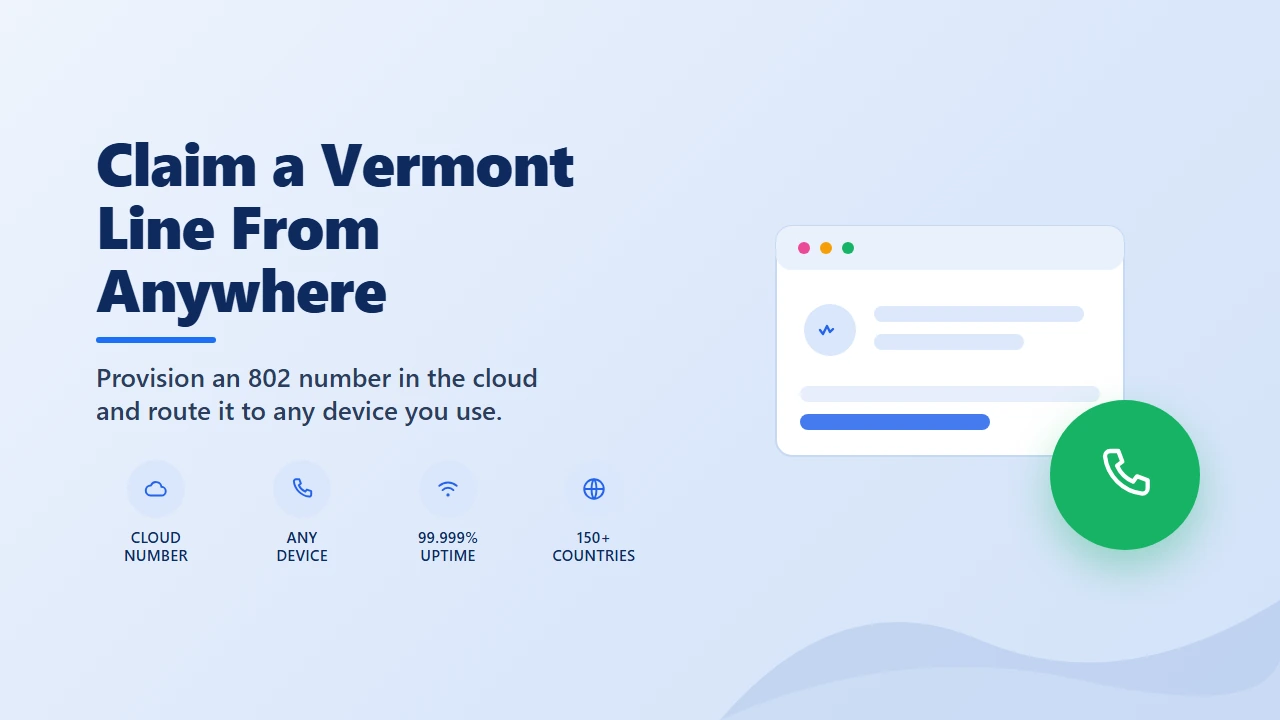
You don't need a storefront in Burlington or a farmhouse in the Northeast Kingdom to hold a number in this territory. Modern cloud phone systems let a business or individual request a number tied to almost any area code in the country, then route incoming calls to a mobile phone, desktop app, or existing office line. This is especially useful for companies expanding into Vermont's tourism, agriculture, or professional services markets without opening a physical location there.
Rozper is one option worth considering for exactly this situation. Alongside coverage across 150+ countries and a 99.999% uptime guarantee, it lets teams provision an 802 area code number in minutes and manage it beside their other business lines, with real human support behind the setup instead of an automated ticket queue. If your growth plans stretch into other regional markets, it's worth comparing how a 385 area code number works for a very different kind of numbering situation — a fast-growing metro overlay rather than a single statewide code.
How 802 Fits Into the Bigger Numbering Picture
Most states long ago outgrew their original single area code, which is why comparing a code like this against a metro market is useful context. Our guide to the 801 area code explains how Utah's original prefix eventually needed an overlay once its capital region grew past capacity — the exact scenario Vermont has avoided so far thanks to its smaller population. Seeing both situations side by side makes it easier to understand why some regions need multiple codes while others, like Vermont, still get by on one.
The rules governing how U.S. area codes are assigned, split, or overlaid are documented publicly by the North American Numbering Plan Administrator, and additional detail is available through the Federal Communications Commission, which oversees numbering policy nationwide. For most businesses, the practical takeaway is simple: an 802 area code number reaches every corner of Vermont, no exceptions and no second code to worry about.
Not Behind, Just Different
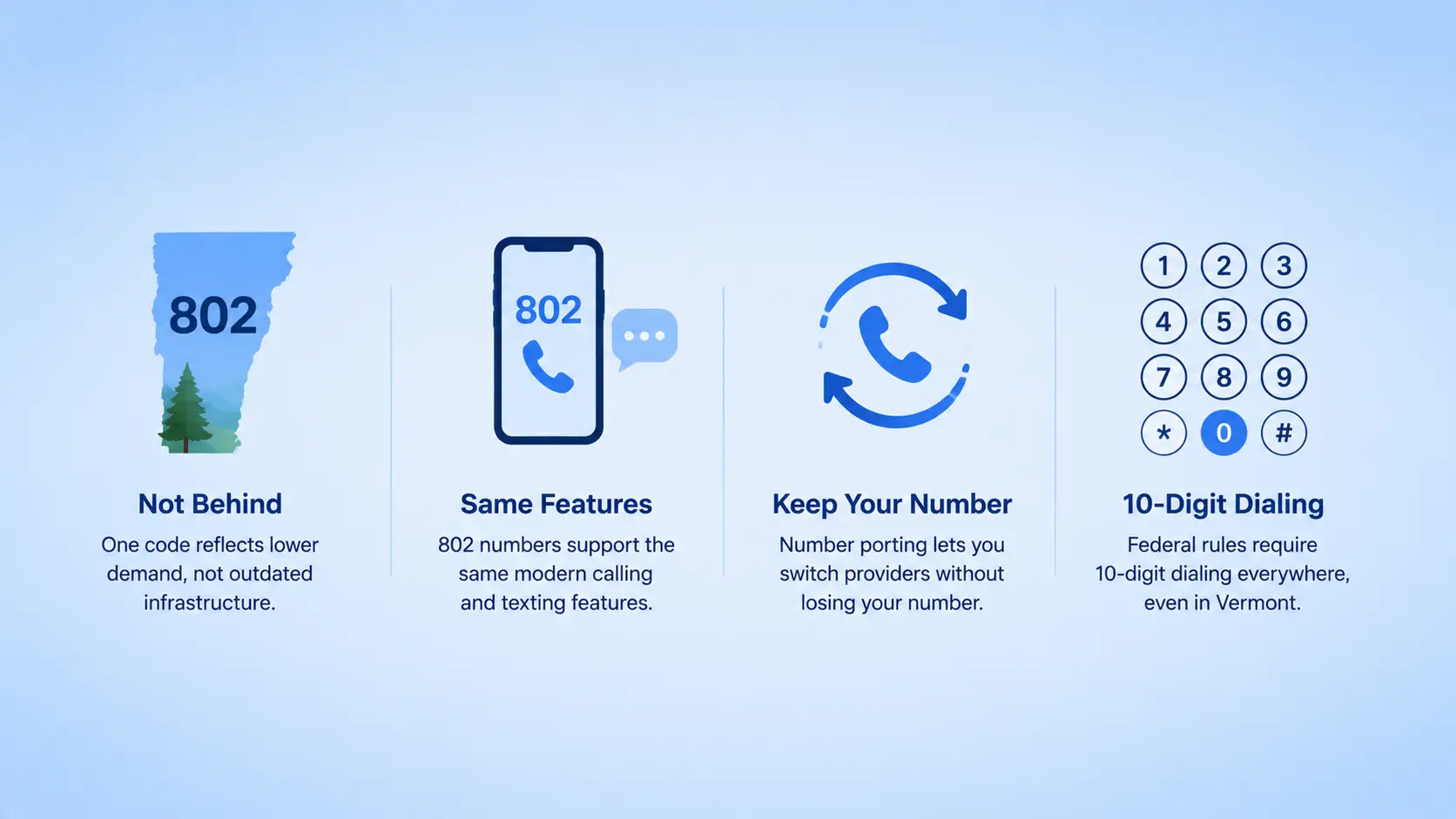
Some callers assume a statewide code like this must mean Vermont is somehow behind on infrastructure, when in reality it just reflects lower demand for new numbers compared with denser states. Others assume that because only one code exists, Vermont numbers are somehow less flexible for business use — but a number under area code 802 supports the same modern calling and texting features as any other U.S. prefix.
Porting is another common point of confusion. Many business owners believe that switching providers means giving up a number their customers already recognize, but most modern carriers support number porting, which lets a company keep its existing digits while moving service to a new platform entirely. This matters for Vermont businesses that have spent years building name recognition around one line and don't want a provider switch to disrupt that continuity. It's also worth noting that federal rules now require ten-digit dialing nationwide, so even in a single-code state like Vermont, callers dial the full number, including the area code, every time.
Conclusion
Eighty years without a split or an overlay makes this one of the most stable area codes left in the country, and that stability says as much about Vermont's steady pace of growth as it does about telecom history. Whether you're trying to place a call from an unfamiliar number or deciding whether your business should claim one of its own, understanding why this prefix has never needed backup puts you ahead of nearly everyone who dials it without a second thought. As long as Vermont keeps growing at its own unhurried pace, don't expect that to change anytime soon.
FAQs
What towns does the 802 area code cover?
It covers the entire state of Vermont, including Burlington, Montpelier, Rutland, Barre, Bennington, and Brattleboro, with no separate codes anywhere else in the state.
Will Vermont ever need a second area code?
Not in the foreseeable future. Current usage under area code 802 remains well below the threshold that would force a split or overlay.
Can I get a number here if I don't live in Vermont?
Yes, cloud phone providers let you request and route a number tied to this code regardless of where you physically live or work.
Do I need to dial ten digits for local calls?
Yes, federal rules now require ten-digit dialing nationwide, so Vermont callers dial the area code even for calls within the state.
Is this a toll-free or premium prefix?
No, it's a standard geographic prefix for Vermont, not a toll-free code like 800 or 888, and calls are billed at normal rates.