Introduction
Wholesale voice services are a cornerstone of the modern telecommunications industry, essential for businesses to maintain effective communication with their customers, partners, and employees. This guide provides an in-depth look into the realm of wholesale voice, covering its definition, significance, and advantages. Understanding these services is crucial for any organization aiming to enhance their telecommunication strategies and broaden their operational reach. Whether you are a carrier, reseller, or enterprise, knowing how wholesale voice works puts you in a stronger position to make smart infrastructure decisions and negotiate more effectively with service providers.
What is Wholesale Voice?
Wholesale voice refers to the bulk sale of voice communication services to businesses, carriers, and operators. This includes voice termination, origination, and transit. Voice termination connects outbound calls to the recipient's network, voice origination handles the initiation of calls from the user's end, and voice transit routes calls between different networks. These wholesale voice services are typically offered by large carriers and operators, then resold by businesses to their own customers — enabling seamless and cost-efficient communication at scale. The bulk model makes it especially attractive for organizations that handle high call volumes daily.
The distinction between wholesale and retail voice is important. Retail voice targets individual consumers with fixed, standardized plans. Wholesale voice is built for businesses that need customizable, high-volume solutions — with pricing models, routing controls, and API integrations that retail products do not offer.
Key Takeaways
- Global Connectivity: Wholesale voice services facilitate global communication, allowing businesses to extend their reach and interact with international clients and partners.
- Service Scalability: These services enable businesses to scale their communication capabilities efficiently, adapting to increasing demand without significant infrastructure investments.
- Enhanced Communication: Reliable, high-quality voice connections significantly improve collaboration within and outside the organization.
- Customer Experience: Clear, consistent, and timely communication delivers a measurably better customer experience across every touchpoint.
- Cost Efficiency: Bulk purchasing of voice services results in meaningful, measurable cost savings for businesses managing high-volume communication needs at scale.
Understanding Wholesale Voice Services
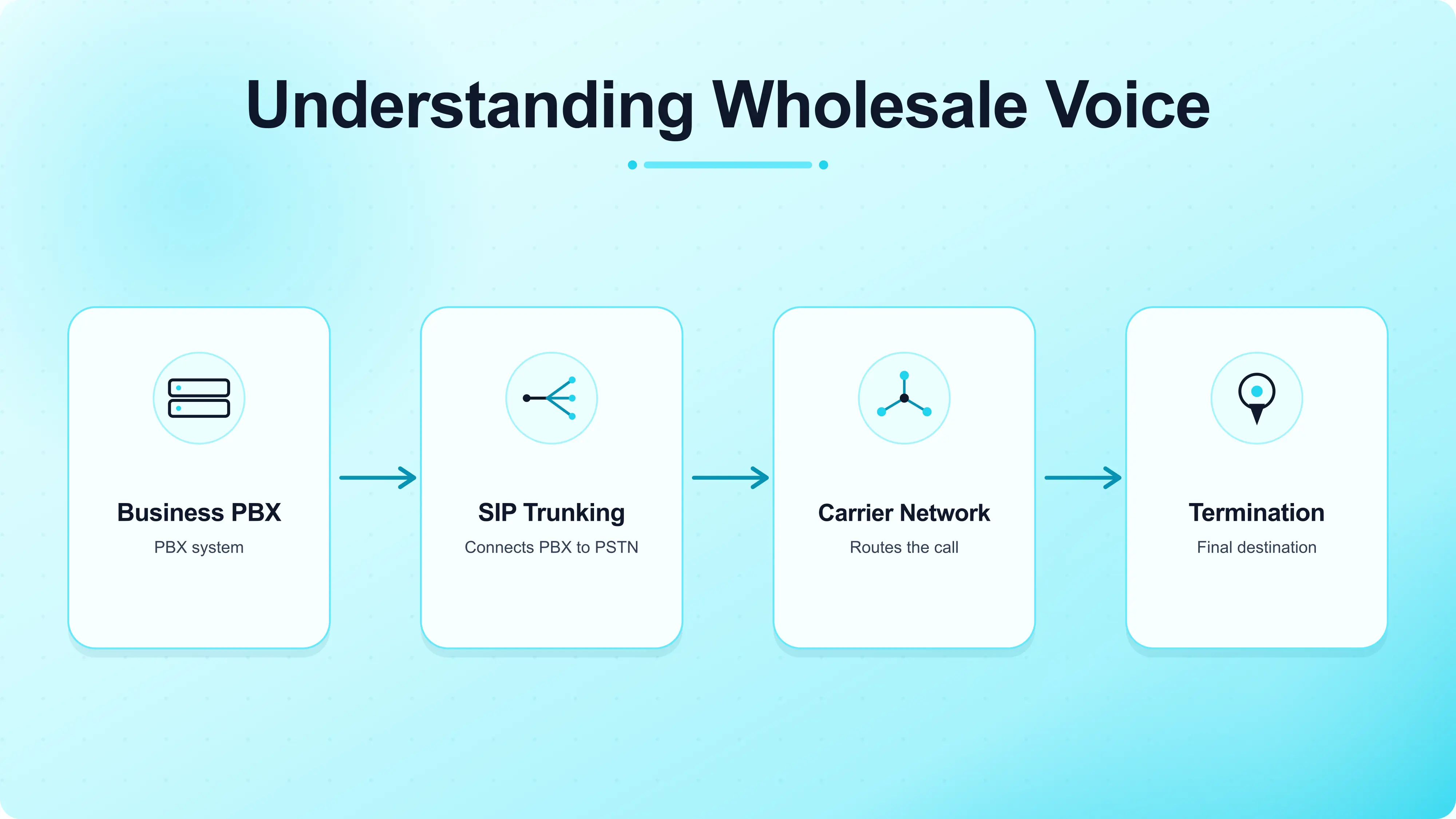
Wholesale voice services comprise several key components that work together to facilitate reliable voice communication. SIP trunking connects PBX systems to the public switched telephone network using the Session Initiation Protocol, while voice termination services connect calls to their final destination. When a business initiates a voice call, it is routed through a carrier's network and terminated at the receiving end — seamlessly, regardless of origin or destination.
Services span three main categories: traditional circuit-switched voice, VoIP-based communication transmitted over internet protocol networks, and SIP trunking solutions that offer flexible and cost-effective PSTN connectivity. Applications extend across business communications, carrier operations, and over-the-top (OTT) platforms that integrate voice into broader digital services. Understanding which service type fits your traffic profile is the starting point for any wholesale voice strategy.
Benefits of Wholesale Voice
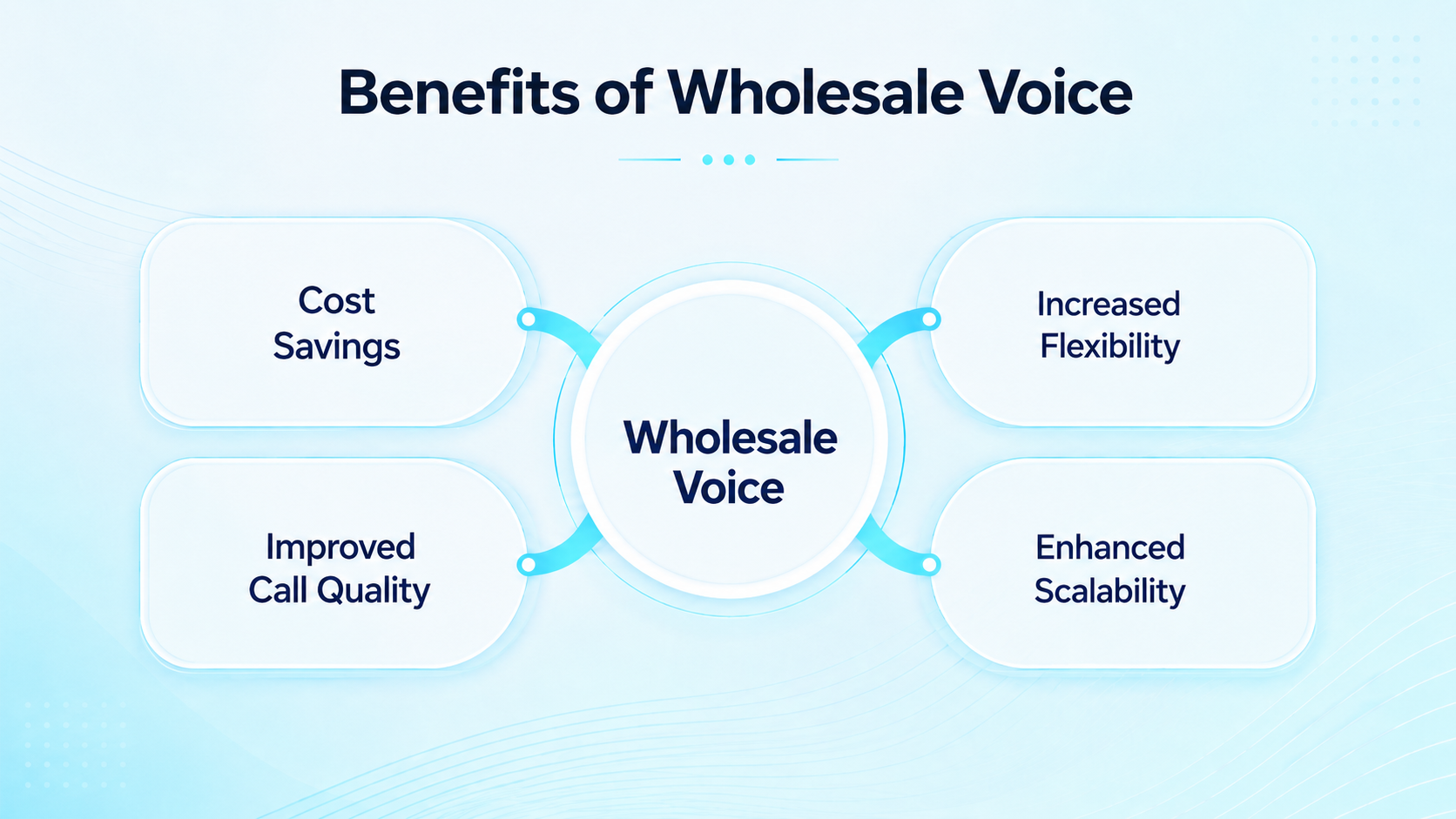
Cost Savings: Businesses achieve reduced costs per minute, lower infrastructure overhead, and economies of scale through bulk purchasing. Over high call volumes, these savings are substantial and directly improve margin.
Increased Flexibility: Wholesale voice scales to accommodate fluctuating call volumes and allows businesses to customize routing. This flexibility gives organizations greater control over their communication strategy and enables rapid adjustment to market changes.
Improved Call Quality: High-quality voice connections with reduced latency and echo ensure professional, reliable communication. This improvement benefits both the business and its customers, reducing frustration and building trust in every interaction.
Enhanced Scalability: Services can scale up or down rapidly to meet changing demands, supporting high-volume traffic and accommodating business growth without the need for additional hardware investment. This is especially valuable for businesses in expansion phases or those managing seasonal traffic spikes. For a broader look at how these benefits apply in practice, see our guide on wholesale voice services.
Key Features of Wholesale Voice
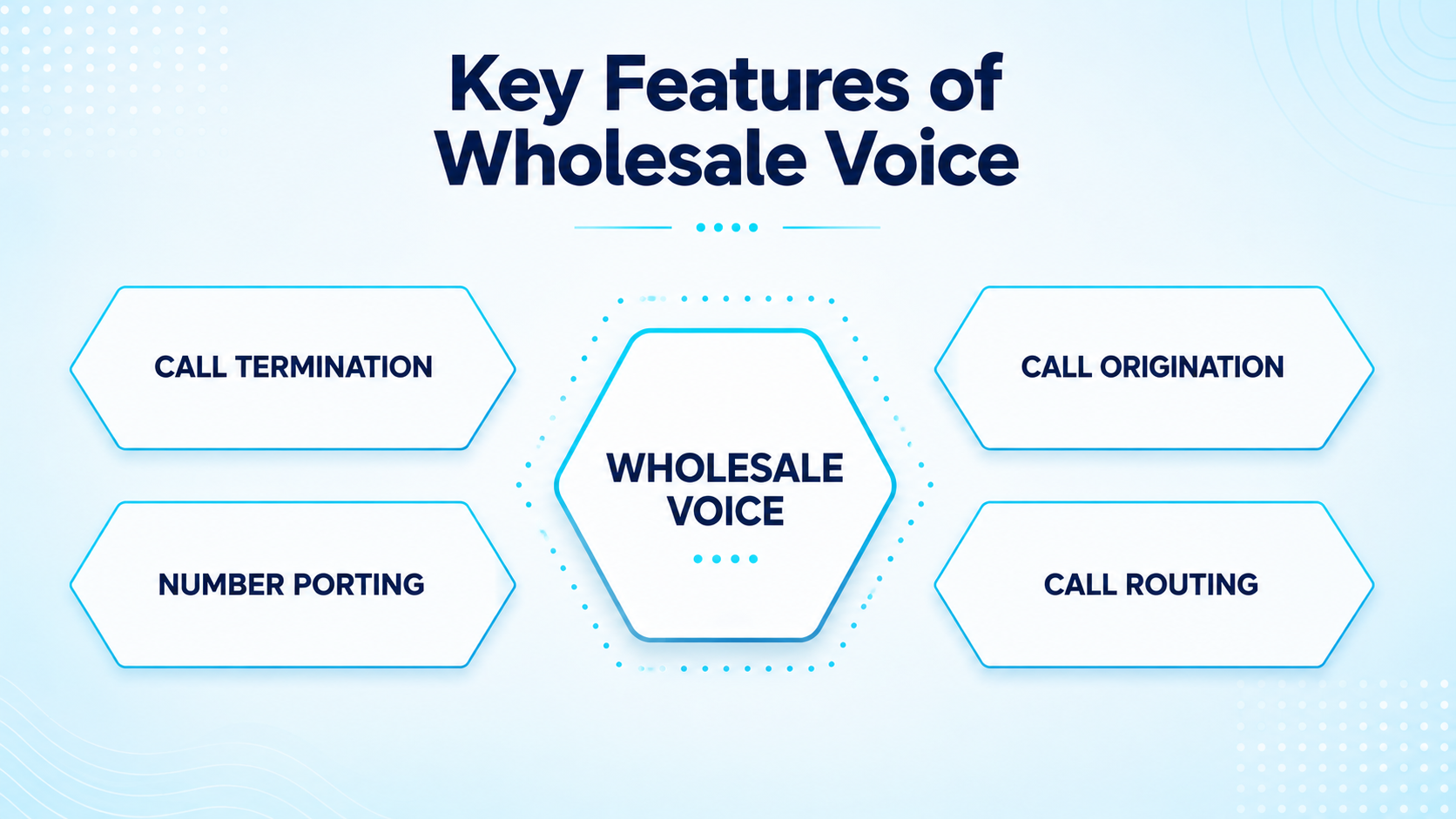
Call Termination: Connects voice calls to their final destination with high quality and competitive per-minute rates, ensuring efficient routing at scale and reliable delivery to any network worldwide.
Call Origination: Supports toll-free and local numbers with advanced features such as call forwarding and call waiting, improving inbound communication management and expanding the range of channels available to customers.
Number Porting: Enables businesses to transfer phone numbers between carriers with minimal disruption. Support for international number porting is particularly beneficial for businesses with global operations or those switching providers while retaining brand identity through existing numbers.
Call Routing: Advanced routing capabilities including least cost routing (LCR) and quality-based routing optimize both cost and call quality. Real-time routing updates adapt to changing network conditions, ensuring calls are directed through the most efficient and reliable paths available. Businesses looking to go deeper on routing infrastructure can explore our guide on wholesale VoIP termination.
Choosing the Right Wholesale Voice Provider
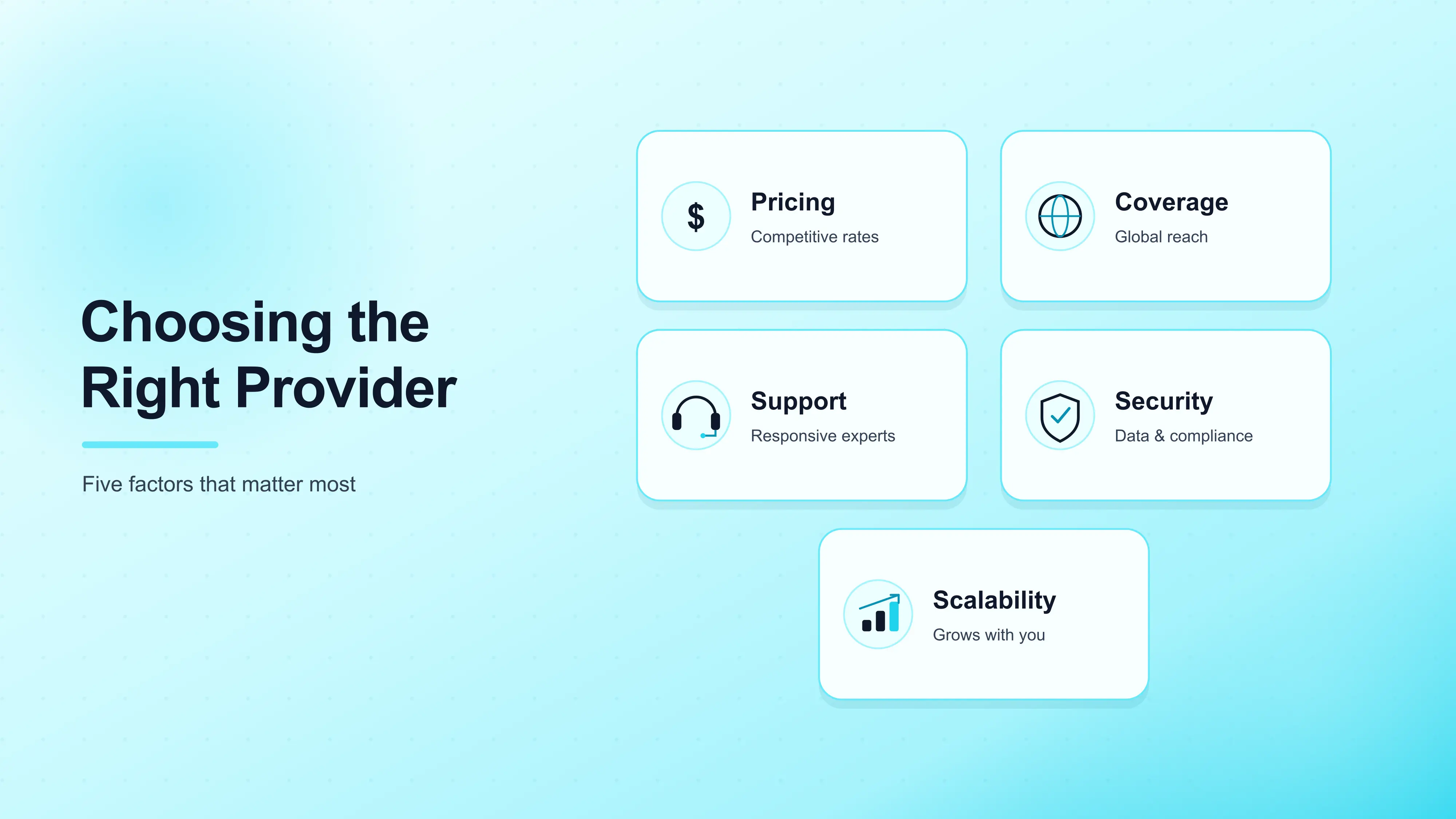
Selecting the right provider is one of the most consequential decisions in building a wholesale voice strategy. Five factors matter most: pricing (competitive rates and flexible models that align with your budget), network coverage (global reach with consistent quality), customer support (responsive technical expertise available when you need it most), security and compliance (robust data protection and regulatory adherence across all operating jurisdictions), and scalability (the ability to grow with your business over time without renegotiating contracts at every inflection point).
To evaluate candidates effectively: research industry reputation and request customer references, issue a Request for Proposal (RFP) to shortlisted providers with clearly defined technical and commercial requirements, run a Proof of Concept (POC) to test real-world performance under your actual traffic conditions, then negotiate a contract with flexible terms and defined SLAs. Red flags to avoid include unclear pricing structures with hidden fees, unresponsive support teams during testing, and inadequate security measures — any of which can create costly operational problems well after onboarding is complete. The evaluation process itself is a signal: providers who handle your RFP and POC professionally are far more likely to be reliable long-term partners.
Wholesale Voice Pricing and Cost Optimization
Wholesale voice pricing models include per-minute pricing (ideal for variable call volumes), flat-rate pricing (fixed monthly fee for unlimited calls), tiered pricing (rates decrease with higher volume), and custom pricing for unique or large-scale needs.
To reduce costs and optimize services: consolidate with a single provider, optimize routing for the most cost-effective paths, monitor usage patterns regularly to identify savings opportunities, negotiate rates by leveraging competitive alternatives, and explore VoIP and SIP trunking upgrades that deliver better economics at scale. Businesses that treat cost optimization as an ongoing process — rather than a one-time procurement decision — consistently outperform those that set their voice contracts and forget them. Regular audits of call traffic, route performance, and provider SLA compliance are the practical tools that keep wholesale voice costs aligned with actual business needs. For regulatory guidance on telecommunications pricing and compliance, the Federal Communications Commission (FCC) provides authoritative resources for businesses operating in the US market.
Conclusion
Wholesale voice services are indispensable for any business that requires reliable, scalable, and cost-effective voice communication. From call termination and origination to advanced routing and number porting, these services provide the infrastructure underpinning modern business communication. Selecting the right provider — carefully evaluated across pricing, coverage, support, security, and scalability — ensures your communication strategy remains competitive and positioned for long-term growth. Businesses that invest in understanding and optimizing their wholesale voice stack gain a durable operational advantage in an increasingly connected world. The combination of cost efficiency, flexibility, and quality that wholesale voice delivers is simply not replicable through retail alternatives — making it the smart choice for any organization serious about communication performance at scale.
FAQ'S
What are wholesale voice services, and how do they differ from retail voice services? Wholesale voice services involve the bulk sale of voice communication capabilities to businesses and carriers, offering customizable solutions and advanced features. Retail voice services cater to individual end-users with standardized plans and significantly less flexibility.
Why should a business consider using wholesale voice services? Businesses should consider wholesale voice if they need to handle high volumes of voice traffic, require customized communication solutions, or seek meaningful cost savings through scalable pricing models and bulk service procurement.
What are the key benefits of using wholesale voice services? Key benefits include cost savings, increased flexibility, improved call quality, and enhanced scalability — all of which help businesses manage their communication needs more efficiently and at lower cost.
How do wholesale voice services enhance call quality? They offer high-quality connections with reduced latency and echo, ensuring clear and uninterrupted communication that improves the experience for both businesses and the customers they serve.
What factors should be considered when choosing a wholesale voice provider? Evaluate pricing, network coverage, customer support responsiveness, security measures, and the provider's ability to scale with your business to ensure a strong long-term fit.