Introduction
Northeast Texas businesses face a specific problem: when customers see an out-of-state or unrecognized number, they let it ring. The 903 area code solves that — more than a three-digit prefix, it's a regional identity signal that tells customers, vendors, and partners exactly where your roots are.
This guide breaks down what the 903 area code covers: the cities it serves, the industries that run through it, and how businesses use a local 903 number to build credibility in Northeast Texas.
Where Is the 903 Area Code?
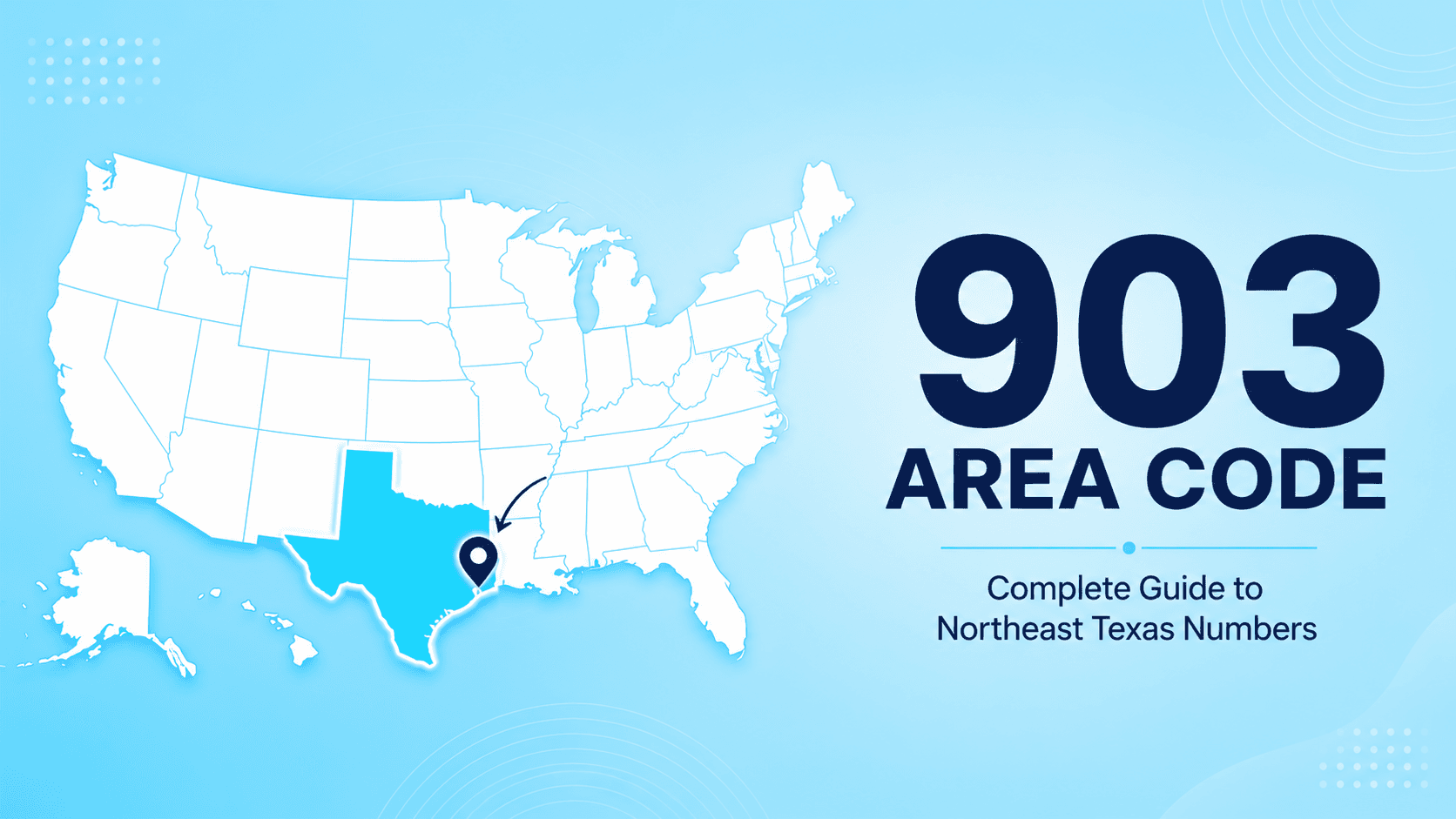
The 903 area code serves Northeast Texas — a region stretching from the Dallas-Fort Worth metro's eastern edge to the Arkansas and Louisiana state lines. Split from area code 214 in 1990 as the Dallas metro outgrew a single prefix, it carved out a distinct regional identity that still holds today.
The coverage zone spans mid-sized cities, rural counties, and communities with deep agricultural and energy roots. Unlike the 214/469/972 codes that define DFW, 903 signals a different Texas — one where community ties and local recognition carry real weight.
Just as a major metro code anchors businesses in Downtown Los Angeles, the 903 area code anchors businesses across Northeast Texas's commercial landscape — a region with its own distinct economic identity.
Key Cities and Counties in the 903 Area Code
A 903 virtual number can anchor your presence across multiple economic hubs in the region. Here are the major cities this prefix covers:
| City | County | Key Industry Focus | Approx. Population Influence |
|---|---|---|---|
| Tyler | Smith | Healthcare, Retail, Education | High |
| Longview | Gregg | Oil & Gas, Manufacturing, Healthcare | High |
| Texarkana | Bowie | Government, Retail, Healthcare | High (TX-AR border) |
| Sherman | Grayson | Manufacturing, Technology, Retail | Medium-High |
| Paris | Lamar | Healthcare, Agriculture, Manufacturing | Medium |
| Marshall | Harrison | Healthcare, Education, Government | Medium |
| Nacogdoches | Nacogdoches | Education (SFA), Forestry, Healthcare | Medium |
| Lufkin | Angelina | Forestry, Manufacturing, Healthcare | Medium |
| Greenville | Hunt | Aviation, Manufacturing, Retail | Medium |
| Palestine | Anderson | Healthcare, Government, Oil | Low-Medium |
Each city operates within its own economic micro-climate. Tyler — the "Rose Capital of America" — is the largest and most commercially dense, anchoring regional healthcare and retail. Longview's proximity to East Texas oil fields keeps energy activity high. Texarkana, sitting on the Texas-Arkansas state line, draws customers from both sides of the border. If your business also operates in Deep East Texas, see our guide on the 936 area code for a full breakdown of that region.
Connecting with Regional Commerce Hubs
For businesses establishing or expanding a 903 area code presence, local chambers provide networking infrastructure no virtual number alone can replace.
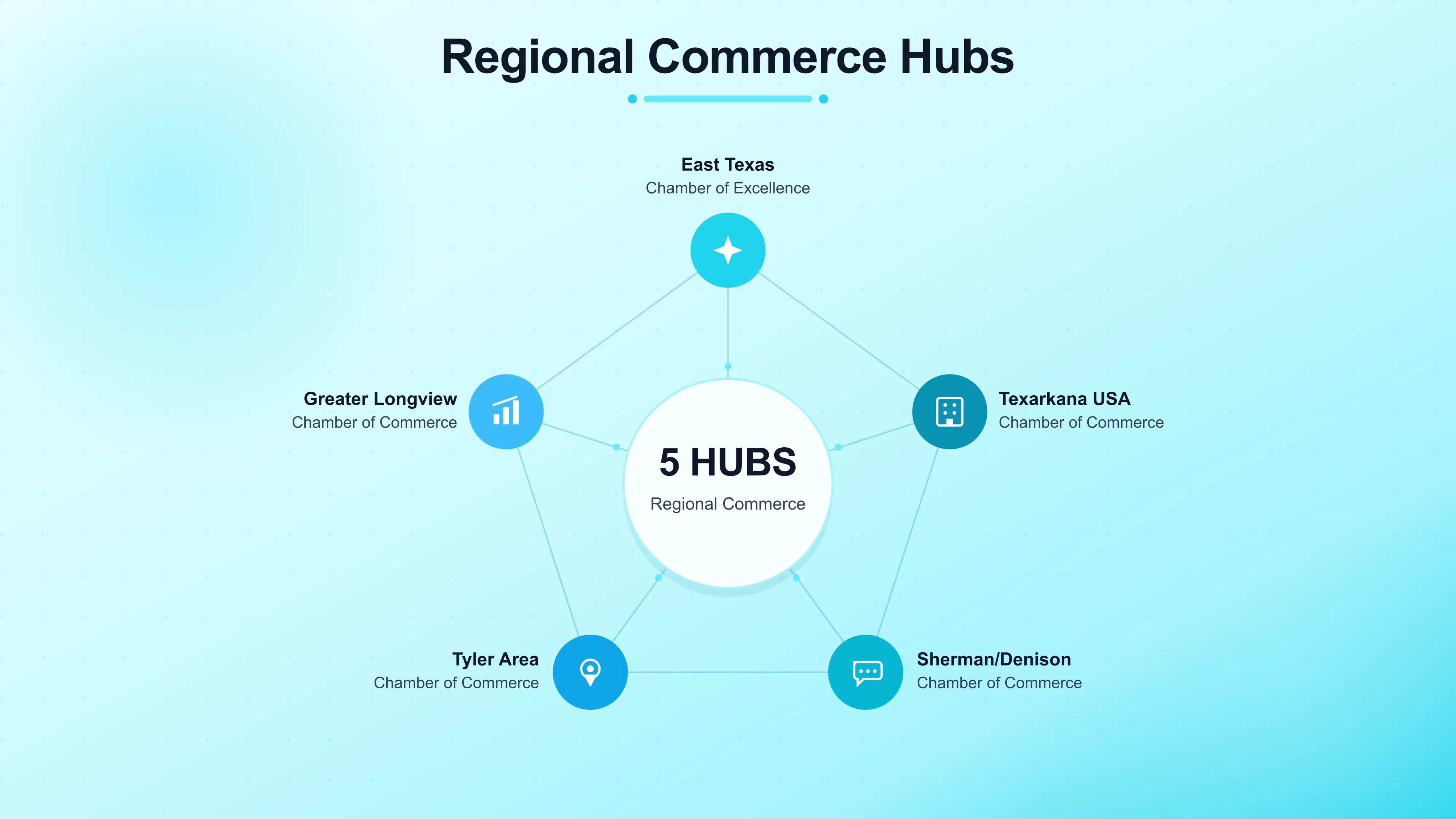
East Texas Chamber of Excellence — connects businesses across multiple counties, with advocacy, business development resources, and community events tied to regional decision-makers.
Greater Longview Chamber of Commerce — one of the region's most active hubs, offering business education programs, referral networks, and economic development initiatives that reflect Longview's industrial base.
Texarkana USA Chamber of Commerce — uniquely positioned for businesses operating across state lines, providing exposure to both Texas and Arkansas markets simultaneously.
Tyler Area Chamber of Commerce — represents Smith County's business community with networking, legislative advocacy, and economic development programs. As the region's commercial center, connections here carry outsized reach.
Sherman/Denison Chamber of Commerce — serves the northern corridor near the Red River, connecting Grayson County businesses across manufacturing, technology, and retail.
Membership gives 903 area code businesses more than a directory listing. It places them inside the trust networks local buyers rely on when making purchasing decisions — the same dynamic that makes a recognized local code so valuable in any market.
Official Resources for 903 Area Businesses
Operating under a 903 area code number means working within Texas's regulatory and economic frameworks. These official sources support compliance, registration, and business development:
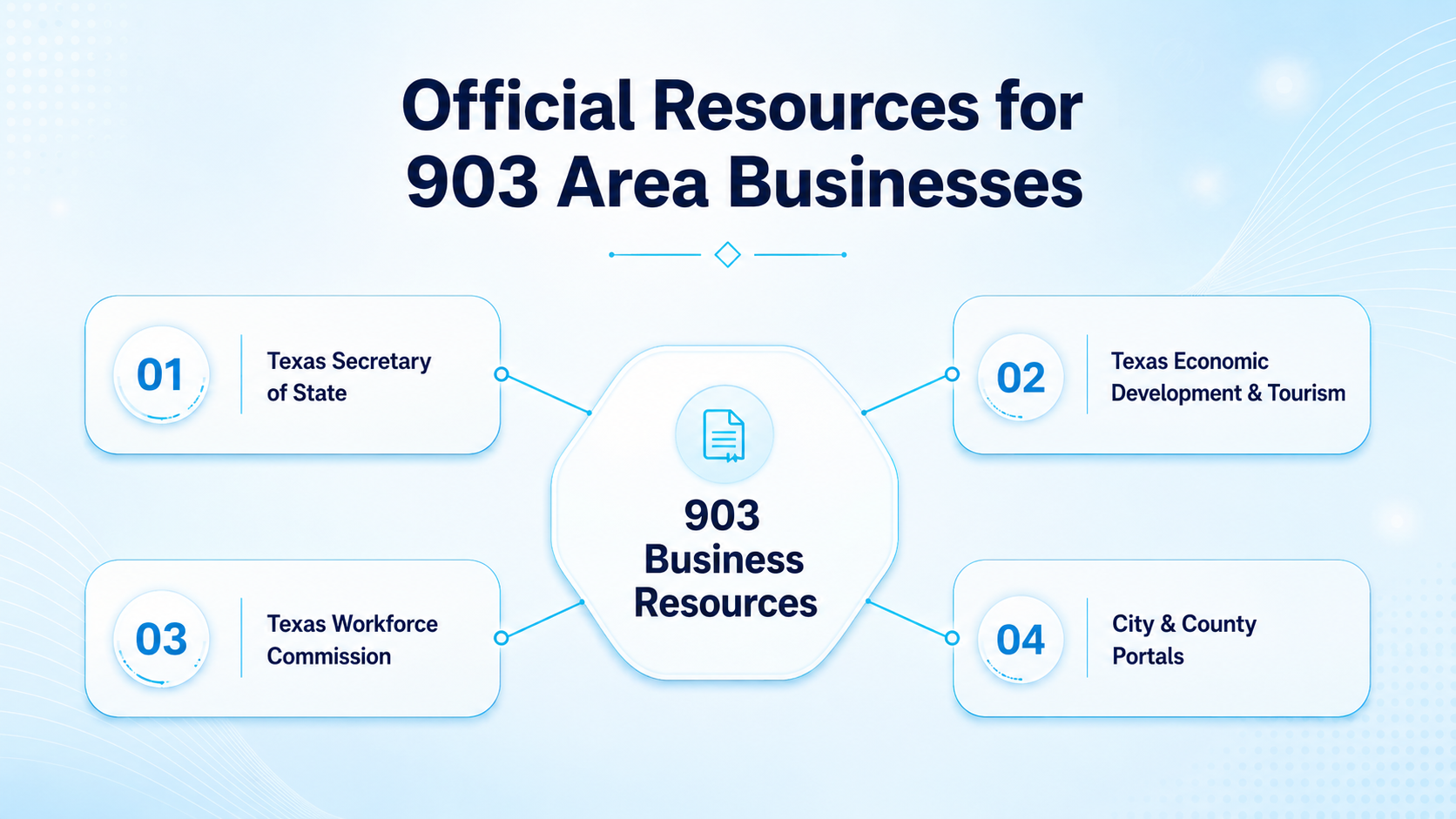
Texas Secretary of State — the primary resource for business entity registration, franchise tax information, and document filing. Businesses establishing a Texas presence under a 903 number typically start here.
Texas Economic Development and Tourism — the state's official channel for business incentives, site selection data, and industry cluster information. Northeast Texas industries like advanced manufacturing and healthcare regularly appear in the development pipeline.
Texas Workforce Commission — relevant for any business hiring locally. It administers unemployment insurance, provides labor market information, and manages workforce training programs tied to regional employers.
Individual city and county portals — cities like Tyler (tylertexas.com), Longview, and Texarkana maintain business portals covering local permits, zoning, and economic development contacts.
Staying connected to these channels isn't just about compliance — it keeps businesses informed of regional development projects, incentive programs, and workforce shifts that affect growth strategy.
Protect Your 903 Number: Easy Ways to Avoid Scam Calls
Phone scams targeting local area codes have grown significantly. Fraudsters use 903 numbers to appear like familiar local callers — a tactic called neighbor spoofing — because local numbers earn higher answer rates than out-of-state ones.
Common Phone Scams in the 903 Area Code Region
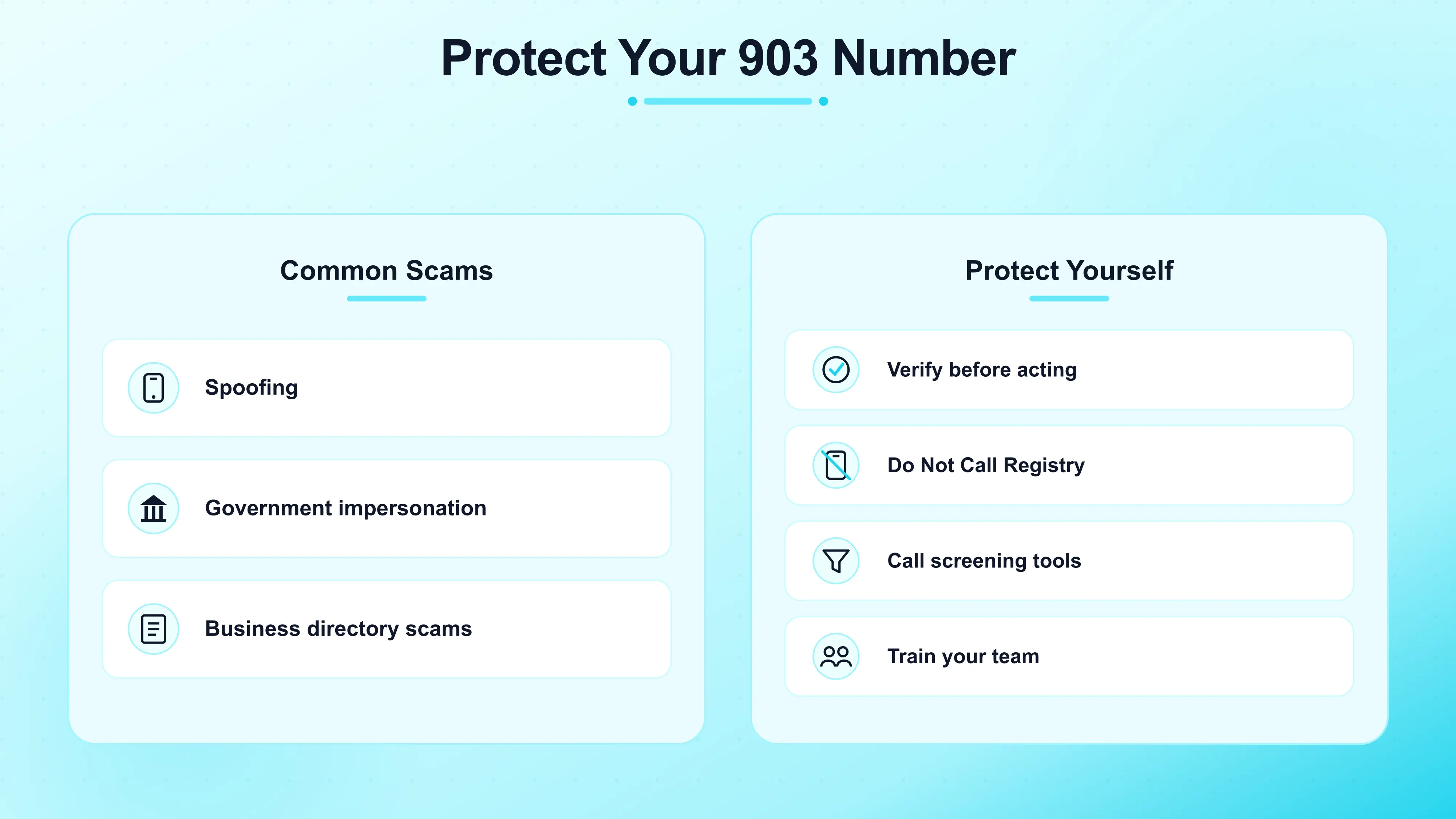
Spoofing: Scammers mask their real number behind a 903 prefix so calls appear local. Recipients see what looks like a neighbor, local business, or government office — and answer. Then the scam unfolds: fake IRS agents, utility shut-off threats, prize claim schemes.
Government impersonation: Fraudsters posing as the Social Security Administration, IRS, or local offices are common in rural Northeast Texas, using 903 numbers to reinforce the "local official" illusion.
Business directory scams: Callers claiming to "update" or "verify" a business listing, then charging fees for a listing that doesn't exist.
How to Protect Yourself
- Verify before acting: Hang up and call the organization directly using a number from their official website — not the number that called you.
- Register with the Do Not Call Registry: Free registration at the National Do Not Call Registry reduces unwanted solicitation calls.
- Use call screening tools: Most carriers offer spam call filtering. Enable it.
- Report suspicious calls: File complaints with the FTC at reportfraud.ftc.gov and the FCC at consumercomplaints.fcc.gov.
- Train your team: For businesses, staff should verify caller identities before sharing information or processing any requests.
Legitimate businesses aren't immune to reputation damage when scammers exploit the same prefix. A verified, professional presence signals to customers that your number is trustworthy.
Get a Local 903 Number for Your Business
A physical presence in Northeast Texas isn't required for a 903 area code number. Virtual phone number providers let you establish a local 903 presence from anywhere.
When evaluating providers, look for number availability across the coverage zone, call forwarding reliability, and the ability to connect with your existing tools — CRM platforms, call center software, or PBX systems. Businesses expanding elsewhere may also find a local Los Angeles virtual number useful alongside their 903 presence.
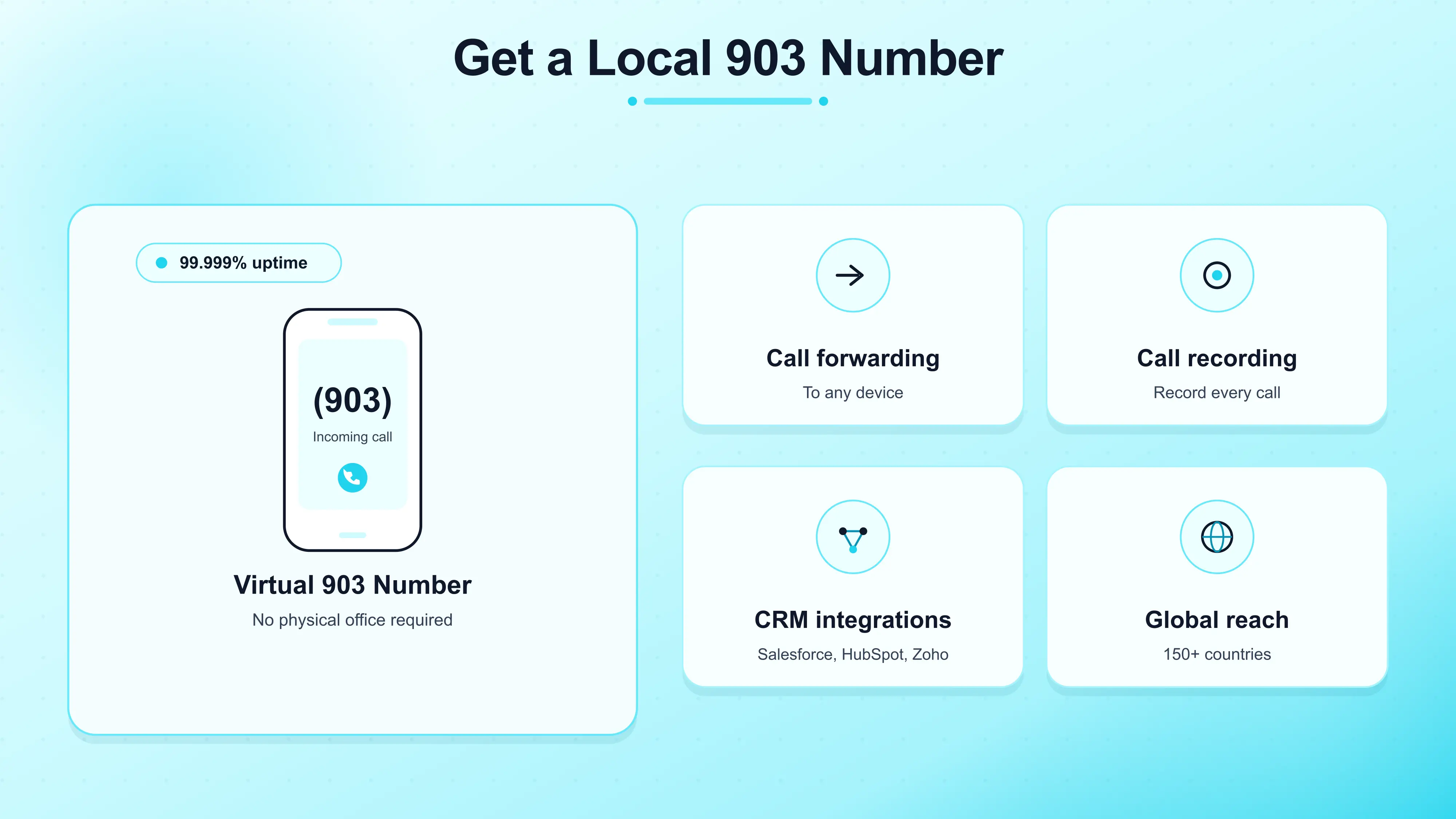
Rozper offers virtual 903 numbers as part of its service covering 150+ countries: call forwarding to any device, call recording, and CRM integrations with Salesforce, HubSpot, Zoho, and others — backed by 99.999% uptime and no physical Texas office required. Start at rozper.com.
Frequently Asked Questions About the 903 Area Code
Which cities does 903 serve? The 903 area code covers Northeast Texas, including Tyler, Longview, Texarkana, Sherman, Paris, Marshall, Nacogdoches, Lufkin, Greenville, and Palestine. It spans Smith, Gregg, Bowie, Grayson, Lamar, Harrison, Nacogdoches, Angelina, Hunt, and Anderson counties, among others.
When was the 903 area code created? The 903 area code was established in 1990 when Texas split area code 214 to accommodate growth in the Dallas metro, giving Northeast Texas its own distinct telecommunications identity separate from DFW.
Is there an overlay area code for 903? As of this writing, no overlay has been introduced for the region. All calls within the 903 zone use a standard 10-digit dialing format (area code + 7-digit number).
Can I get a 903 number without a physical Texas office? Yes. Virtual phone number providers like Rozper allow businesses to get a local 903 number and route calls to any device, anywhere. You establish a local Northeast Texas presence without needing a physical location.
Why do businesses use 903 numbers? Local numbers earn higher answer rates than out-of-state or toll-free numbers. For businesses targeting Northeast Texas customers, a local 903 number signals community presence and builds the familiarity that encourages people to pick up.
How do I report a scam call from a 903 number? Report suspicious calls to the FTC at reportfraud.ftc.gov and the FCC at consumercomplaints.fcc.gov. You can also contact your carrier directly to report spoofed numbers.
What is the largest city in the 903 region? Tyler is the largest city in the region. It serves as the commercial and healthcare hub of Northeast Texas, with a metro population exceeding 230,000.