Introduction
If a Boston number flashes on your screen, there is a good chance it starts with these three digits. The 857 area code is one of two prefixes that cover Massachusetts's largest city. It has quietly become a sign of a real, local presence in the region. This guide explains where it reaches. It covers how it came to be, why you dial ten digits, and how any business can claim a Boston line of its own.
Where the 857 Area Code Covers
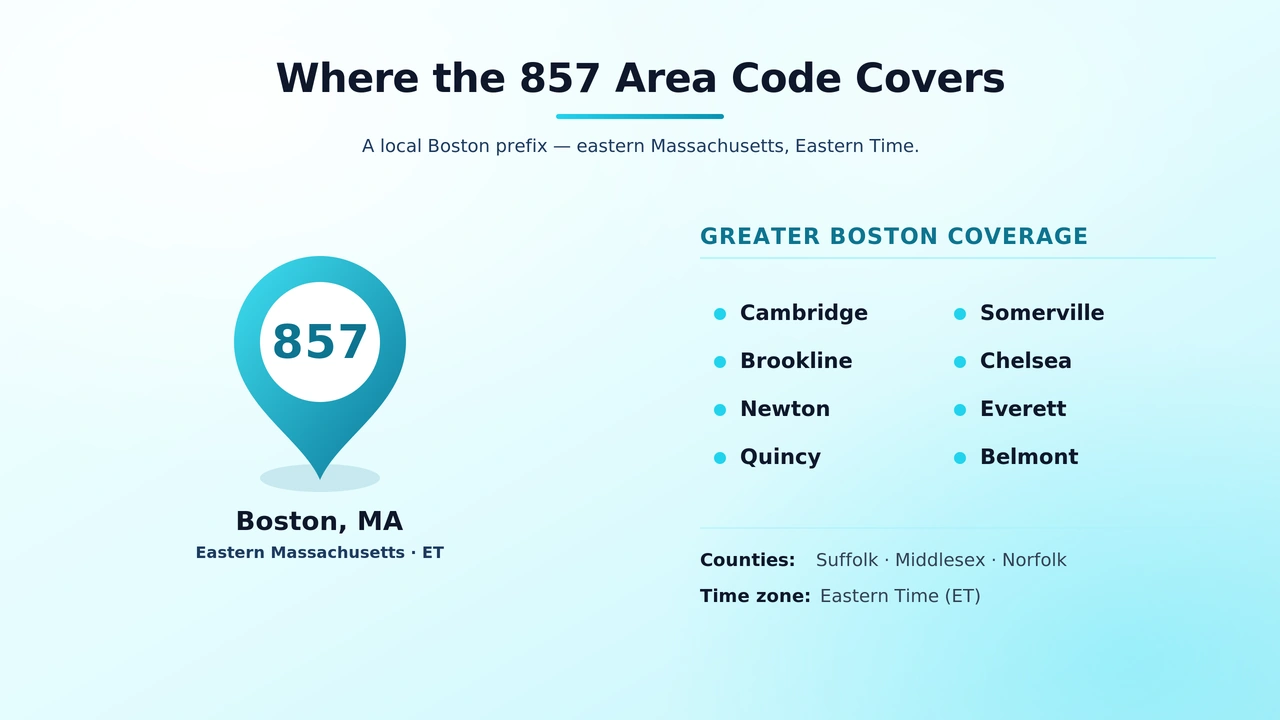
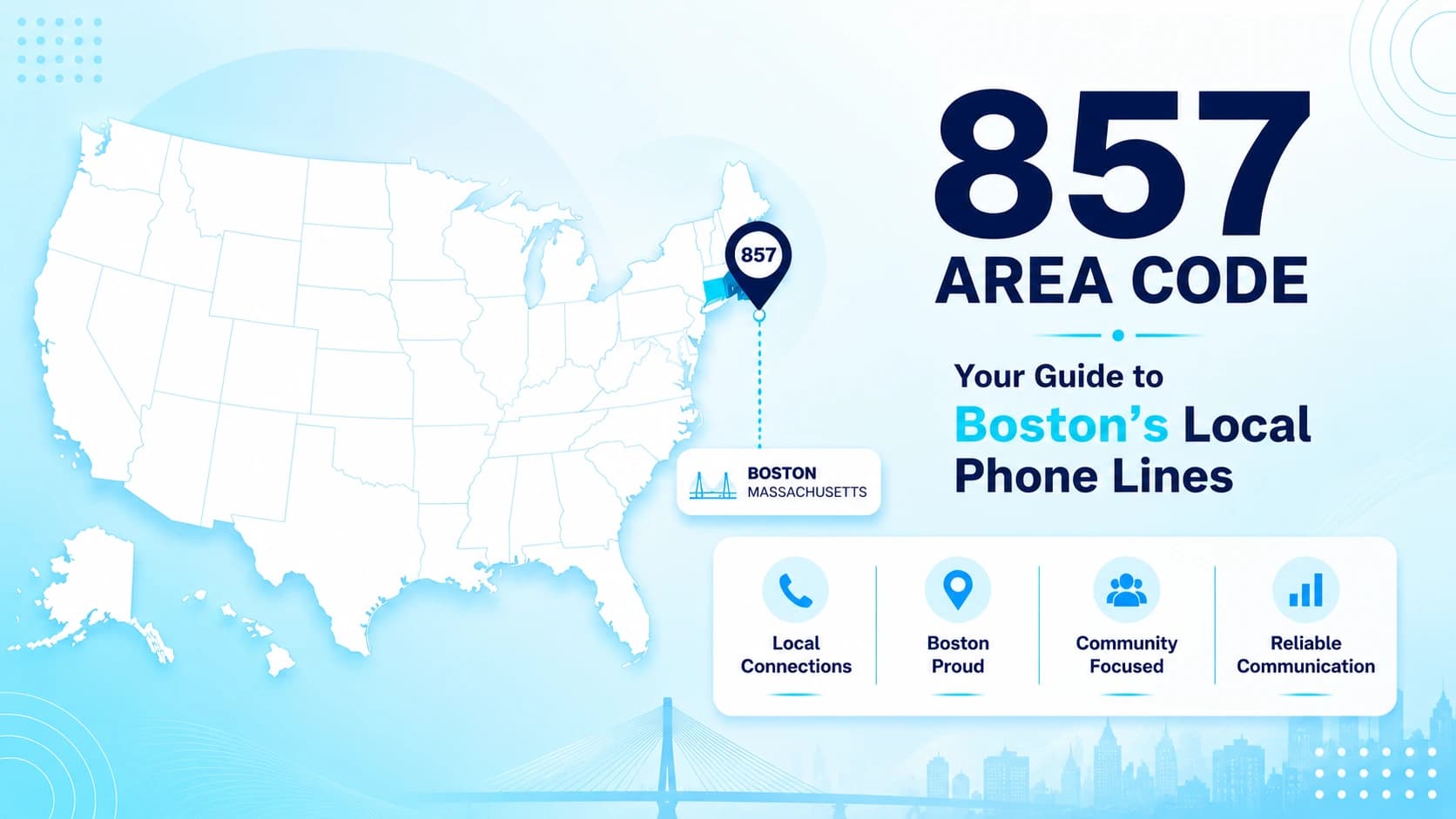
The 857 area code serves Boston and the dense ring of towns around it. That list includes Cambridge, Brookline, Newton, Quincy, Somerville, Chelsea, Everett, and Belmont. It spans parts of Suffolk, Middlesex, and Norfolk counties, and it sits in the Eastern Time zone. A toll-free prefix floats across the whole country. This one does not. It stays tied to this corner of eastern Massachusetts. That is exactly why a number with this prefix reads as truly local to anyone in greater Boston.
How 857 Overlays the 617 Area Code
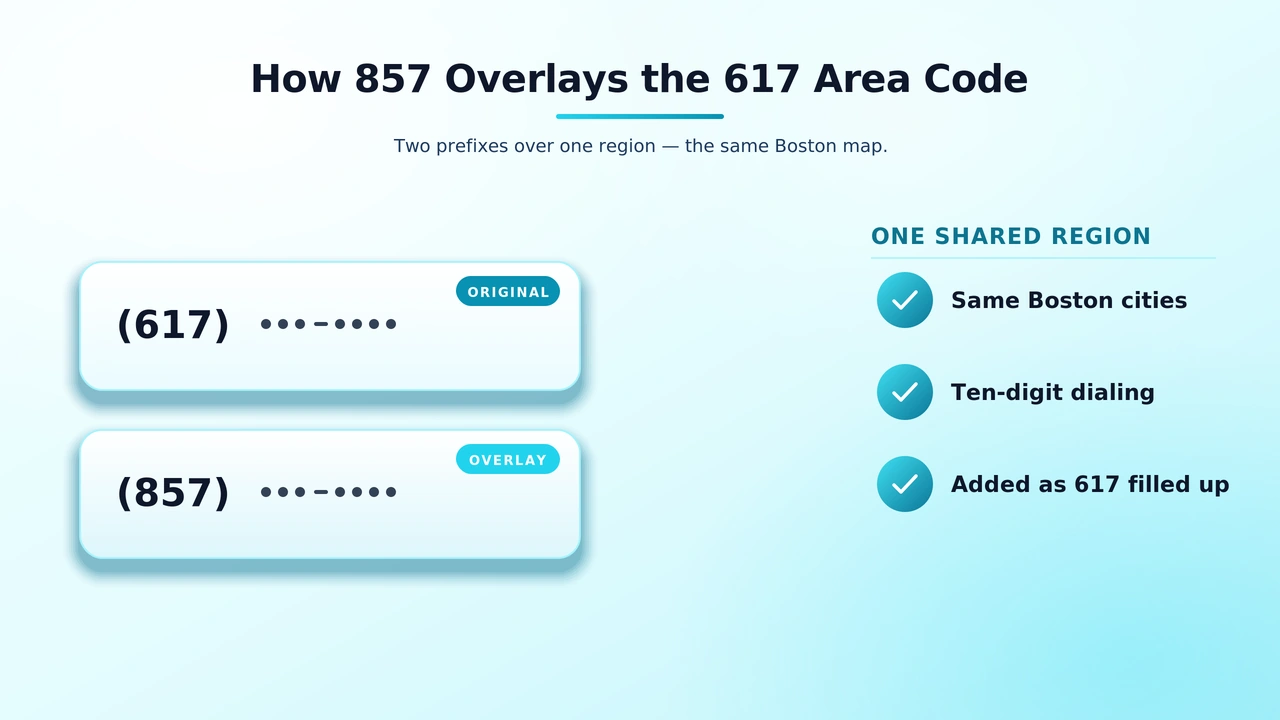
The 857 area code does not replace anything. It shares the same map as the older 617 code. Phone planners call this setup an overlay. Both codes cover the same cities. So two neighbors on the same street can hold numbers with different prefixes. If you want the companion view, our guide to the 617 area code walks through the original Boston prefix in detail. Why the overlay? Demand for new numbers in Boston grew faster than 617 alone could supply. This same pattern has played out in busy metro areas across the country.
Prefer a Nationwide Toll-Free Option?
A local Boston line is not the only path. Maybe your customers are spread across the country, not just Massachusetts. If so, a toll-free number may serve you better. Our toll-free vs. local numbers guide explains how those work. Here is a simple rule of thumb. Choose the 857 area code when you want to look local to Boston. Choose a toll-free prefix when you want to look national. Many growing businesses end up running both side by side.
A Quick History of the 857 Area Code
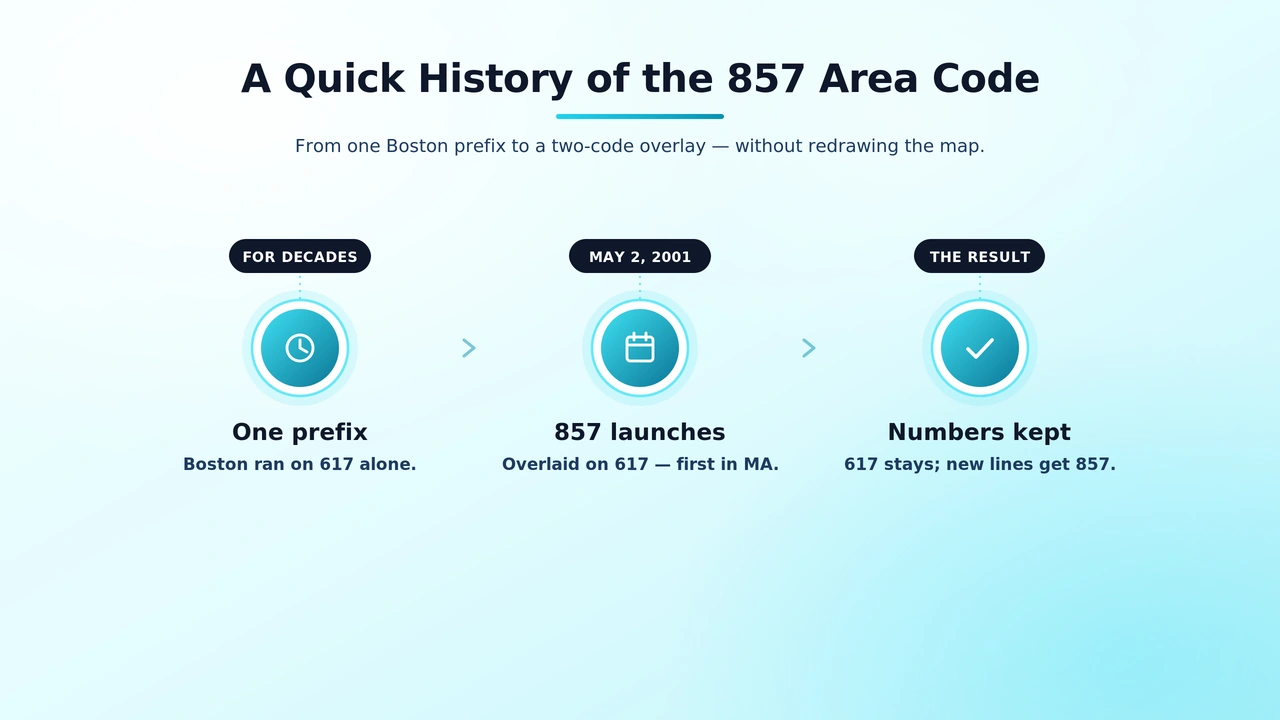
Boston ran on a single prefix for decades. Then the city's growing hunger for phone numbers forced a change. On May 2, 2001, the 857 prefix was laid on top of 617. This made it the first overlay in Massachusetts, and one of the early examples of the approach in New England. The FCC's consumer dialing guide explains how overlay codes like 857 get introduced, and why ten-digit dialing then becomes mandatory. The takeaway is simple. The 857 code was created to add capacity without redrawing the map. Longtime 617 holders kept their numbers. New lines simply drew from the fresh prefix.
Why Ten-Digit Dialing Is the Norm
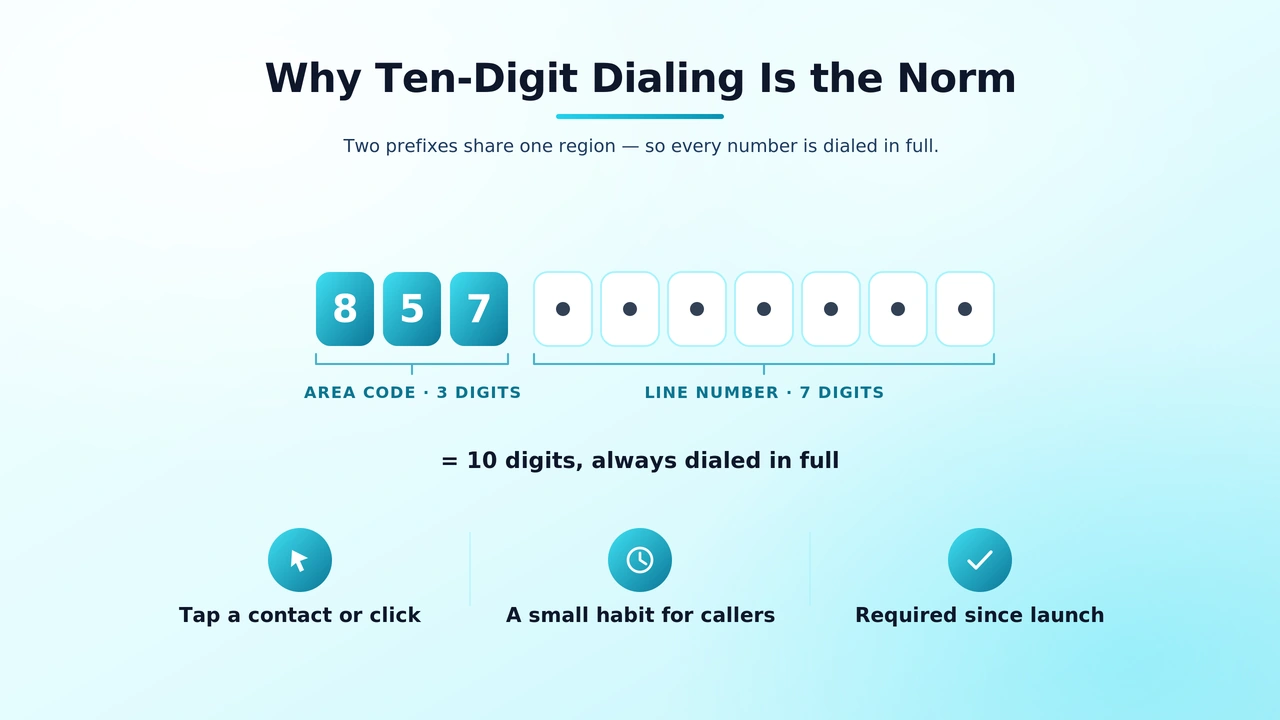
Two prefixes share one region. So you cannot assume a local call lives on 617 or 857. That is why ten-digit dialing has been required across the overlay since it launched. That means you dial the full area code plus the seven-digit number. For callers it is a small habit. For businesses it barely matters, since customers almost always tap a saved contact or click a number on a website instead of typing it by hand. The practical effect is simple. Every number in the region gets dialed in full, no matter which prefix it uses.
Getting a Local 857 Number for Your Business
You do not need a Boston office to hold a Boston number. Providers can assign you a line on the 857 prefix. They route it to whatever phones or apps your team already uses, with no hardware to install. You search available numbers, pick one, and point it wherever you like. That could be a mobile, a desk phone, a call center, or a cloud app. This is where a provider like Rozper fits in. With 99.999% uptime and coverage across more than 150 countries, it can set up a local Boston line that routes anywhere. It keeps calls, texts, and analytics together in one dashboard. A remote team can answer a Boston number from three time zones away, and the caller never knows the difference.
Is Every 857 Call Local and Legitimate?
A familiar prefix builds instant comfort. Still, it pays to stay alert. Numbers on the 857 area code can be obtained from anywhere. So the occasional robocall or spoofed caller-ID may wear a Boston disguise to seem trustworthy. The prefix itself is not a warning sign. Countless local shops, clinics, and offices rely on it every day. But treat any unsolicited call asking for personal or payment details with the same caution you would give any number. For your own line, working with a reputable provider and registering it correctly keeps it in good standing.
What a Boston Number Signals
A phone number is a small detail, but customers read it quickly. To someone in greater Boston, a local prefix suggests a business is nearby, established, and easy to reach. An out-of-state number can quietly raise doubt before a word is spoken. That impression matters most for trades, clinics, real-estate offices, and service firms. Their customers expect a neighbor, not a distant call center. Even online brands that ship nationwide often keep a local Boston line, so regional buyers feel they are dealing with someone close. The number itself does not change your service. But it shapes the first second of trust, and that second often decides whether the call connects at all. It is a quiet edge that costs almost nothing to claim.
Setting Up or Porting a Number
Claiming a Boston line is faster than most owners expect. You browse a provider's inventory, choose an available number, and point it at the devices your team already uses. There is no equipment to buy and no install visit to schedule. Already hold a local number you like? You can usually port it to a new provider without losing it. You just supply account details and authorization, and the switch typically finishes with little or no downtime. From there you can add call routing, voicemail-to-email, business-hour scheduling, and recording. That way, even a one-person operation can answer like a full front office. The setup scales as you grow, from a single line to many, without rebuilding anything.
The Bigger Picture for Boston Numbers
Overlays like this one are now the standard way the phone system keeps up with demand, and Boston was an early adopter. Regulators could split a region in two and force half the city to change numbers. Instead, they simply add a second prefix that shares the same ground. For residents and businesses, the day-to-day effect is small. You dial ten digits, you keep the number you have, and the city gains room to grow. Understanding that backdrop makes the 857 area code feel less like a mystery on your caller ID. It becomes just a natural part of how a busy metro area stays connected.
Conclusion
In the end, the 857 area code is more than a string of digits. It is a quiet signal that a business belongs to Boston. Maybe you live in Cambridge. Maybe you run a shop in Quincy. Or maybe you operate a remote team that simply wants to feel close to the city. Either way, a local prefix lowers the barrier for nearby customers to call. Pair it with reliable routing and modern call tools. Then a single phone number becomes a steady, recognizable front door to everything your business does in greater Boston.
FAQs
Where is the 857 area code located?
The 857 area code covers Boston, Massachusetts, and nearby communities such as Cambridge, Brookline, Newton, Quincy, and Somerville, spanning parts of Suffolk, Middlesex, and Norfolk counties in the Eastern Time zone.
Is area code 857 the same as 617?
Effectively, yes — they overlay the same region. Area code 857 was added on top of 617 so the Boston area would have enough numbers, and both prefixes serve identical cities and towns.
Do I have to dial ten digits for an 857 number?
Yes. Because area code 857 shares its territory with 617, ten-digit dialing — the area code plus the seven-digit number — has been required across the region since the overlay began.
Can I get an 857 number if I am not in Boston?
You can. Providers assign numbers on the area code 857 and route them to any device, so a business anywhere can hold a local Boston line without a physical office in the city.
Is the 857 area code a scam code?
No. The 857 area code is a legitimate Boston prefix used by thousands of real businesses. As with any number, stay cautious with unsolicited calls asking for sensitive details, but the prefix itself is not a red flag.
Can I text from an 857 number?
Yes. A modern 857 line supports SMS as well as voice, so businesses can answer calls and texts from the same Boston number — handy for appointment reminders, quick confirmations, and customers who would rather message than call.