Introduction
Two neighbors on the same Arlington street can answer the phone with completely different area codes, and neither one has moved, upgraded, or changed carriers to make it happen. That quirk is the everyday reality of the 571 area code, a prefix layered directly on top of Northern Virginia's original numbering territory rather than carved out as its own separate region. This guide explains exactly how that overlay works, which cities and counties share it, why a matching local number still carries weight for businesses in one of the country's most competitive metro markets, and how you can claim one no matter where you're actually based. By the end, you'll understand this prefix far better than the average commuter dialing it every day.
Key Takeaways:
- The 571 area code is a Northern Virginia overlay that shares identical territory with 703.
- It was introduced in 2000 to relieve numbering pressure without forcing a geographic split.
- Every local call in the region requires the full ten-digit number, including the area code.
- Businesses can request a matching number through a cloud phone system without opening a local office.
Understanding the 571 Area Code
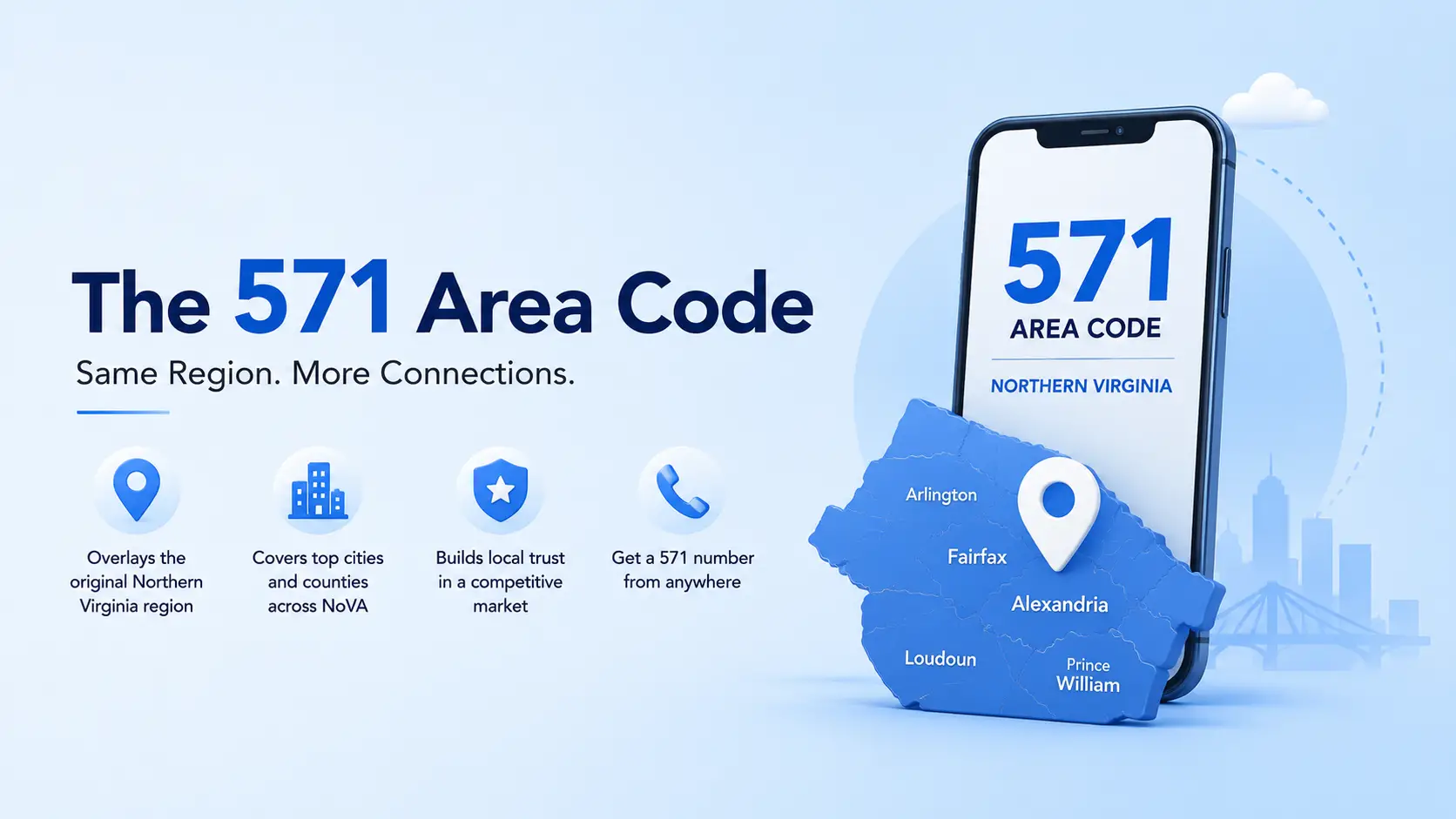
The 571 area code is an overlay code introduced in 2000 to serve the same Northern Virginia territory already covered by the long-standing 703 prefix. Unlike a geographic split, where a region is divided into two separate zones, an overlay stacks a brand-new code directly on top of existing territory, so both prefixes now serve identical cities, streets, and even individual buildings side by side. Regulators chose this approach because Northern Virginia's population and business growth had pushed the original numbering pool toward exhaustion faster than a clean split could reasonably manage.
Because it shares ground with 703 rather than replacing any part of it, this overlay prefix requires ten-digit dialing for every local call in the region, a detail that still catches long-time residents off guard decades after the overlay began. Two people living blocks apart may hold numbers under entirely different codes, yet both are unmistakably calling from the same corner of Northern Virginia under area code 571.
Connecting Northern Virginia to Opportunity
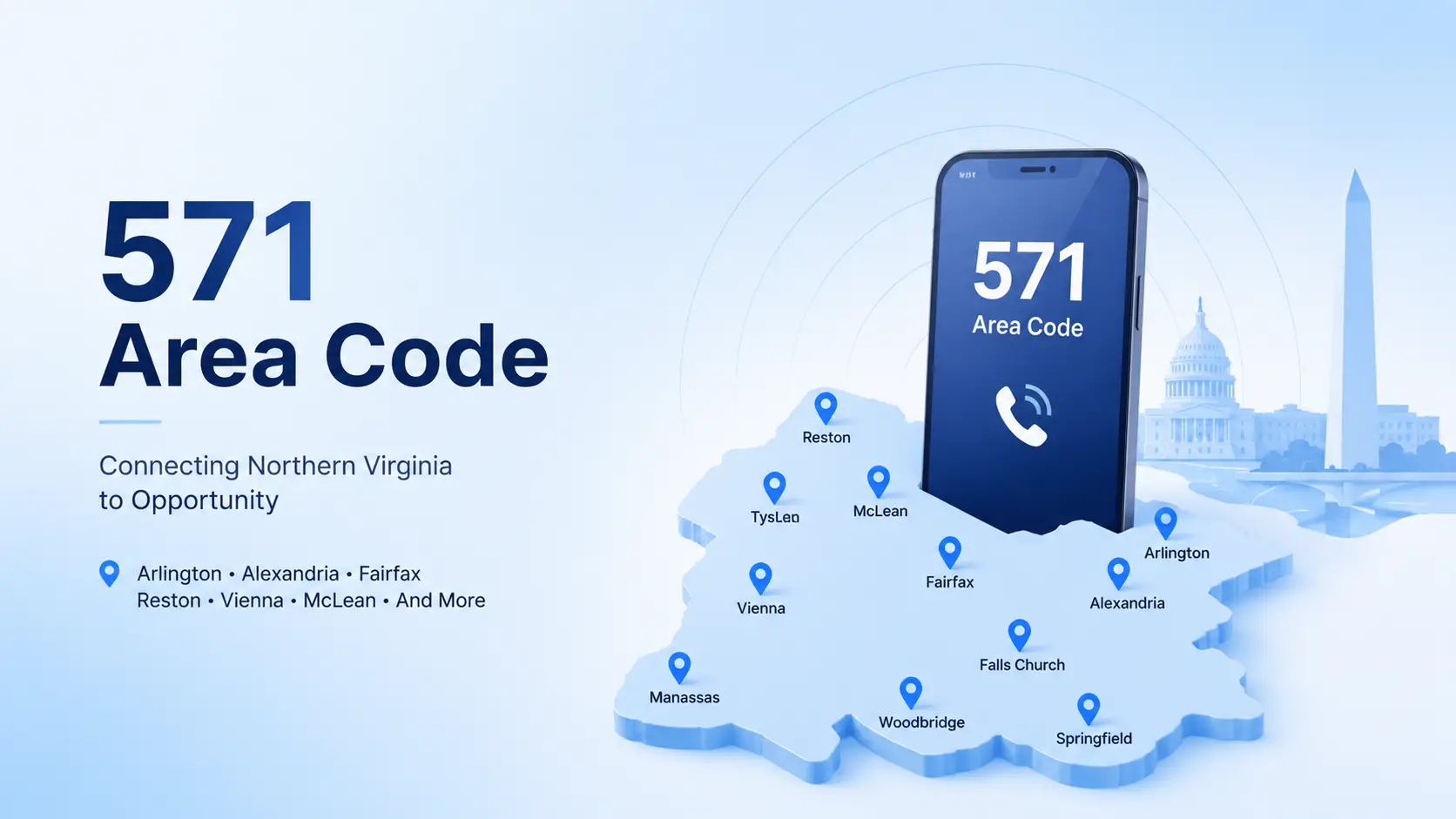
The 571 area code reaches across one of the most densely populated and economically active corners of the state. Communities served by this prefix include Arlington, Alexandria, Fairfax, Reston, McLean, Tysons, Herndon, Vienna, Manassas, Woodbridge, Springfield, and Falls Church, among many others inside the Capital Beltway and its surrounding suburbs. This is the heart of Northern Virginia's federal contracting, technology, and professional services economy.
Because this territory sits just across the Potomac from Washington, D.C., a number carrying this prefix signals proximity to the nation's capital and its dense concentration of government agencies, consulting firms, and tech employers. For a business courting clients or talent in this market, holding a 571 area code number can reinforce exactly the kind of regional presence that carries weight in federal and corporate contracting circles alike.
Why Northern Virginia Got an Overlay Instead of a Split
Not every area experiencing numbering pressure gets the same fix. Regulators generally choose an overlay when splitting a region geographically would be too disruptive to established businesses, government offices, and residents who've built years of recognition around their existing numbers. Northern Virginia's density of federal contractors, agencies, and long-established firms made a clean geographic split especially impractical, since it would have forced thousands of organizations to renumber overnight.
Instead, this overlay code let new lines and additional numbers draw from a second numbering pool without displacing a single existing 703 customer. That decision came at the cost of universal ten-digit dialing across the region, but it preserved every legacy number exactly as it was, a tradeoff regulators judged worthwhile given how much institutional continuity was riding on the original prefix.
Local Presence. Stronger Connections.
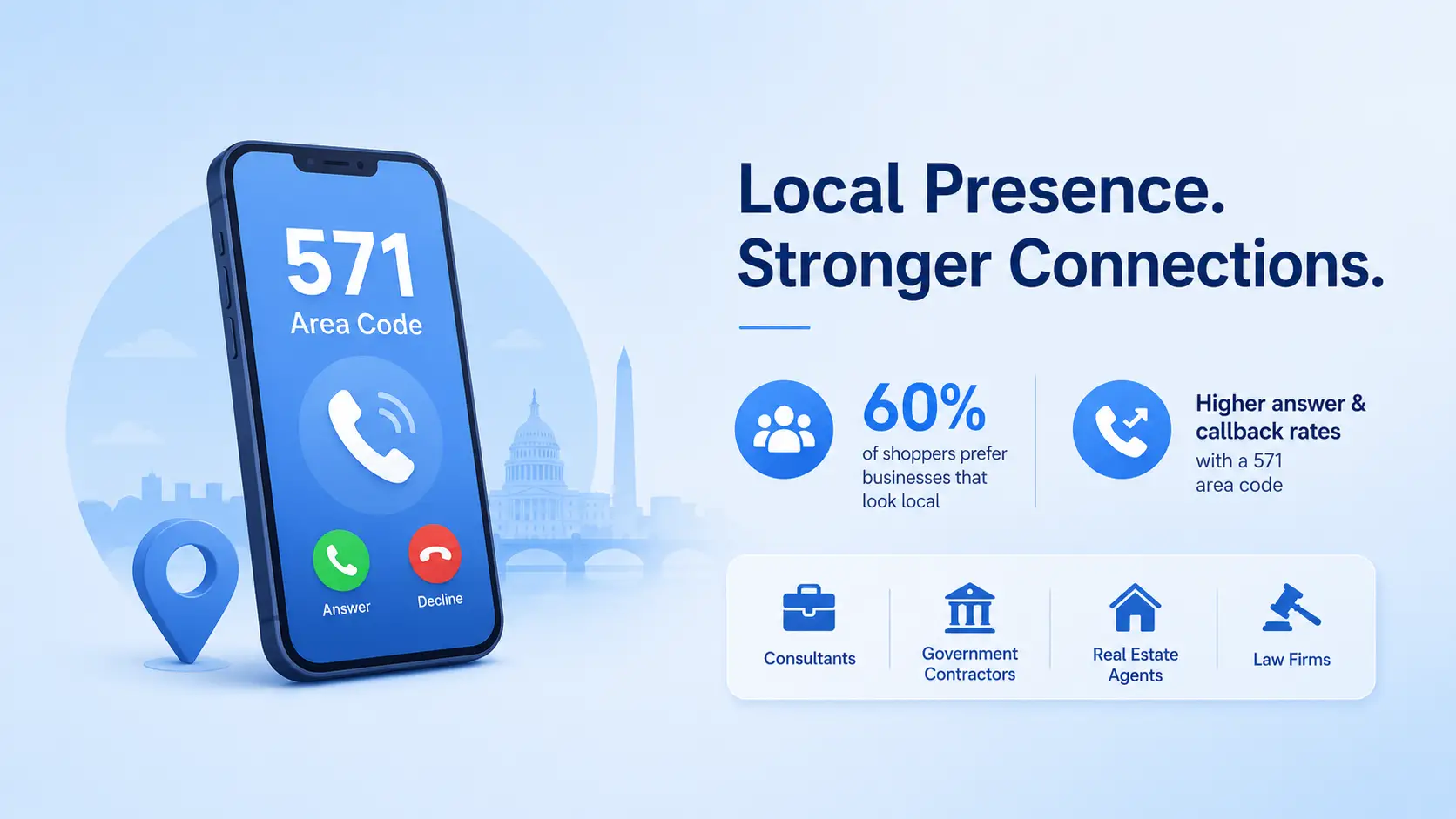
Local phone numbers still shape whether people decide to answer at all. Surveys consistently show that most consumers are more likely to pick up a call sharing their own regional prefix, and roughly 60% of shoppers say they prefer working with a business that looks local. For any company selling into the Washington, D.C. metro from the Virginia side, holding a 571 area code number can meaningfully improve answer and callback rates compared with an out-of-state or toll-free line.
That advantage cuts both ways. Sales teams dialing prospects from a 571 area code number tend to see stronger pickup rates than teams calling from an unfamiliar prefix, since recipients are less likely to assume the call is a distant robocall. For consultants, government contractors, real estate agents, and law firms working this market, a matching number quietly reinforces that the business understands the region's federal and corporate rhythms, not just its geography.
Get a 571 Area Code Number—Anywhere.
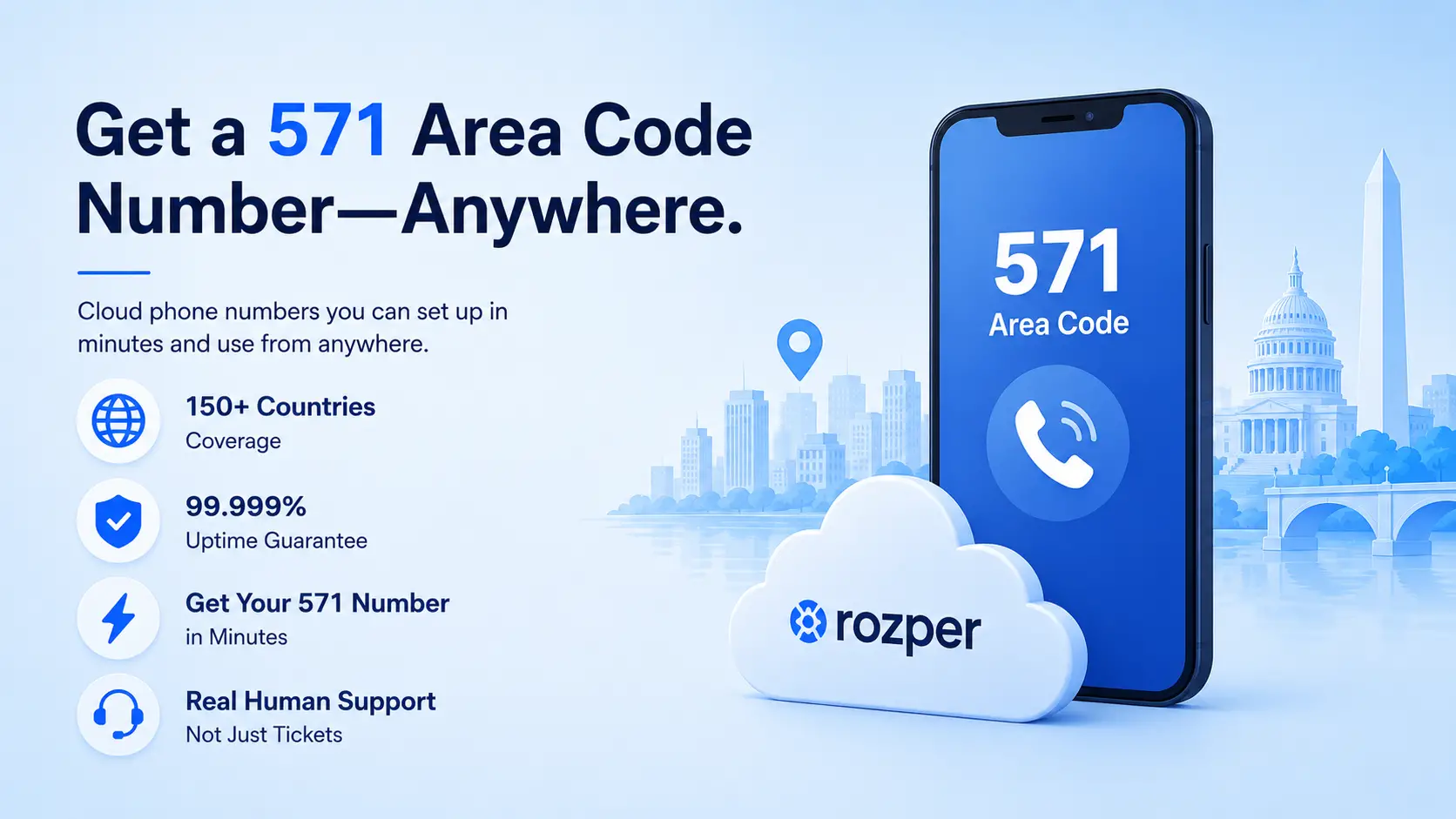
You don't need a lease in Tysons or an office in Arlington to hold a number tied to this territory. Modern cloud phone systems let a business or individual request a number tied to almost any area code in the country, then route incoming calls to a mobile phone, desktop app, or existing office line. That flexibility suits companies expanding into the Northern Virginia and D.C. metro without a physical branch there, and remote teams that want one consistent local identity across every customer touchpoint.
Rozper is one option worth considering for exactly this situation. Alongside coverage across 150+ countries and a 99.999% uptime guarantee, it lets teams provision a 571 area code number in minutes and manage it beside their other business lines, with real human support behind the setup instead of an automated ticket queue. If your footprint also reaches further into the Commonwealth, it's worth seeing how a 540 area code number compares for a very different kind of Virginia numbering situation, a geographic split rather than an overlay.
571 Compared With Other Virginia Codes
Virginia's numbering map mixes both overlays and splits, and the 571 area code stands out as one of the few in the state built on the overlay model rather than a clean geographic division. That distinction matters practically: businesses here must always dial ten digits locally, unlike regions served by a single non-overlapping code where seven-digit dialing sometimes persisted longer.
If you're comparing numbering situations elsewhere in the Commonwealth, our guide to the 434 area code explains how Central Virginia's 1995 split created a self-contained territory around Charlottesville and Lynchburg, a useful contrast to the overlay covering area code 571. The rules governing how U.S. area codes are assigned, split, or overlaid are documented publicly by the North American Numbering Plan Administrator, and additional detail is available through the Federal Communications Commission.
Same Region. Same Standing.
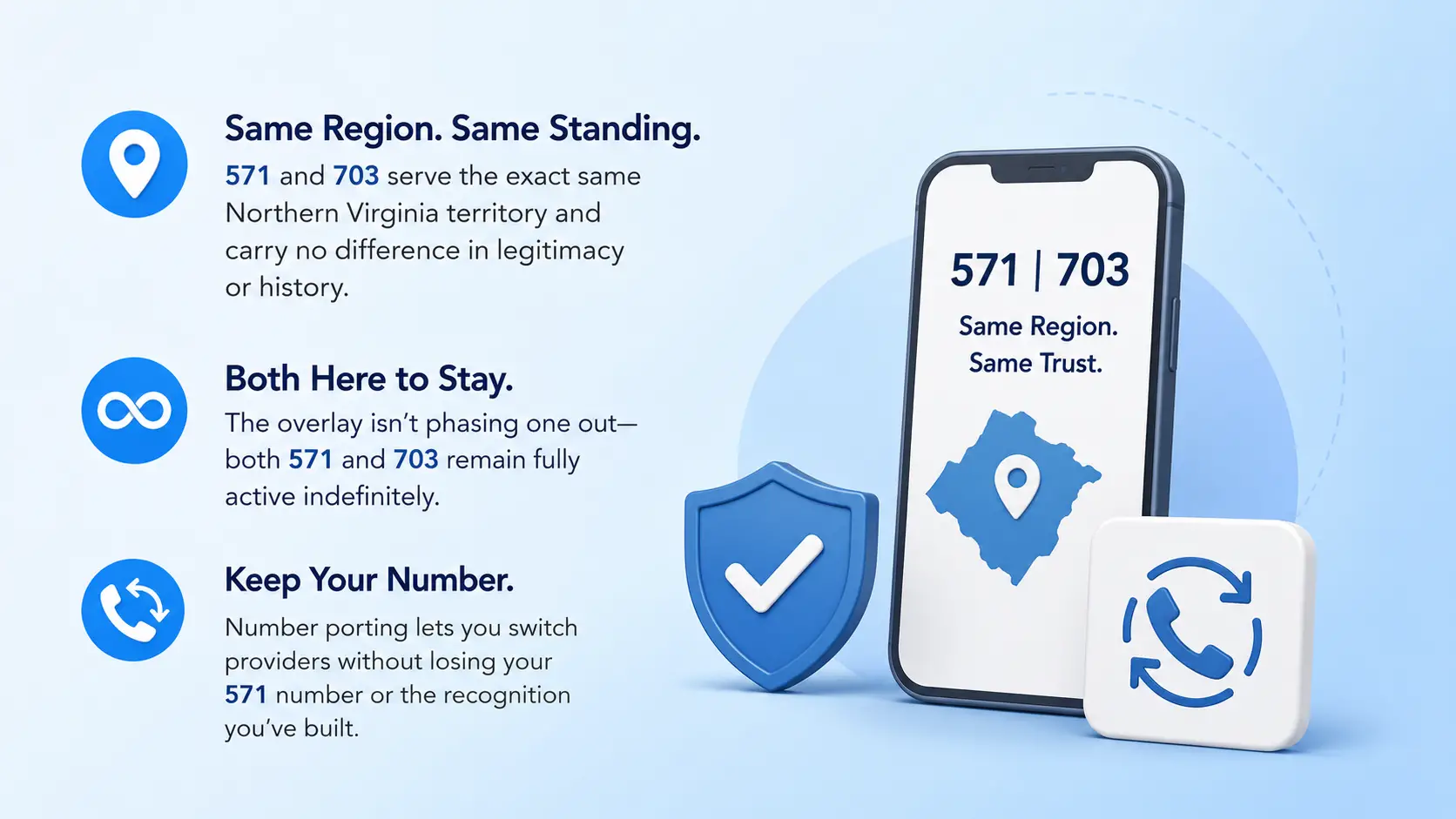
Some callers assume a number under area code 571 must belong to a newer, less established business than one under 703, when in reality both prefixes serve the exact same territory and carry no difference in legitimacy or history. Others assume the overlay means one code is somehow being phased out — it isn't; both remain fully active indefinitely, with new numbers simply drawing from whichever pool still has capacity.
Porting confusion comes up often here too. Many business owners assume switching providers means giving up a 571 area code number their clients already recognize, but most modern carriers support number porting, which lets a company keep its existing digits while moving service to a new platform entirely. This matters in a region like Northern Virginia, where long-tenured government contractors and firms have built years of recognition around one number and don't want a provider switch to disrupt that continuity.
Conclusion
Few overlay codes carry as much practical weight as this one, sitting directly across the river from the federal government and threaded through some of the busiest corporate corridors in the country. Whether you're tracing an unfamiliar call from Northern Virginia or deciding whether your business should claim a matching local number, understanding how the 571 area code shares its territory with 703 puts you ahead of most callers who never think about the overlay at all. As the region keeps growing its federal, tech, and consulting economy, expect this prefix to remain woven into daily business communication for years to come.
FAQs
Which cities does area code 571 cover?
It covers Northern Virginia, including Arlington, Alexandria, Fairfax, Reston, McLean, and Tysons, sharing the same territory as 703.
Is 571 newer or less established than 703?
No, both codes serve identical territory as an overlay, and neither one signals a newer or less credible business.
Why do I need to dial ten digits locally?
Because this is an overlay region, every local call requires the full ten-digit number, including the area code, even between neighbors.
Can I get a number here if I don't live in Virginia?
Yes, cloud phone providers let you request and route a number tied to this region no matter where you physically live or work.
Can a number in this prefix send text messages?
Yes, most modern numbers here support both voice and SMS, which works well for reminders and client follow-ups.