Introduction
Every phone number tells a story. It tells you where a business works. Have you gotten a call from central Ohio? Do you want a local presence there? Then the 380 area code is likely already on your radar. It was set up as an overlay to the old 614 prefix. Both codes serve the same area. They cover Franklin County and nearby towns. Together, they make Columbus one of the most clear metro markets in the Midwest. This guide covers it all. You'll learn the cities it serves, how it came to be, why firms use local 380 numbers, and how your firm can get one fast.
Cities the 380 Area Code Covers
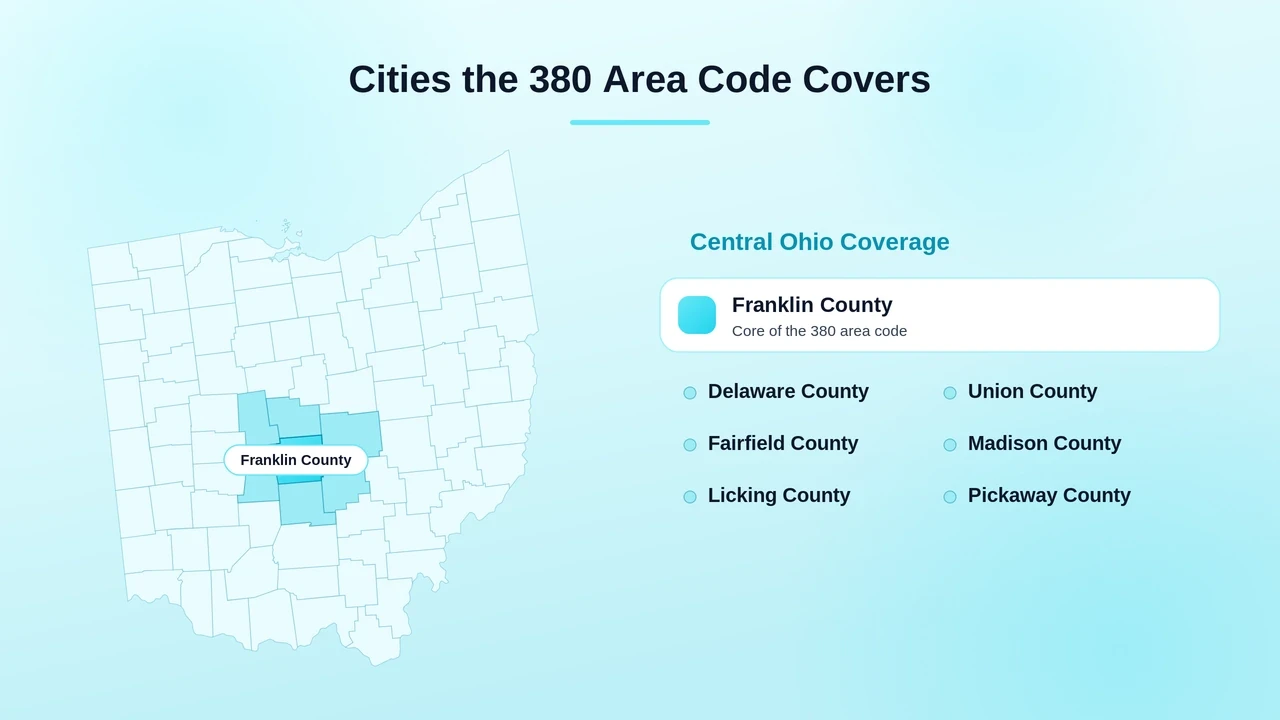
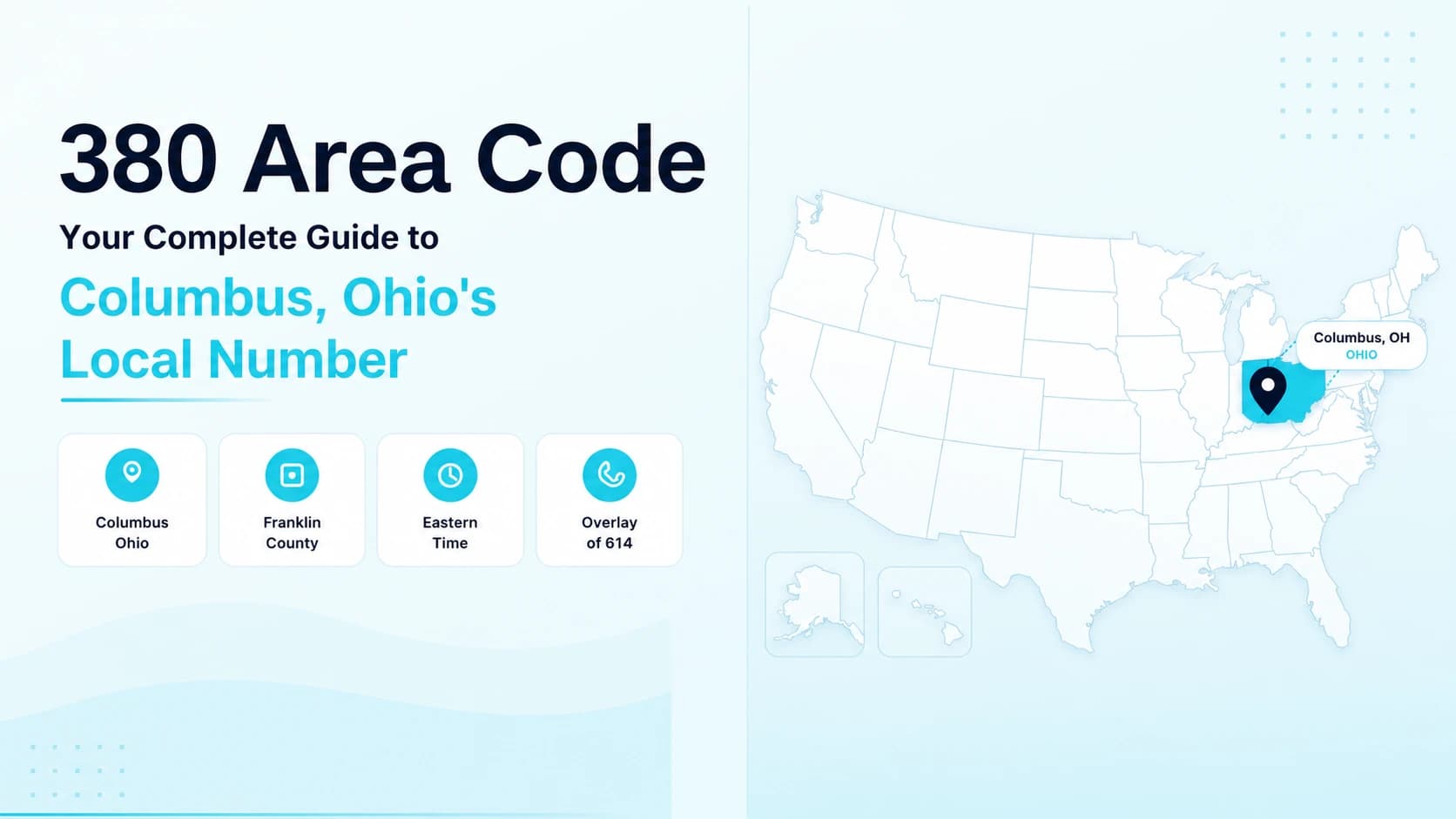
The 380 area code serves central Ohio as an overlay to the original 614 prefix. Both codes cover the same area. There is no service or location difference between them. The only difference is the three-digit prefix. Because of the overlay, every local call needs 10-digit dialing.
The service area covers Franklin County and parts of a few nearby counties. These are Delaware, Fairfield, Licking, Madison, Pickaway, and Union. All numbers here use Eastern Time (ET). That means EST (UTC-5) in winter. It means EDT (UTC-4) from spring through fall. So a 9:00 a.m. meeting in Columbus is 6:00 a.m. in Pacific time. It's 2:00 p.m. in London.
Major cities and communities served include:
- Columbus — Ohio's capital and largest city. A hub for finance, health care, and tech
- Dublin — a growing tech and business hub northwest of Columbus
- Westerville — home to Otterbein University and many corporate campuses
- Gahanna — a suburb east of Columbus
- Grove City — a business hub south of the city
- Reynoldsburg — a retail and residential suburb to the east
- Upper Arlington — an upscale area next to Ohio State University
- Hilliard — a fast-growing suburb to the northwest
- Worthington — an old town with deep business roots
- Bexley — a small city known for walkable streets, close to downtown Columbus
Over 2 million people live in the Columbus metro area. Major employers include JPMorgan Chase, Nationwide Insurance, Amazon, Cardinal Health, and Honda. These organizations drive steady demand for reliable local phone service. Many businesses that serve multiple Midwest markets pair a 380 Columbus number with a 313 area code for Detroit coverage. That builds a connected Great Lakes presence.
How the 380 Area Code Came to Be
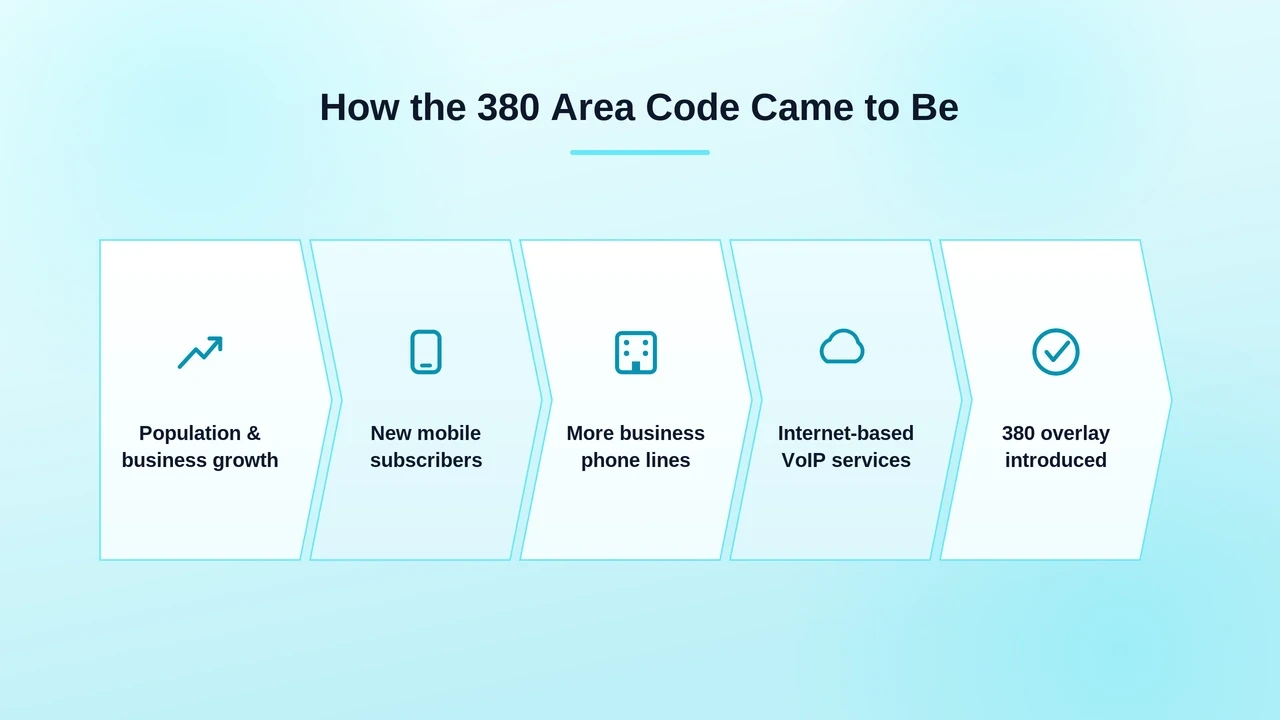
Central Ohio grew fast in the early 2000s. Its people and its businesses both grew fast. This growth put heavy strain on the 614 number supply. New cell phone users, new business lines, and new VoIP services all added demand. Together, they used up open numbers faster than planners had guessed.
In 2001, the Public Utilities Commission of Ohio (PUCO) approved area code 380. It was set up as an overlay to fix the shortage. The code went live on February 27, 2016. It added a fresh set of numbers. No one had to change an existing number. Old 614 users kept the numbers they already had. New phone lines simply drew from the 380 pool instead. From that day on, 10-digit dialing became a must for both codes.
An overlay works differently than a split. In a split, two codes divide a region into two halves. An overlay does not split anything. It kept the whole Columbus area connected as one. Homes and businesses with 614 numbers saw no change at all. The one real change for callers was the switch to 10-digit dialing. That applied to every local call. Even a call between neighbors on the same street needed all 10 digits.
This overlay model is now the top choice in cities that grow fast. In those cities, a split would force too many people to change numbers they've had for years.
Why Businesses Choose a 380 Area Code Number
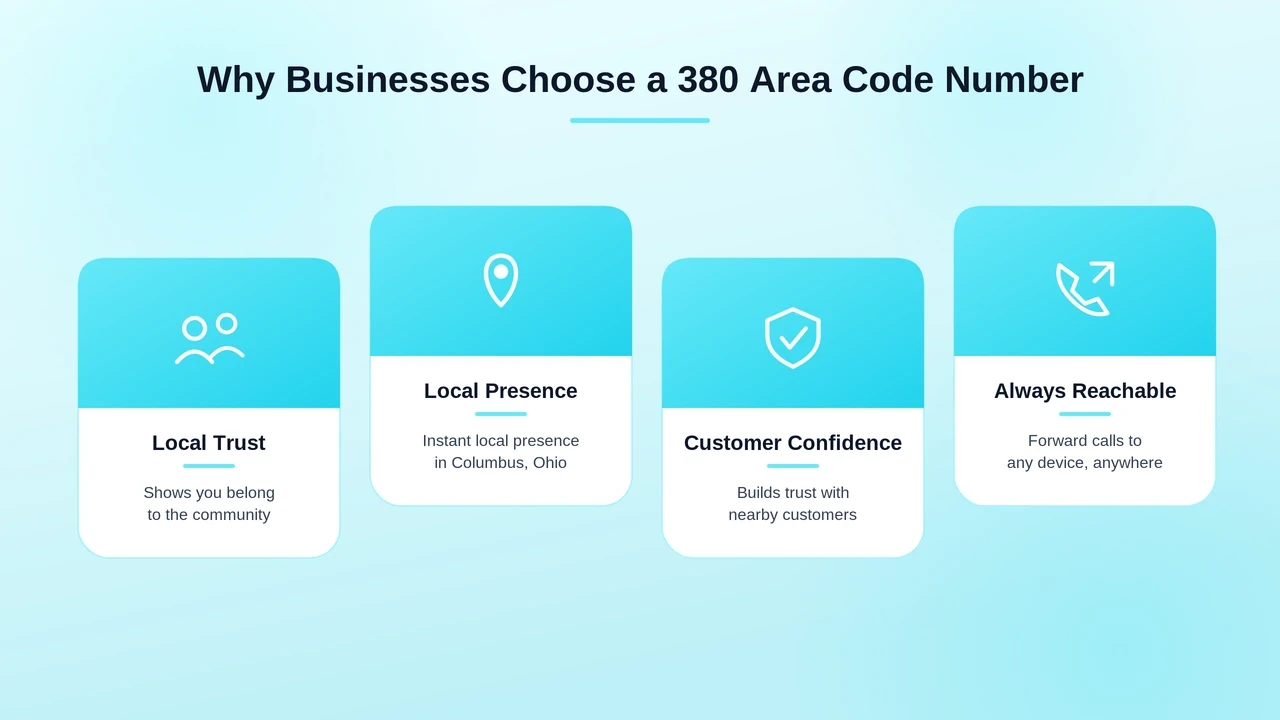
A local phone number tells customers your business is part of their town. Studies show people are more likely to pick up and talk when a call comes from a local prefix. They answer these calls more than toll-free or out-of-state numbers. This is true across many fields, from health care to banking to retail.
For firms that target Columbus and its suburbs, a 380 area code number gives quick trust. This shows up on every outbound call. It also shows up in all your marketing, from Google Business profiles to digital ads. Customers who see a local Columbus prefix view the business as local. It does not feel like a distant call center. That trust leads right to higher answer rates and stronger first contact.
For businesses outside Ohio, a 380 number lets you enter the market with no cost of a physical office. Sales teams, support teams, and regional service firms can all show a steady Columbus presence. They do this by routing calls through a virtual local number to any device, anywhere.
This same local edge works in other big markets too. The 678 area code gives the same local trust for Atlanta-area customers. Firms that pair Columbus and Atlanta coverage often see better answer rates in both spots. This happens when they use local prefixes on outbound calls.
Modern virtual phone providers pair these numbers with pro-grade tools. These include call queues, IVR menus, voicemail-to-email, CRM links, and mobile app access. All these tools help you keep a local feel while you handle inbound calls from any spot.
How to Get a Local Columbus Phone Number
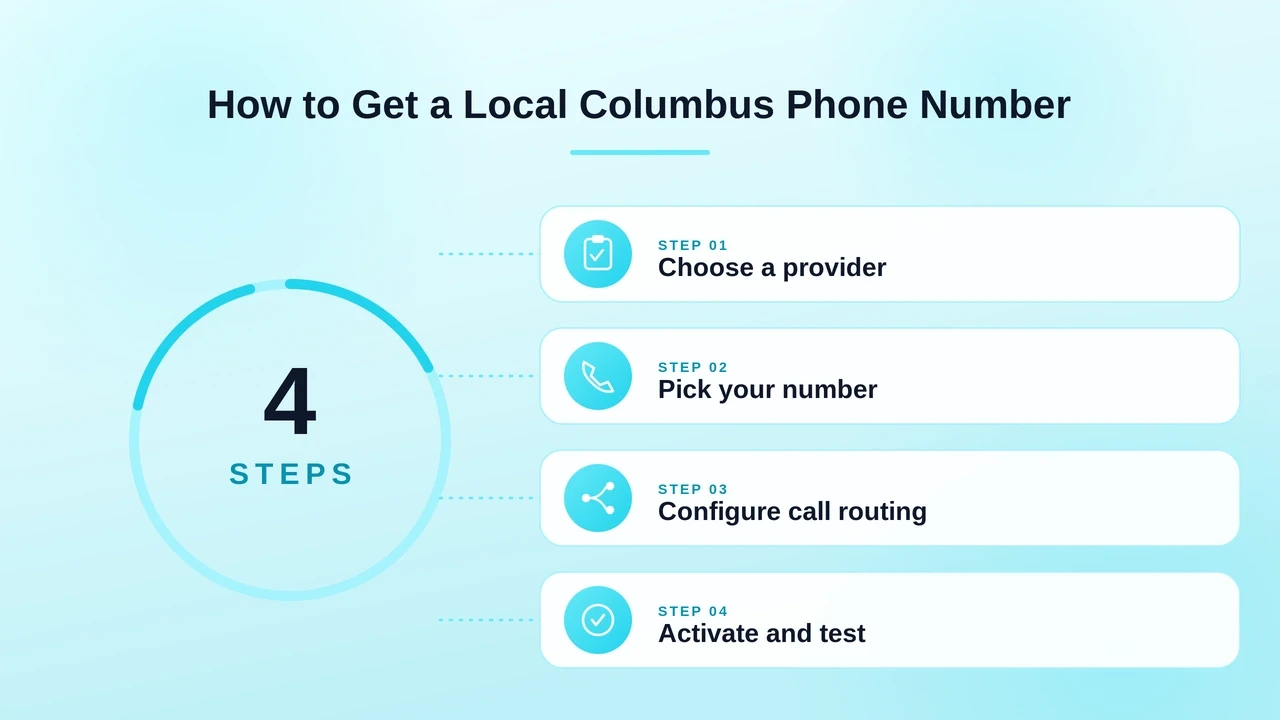
Getting a Columbus-area number is easier than most firms think. Virtual phone providers let you get a 380 area code number with no old-style carrier deal. You need no physical gear. You don't even need a real Ohio address.
Step-by-Step: Getting a 380 Number
- Choose a provider — Pick a VoIP or virtual phone service that offers Ohio numbers in the Columbus area. Look for solid uptime and clear pricing.
- Pick your number — Providers offer many open numbers. Some offer vanity options too, with fun digits that fit your brand or campaign.
- Set up call routing — Send the number to a mobile phone, a desktop softphone app, or a full cloud PBX system. No hardware is needed.
- Activate and test — Numbers usually go live in minutes, not days.
- Port an existing number — Does your firm already have a Columbus number from another carrier? You can move it over and keep the same digits. This will not disrupt your customer ties.
Providers like Rozper offer area code 380 numbers with 99.999% uptime. They reach across 150+ countries. This lets firms build a Columbus presence as part of a plan that scales across markets, with no old-school phone costs.
For the full background on overlay rules and 10-digit dialing, see the guidance on ten-digit dialing. It is the top source for how these rules apply to the 380 and 614 zone.
Conclusion
Central Ohio is one of the Midwest's busiest economic spots. A local number is often the fastest way for a firm to show it belongs there. Are you entering the Columbus market for the first time? Are you upgrading your current setup? Either way, getting a local number is a smart, low-cost first step. VoIP tools go live in minutes and grow with no hardware. That makes a 380 area code number the fastest path to a real Columbus presence.
FAQs
Where is the 380 area code located?
It serves central Ohio. This includes Columbus and nearby communities like Dublin, Westerville, Gahanna, Grove City, and Upper Arlington. The area spans Franklin County and nearby counties like Delaware, Fairfield, Licking, Madison, Pickaway, and Union.
What cities are covered by area code 380?
Coverage includes Columbus, Dublin, Westerville, Hilliard, Gahanna, Reynoldsburg, Grove City, Upper Arlington, Worthington, Bexley, and Grandview Heights. Both 380 and 614 serve the same area.
What time zone does the 380 area code follow?
Numbers here use Eastern Time. That's EST (UTC-5) in winter and EDT (UTC-4) in summer. Noon in Columbus is 9:00 a.m. Pacific and 5:00 p.m. in London.
Is 380 the same as 614?
Yes, in terms of location. Both 380 and 614 serve the same central Ohio region. 380 was added as an overlay when 614 numbers ran low. There is no location split between them.
Can I get a 380 number without a physical Ohio address?
Yes. Virtual phone providers let any business get a 380 number and route calls to any device worldwide. No Ohio address is needed.
Do I need 10-digit dialing for a 380 number?
Yes. Since 380 launched as an overlay in 2016, all Columbus-area calls need 10-digit dialing. Seven-digit dialing will not connect in the 380 and 614 region.