Introduction
Most area codes are just logistics. The 312 area code is different — it carries the weight of an entire city's identity.
No other three digits say "downtown Chicago" the way 312 does — not even its own sibling, the 773 area code, which covers the rest of the city. It's stamped on the city's financial towers, tied to its cultural landmarks, and recognized instantly by anyone who does business in or with the Windy City. If you're targeting the Chicago market, this number isn't just useful — it's a statement.
Here's everything you need to know about this iconic prefix: where it covers, its history, the overlays, time zone, scam awareness, and how to get a 312 business number that works as hard as you do.
What Is the 312 Area Code?
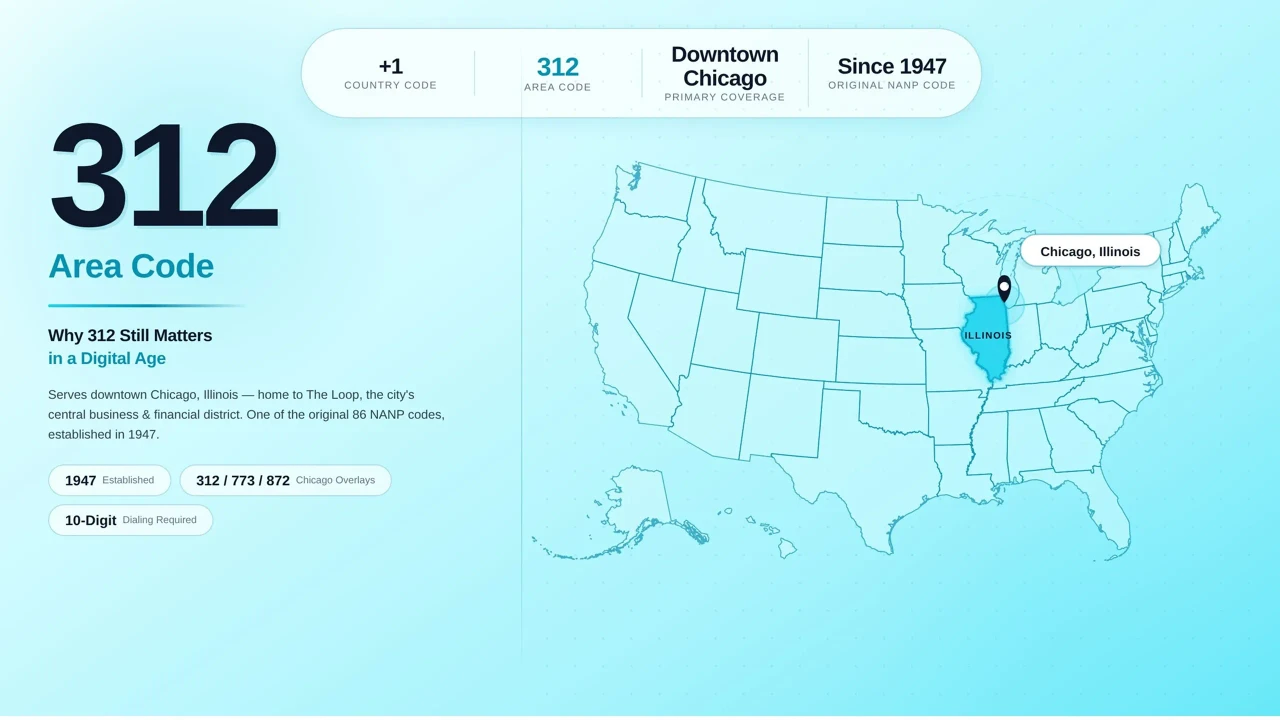
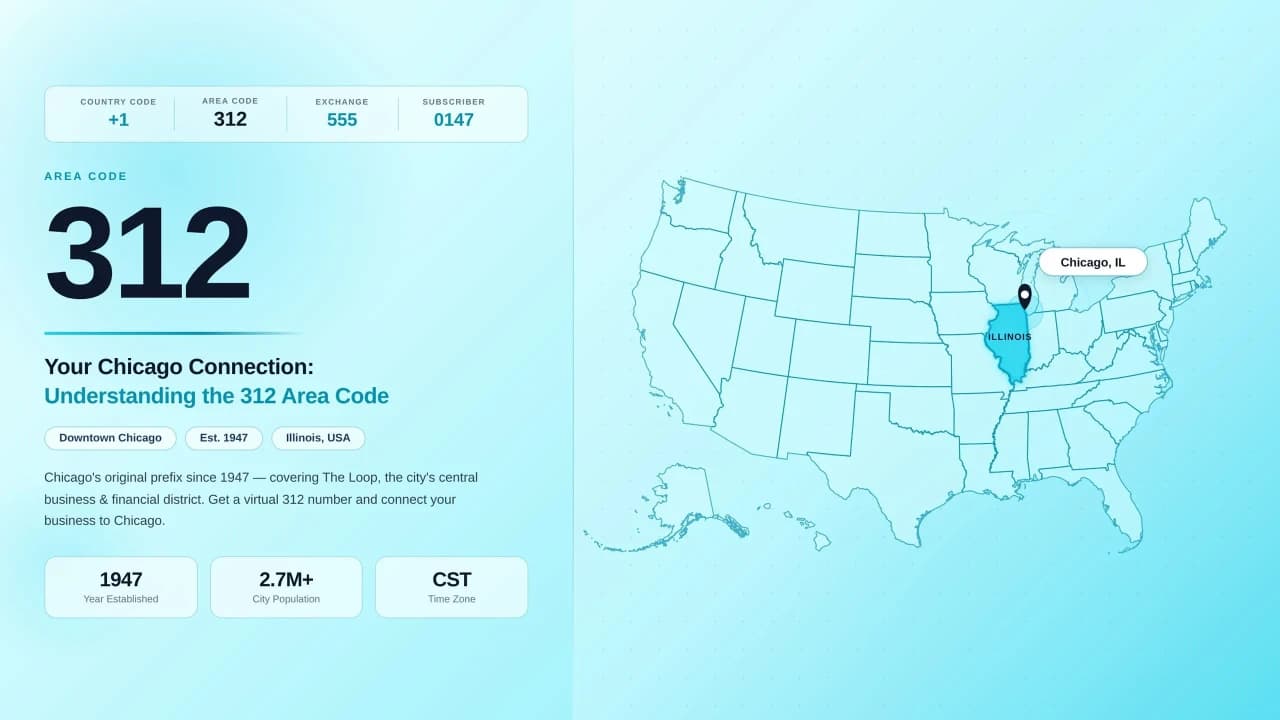
The 312 area code is assigned exclusively to Downtown Chicago and the city's immediate inner neighborhoods. Unlike most area codes that span entire counties or regions, 312 covers a highly concentrated geographic footprint — making it one of the most prestigious and recognizable area codes in the United States.
Quick Facts:
| Detail | Info |
|---|---|
| Area Code | 312 |
| Overlay Codes | 773 (rest of Chicago), 872 (full city overlay) |
| State | Illinois |
| Region | Downtown Chicago / The Loop |
| Time Zone | Central Time (CT) — UTC−6/UTC−5 |
| Dialing | 10-digit mandatory |
| Established | 1947 |
| 773 Split | October 11, 1996 |
| 872 Overlay Added | 2009 |
Area code 312 is tightly concentrated in Chicago's commercial heart — not a sprawling multi-county code like many of its counterparts across the US. Splits and overlays like these are coordinated through the numbering administration, which oversees area code assignments nationwide.
Where Does the 312 Code Cover?
The 312 zone covers Downtown Chicago and its densest inner-city neighborhoods. It is roughly bounded by:
- North: North Avenue
- West: Western Avenue
- South: 35th Street
- East: Lake Michigan
Key Neighborhoods in the 312 Zone
The Loop is the core of the 312 footprint. Chicago's central business district is home to the Chicago Stock Exchange, major financial institutions, law firms, consulting companies, and Fortune 500 headquarters. The Loop is also the hub for Chicago's iconic architecture, theater district, and civic institutions.
River North sits just north of The Loop and is one of Chicago's most commercially active neighborhoods. It is known for its gallery district, tech startups, creative agencies, and high-end restaurants — a dense mix of commerce and culture that makes it a target market for numerous industries.
Streeterville borders Lake Michigan on the near north side. Home to Northwestern University's Chicago campus, Northwestern Memorial Hospital, and the Magnificent Mile's northern end, Streeterville is a high-income, high-traffic neighborhood with strong healthcare and hospitality sectors.
Near West Side encompasses Illinois Medical District — one of the largest medical districts in the country — as well as the United Center arena and growing residential and tech development corridors.
South Loop has grown substantially as a mixed-use residential and commercial neighborhood, attracting young professionals, universities (Columbia College Chicago, Roosevelt University), and boutique businesses.
Together, these neighborhoods constitute one of the highest-density, highest-income urban business zones in the United States. Households in ZIP codes like 60601 and 60606 — squarely within the 312 zone — report median household incomes exceeding $125,000.
History of the 312 Area Code
The 312 area code was established in 1947 as one of the original 86 area codes created under the North American Numbering Plan (NANP). At the time, it covered the entire Chicago metropolitan area, from the city center to its suburbs.
As Chicago's population and telephone demand grew, the numbering capacity of the original 312 territory was eventually exhausted.
For decades, area code 312 served as the only Chicago code — a single prefix for an entire metropolitan region. Its deep roots in the city's communication infrastructure explain why it became so culturally embedded.
Key milestones:
1996 — The 773 Split: On October 11, 1996, all Chicago neighborhoods outside the downtown core were reassigned to the new 773 area code. This left 312 exclusively covering the city's commercial heart. Chicago became one of only a handful of cities in the nation — alongside New York and Los Angeles — to be split across multiple area codes within the same city limits.
2009 — The 872 Overlay: As demand for numbers continued to grow across both 312 and 773 territories, the 872 area code was introduced as a full-city overlay. Unlike a split, an overlay does not reassign existing numbers — it simply provides a new pool of numbers for the same geography. This means a Chicago number may carry a 312, 773, or 872 prefix depending on when it was assigned.
Despite these additions, 312 has never lost its status as the prestige prefix of the city. It remained so embedded in Chicago's identity that March 12th is informally celebrated as "312 Day" by locals and businesses alike — a cultural nod to how deeply this prefix has fused with the city's character.
This kind of regional identity is something you see with other major metro codes — much like the 415 area code has become synonymous with San Francisco's tech and financial districts.
312 Area Code Time Zone
This region operates in the Central Time Zone (CT):
- Central Standard Time (CST): UTC−6 (November to March)
- Central Daylight Time (CDT): UTC−5 (March to November)
This matters practically for businesses operating outside Illinois. If you're based on the East Coast and managing a 312 Chicago line, your Chicago customers are one hour behind you. A 9 AM ET call reaches them at 8 AM — potentially too early for business. Calibrate your outbound call windows, IVR business hours, and automated message schedules to Central Time to avoid irritating customers before the workday begins.
For international businesses targeting Chicago, Chicago sits 6 hours behind London (GMT) in winter, and 7 hours behind during US/UK daylight saving transitions.
Is a 312 Area Code Call a Scam?
This is a completely legitimate area code serving real residents and businesses in one of America's most iconic cities. However, its high name recognition makes it a prime target for scammers who use caller ID spoofing to make fraudulent calls appear local and trustworthy.
312 ranks among the top 10 most-spoofed area codes in the United States. According to consumer reporting data, Chicago-area codes see particularly high volumes of impersonation-based fraud.
Chicago-Specific Scams to Know
IRS arrest warrant threats: Callers posing as IRS agents claim you have an outstanding warrant and demand immediate payment to avoid arrest. No legitimate IRS contact begins over an unsolicited phone call.
Law enforcement impersonation: Unique to this market, scammers have posed as officers from the "Chicago Narcotics team," claiming they can close fabricated investigations in exchange for payment. Real law enforcement does not operate this way.
Fake debt collection: Callers claim to represent collection agencies for debts that do not exist, using urgency and threats to pressure payment.
Tech support fraud: Callers impersonating technology companies claim your device has been compromised and request remote access or gift card payment.
How to Protect Yourself
- Legitimate organizations never demand immediate payment via gift card, wire transfer, or cryptocurrency over an unsolicited call.
- If a Chicago caller asks for personal information unprompted, hang up and verify through official channels.
- Use a reverse phone lookup tool to check whether a number has been reported for scam activity.
- Choose a VoIP provider that supports STIR/SHAKEN caller authentication — this framework verifies that displayed caller ID is accurate and significantly reduces the effectiveness of spoofing.
For businesses operating legitimate 312 numbers, communicating clearly to customers about how and when you contact them helps maintain trust even when scam activity is high in the region.
Chicago's Business Landscape: What the 312 Zone Drives
The 312 zone doesn't just cover a geographic footprint — it covers the economic engine of the Midwest. Understanding what powers this zone helps businesses align their messaging and strategy for maximum relevance.
Finance and Capital Markets
La Salle Street in The Loop is one of the most significant financial corridors in North America. The Chicago Stock Exchange (now part of NYSE Group), commodity trading firms, private equity funds, and major banking institutions all operate within the 312 zone. A local number signals direct access to this financial ecosystem.
Technology and Innovation
Chicago's tech sector has grown rapidly, with The Loop and River North housing a dense concentration of SaaS companies, fintech startups, digital agencies, and venture-backed businesses. The city consistently ranks among the top five US tech metros, and much of that growth is concentrated in the 312 footprint.
Healthcare
The Illinois Medical District on the Near West Side is one of the largest medical districts in the country, employing over 40,000 people. Combined with Northwestern Memorial's Streeterville campus and Rush University Medical Center, healthcare is one of the 312 zone's defining economic pillars.
Professional Services
Law firms, consulting firms, accounting practices, and marketing agencies dominate much of The Loop's office real estate. For professional service providers, a 312 number is almost an expected credential of downtown presence.
Hospitality and Tourism
Chicago attracted over 55 million visitors annually pre-pandemic, and recovery has been strong. Restaurants, hotels, entertainment venues, and tourism operators in the River North and Magnificent Mile corridors all benefit from the local recognition that a 312 number provides.
Why a 312 Business Phone Number Works for Your Brand
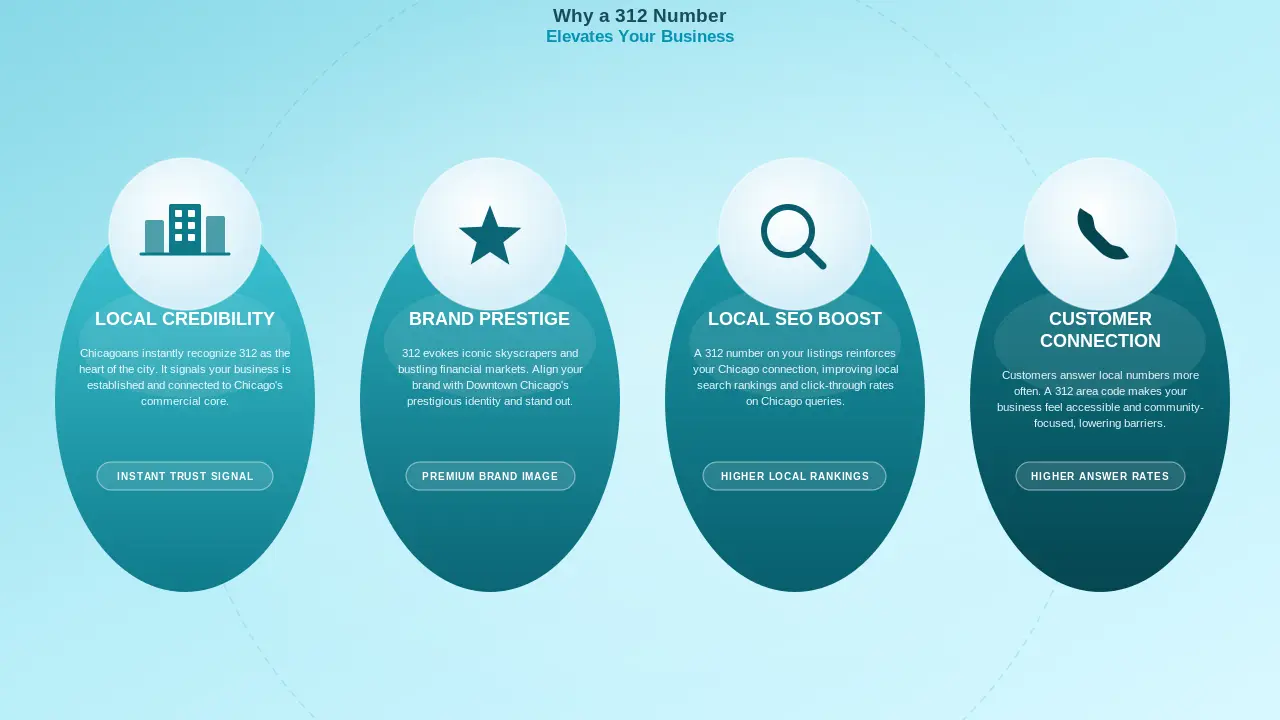
A 312 number does something a toll-free or out-of-state number cannot: it locates your business in the minds of Chicago customers before the call even connects.
Higher Answer Rates
Consumers are demonstrably more likely to answer calls from local area codes. A 312 number signals a familiar, local connection — not an unknown national caller. For outbound sales and customer service teams, this translates directly into higher connection rates and better conversion outcomes.
Brand Credibility Without a Downtown Office
You do not need a physical office in The Loop to carry the credibility of a 312 number. Virtual phone number technology lets you route a 312 line to any device, anywhere — giving your business a legitimate downtown Chicago identity whether your team is in-office, remote, or distributed across multiple cities.
Local SEO Signal
A consistent 312 number in your Google Business Profile, website, and local directory listings reinforces geographic relevance for Chicago searches. Local SEO algorithms factor in NAP (Name, Address, Phone) consistency — a 312 number aligned with Chicago-specific content strengthens your rankings for "near me" and city-specific queries.
Marketing Attribution
Assigning unique 312 numbers to individual campaigns — local print, radio spots, landing pages, or paid digital — gives you clean per-channel call tracking. This lets you measure which marketing activities drive real Chicago inbound calls and optimize budget allocation accordingly.
Prestige by Association
In industries like finance, law, and consulting, a 312 number carries an implicit prestige. It aligns your brand with Downtown Chicago's concentration of high-value businesses. For firms targeting enterprise clients in these sectors, that association has tangible value in first impressions.
How to Get a Local 312 Business Number
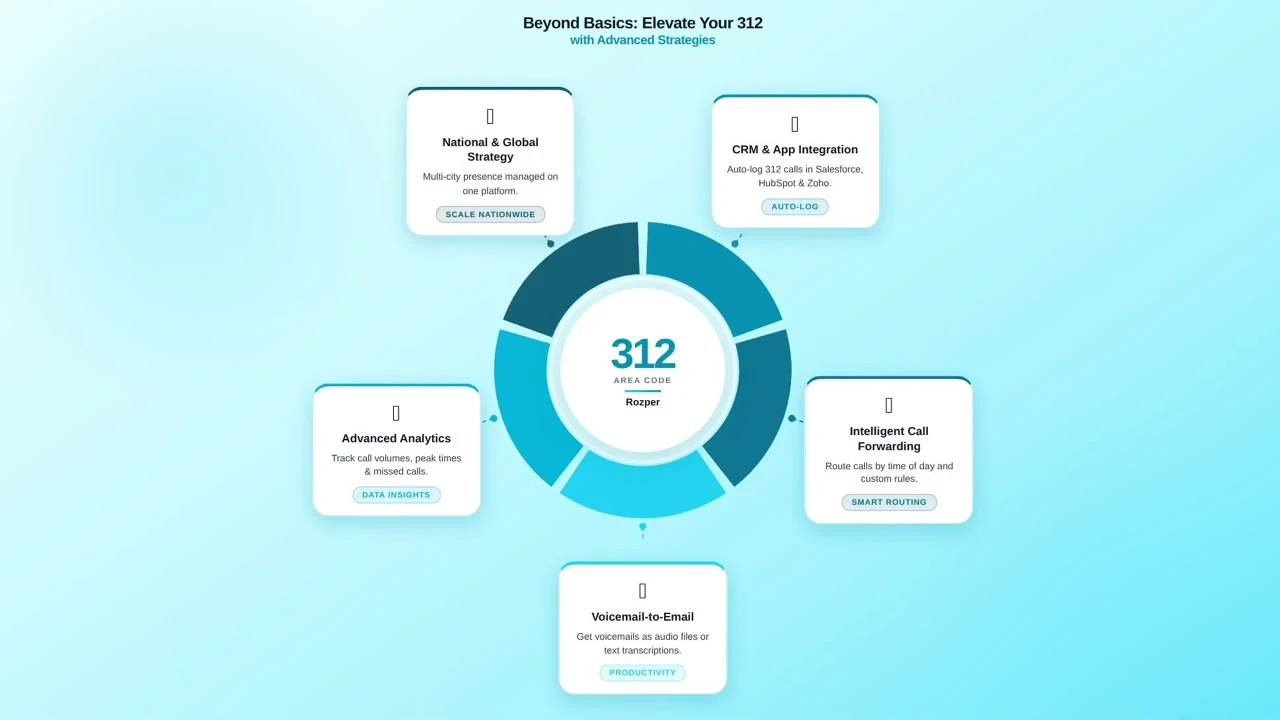
Here is the straightforward process for securing a 312 number:
1. Choose a VoIP or virtual number provider Select a provider that maintains active inventory of 312 numbers. Not all providers stock downtown Chicago numbers — confirm availability before committing.
2. Pick your number Browse available 312 numbers. Some providers offer vanity number options or let you filter by specific patterns for memorability.
3. Set up call routing Configure how your 312 number handles incoming calls: forward to mobile, route to a call queue, connect to an IVR menu, or ring to a softphone app on desktop or mobile.
4. Port an existing number if needed Local Number Portability (LNP) regulations allow you to transfer an existing 312 number to a new provider. Coordinate the port carefully to maintain uninterrupted service.
5. Enable SMS on your number Most modern VoIP providers support SMS on local numbers. Activating two-way text on your 312 line opens an additional channel for appointment reminders, follow-ups, and customer support.
What to Evaluate in a Provider
When selecting a provider for a local Chicago number, prioritize:
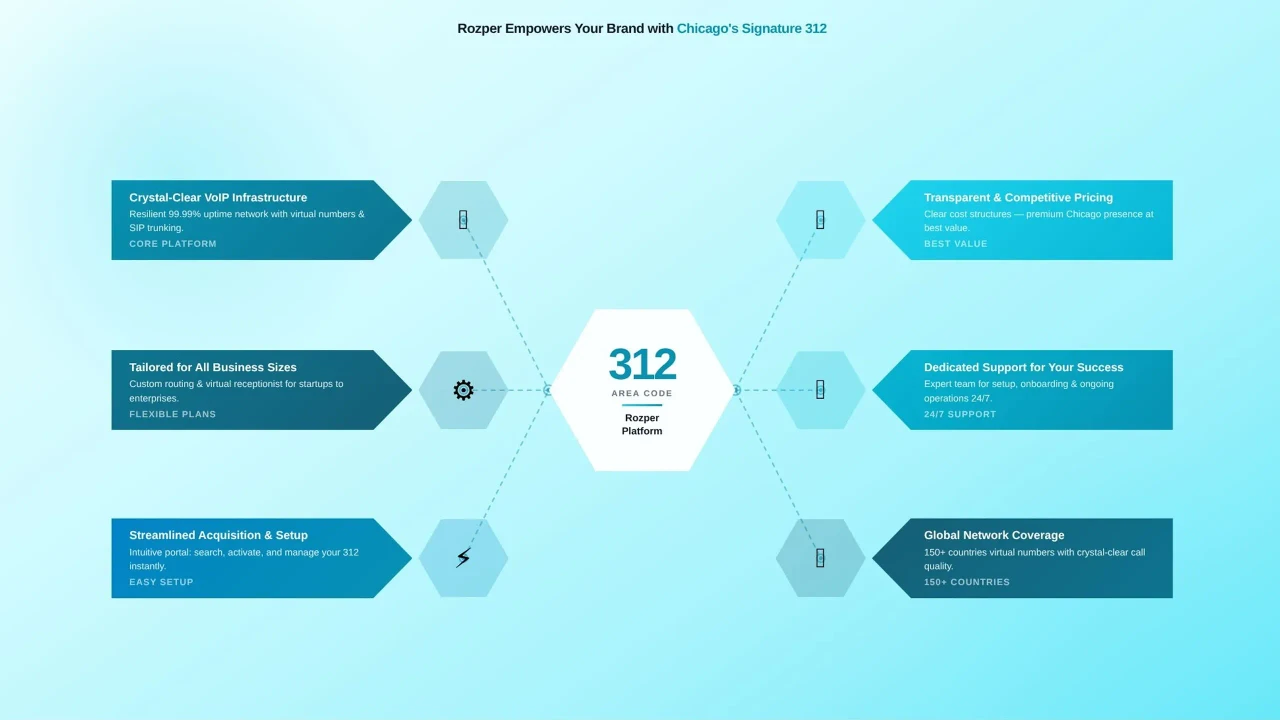
- Uptime reliability — Rozper delivers 99.999% uptime, ensuring your Chicago line stays live when customers and prospects call.
- Call quality — Tier-1 carrier connections and HD Voice codec support keep conversations clear.
- Feature set — IVR, call forwarding, call recording, voicemail-to-email, and analytics should be included.
- International coverage — If your business extends beyond Chicago, a provider with 150+ countries coverage keeps your communication stack unified under one platform.
- Transparent pricing — No hidden fees, no locked-in contracts that punish growth.
Rozper is one option worth considering here, maintaining 99.999% uptime and coverage in 150+ countries so a single platform can serve both your local Chicago line and any international operations.
Managing Your 312 Number: Common Challenges and Smart Fixes
| Challenge | Solution |
|---|---|
| Calls missed outside business hours | Configure after-hours IVR with voicemail-to-email routing |
| Scaling call volume for campaigns | Cloud VoIP adds lines on-demand without hardware changes |
| Poor call quality from previous provider | Switch to Tier-1 carrier with HD Voice and QoS management |
| Tracking multiple campaign numbers | Centralized dashboard shows per-number analytics in real time |
| Caller ID spoofing damaging brand reputation | Use STIR/SHAKEN-compliant provider + educate customers on contact methods |
| Remote team needs a unified local number | Call forwarding and softphone apps route from any location globally |
| CRM data entry eating agent time | Integrate VoIP with CRM for automatic call logging and screen-pop |
The Future of 312 Communications
Several trends will shape how businesses use local Chicago numbers in the coming years:
UCaaS is replacing legacy PBX in Chicago offices. Unified Communications as a Service platforms integrate voice, video, messaging, and collaboration in one interface. For The Loop's enterprise tenants and River North's startups alike, UCaaS adoption is accelerating.
AI-driven call handling is becoming standard. Intelligent routing, real-time sentiment analysis, automated post-call summaries, and AI-assisted agent coaching are moving from enterprise tools to mainstream VoIP features — available even to small businesses running a single 312 line.
Local numbers and local SEO are more tightly linked. As Google's local search algorithms continue to reward geographic specificity, a consistent 312 number paired with a Chicago-optimized Google Business Profile delivers compounding visibility advantages for city-targeted businesses.
STIR/SHAKEN will reshape trust in caller ID. As the STIR/SHAKEN authentication framework matures, verified calls will be displayed differently from unverified ones in major mobile carriers' spam filtering. Businesses using compliant providers will benefit from improved answer rates as consumer trust in authenticated caller ID grows.
Conclusion
The 312 area code is more than a telephony prefix — it is one of Chicago's most enduring cultural and commercial identifiers. Born in 1947 as part of the original NANP rollout, it has survived splits, overlays, and decades of technological change to emerge as the definitive symbol of Downtown Chicago's business community.
For businesses targeting the Chicago market, a 312 number offers measurable benefits: higher call answer rates, stronger local SEO signals, brand credibility rooted in The Loop's prestige, and a professional identity that resonates across finance, tech, healthcare, and professional services.
Whether you are entering the Chicago market for the first time or solidifying an existing presence, securing a 312 number backed by reliable VoIP technology is one of the most cost-effective credibility investments available. That entire numbering system — 312, 773, and 872 alike — is still coordinated through the FCC's numbering administration framework that keeps Chicago's overlay running smoothly.
FAQs
What is the 312 code and where does it cover?
The 312 code covers Downtown Chicago and the immediate inner-city neighborhoods, including The Loop, River North, Streeterville, Near West Side, and South Loop. It is bounded roughly by North Avenue to the north, Western Avenue to the west, 35th Street to the south, and Lake Michigan to the east.
What is the difference between 312, 773, and 872?
All three codes serve Chicago. The 312 prefix covers downtown and the inner city. The 773 prefix was split off in 1996 to cover the rest of Chicago's neighborhoods. The 872 prefix was added in 2009 as a full-city overlay for both 312 and 773, providing additional number inventory without reassigning existing numbers. Ten-digit dialing is required for all local calls across all three codes.
What time zone is the 312 code in?
Area code 312 is in the Central Time Zone (CT). It observes Central Standard Time (CST, UTC−6) from November through March and Central Daylight Time (CDT, UTC−5) from March through November.
Can I get a 312 number without a physical office in Chicago?
Yes. Virtual phone numbers with the 312 prefix can be routed to any device — a mobile phone, softphone application, or desk phone — regardless of your physical location. This lets businesses establish a credible Chicago presence while operating remotely or from another city entirely.
Why is the 312 prefix so heavily associated with prestige?
Because it exclusively covers Downtown Chicago — The Loop, the city's financial district, its legal and consulting corridors, and its major cultural institutions. When 773 was created in 1996 for the rest of Chicago, 312 became the concentrated identifier of the city's commercial core. That exclusivity, combined with nearly 80 years of use, has made it one of the most recognized and sought-after area codes in the US.
Is the 312 prefix used for scam calls?
The 312 prefix itself is legitimate, but it ranks among the top 10 most-spoofed area codes in the US due to its high recognition. Scammers use caller ID spoofing to make calls appear to come from 312 numbers. Common Chicago-area scams include fake IRS arrest warrants, law enforcement impersonation, and fictitious debt collection. Legitimate organizations never demand immediate payment or personal information over unsolicited calls.
Does Rozper offer 312 business numbers?
Yes. Rozper provides local 312 numbers with a full VoIP feature set — call forwarding, IVR, call recording, analytics, voicemail-to-email, and SMS. With 99.999% uptime and coverage across 150+ countries, Rozper handles both local Chicago presence and global communication needs from one platform.