Introduction
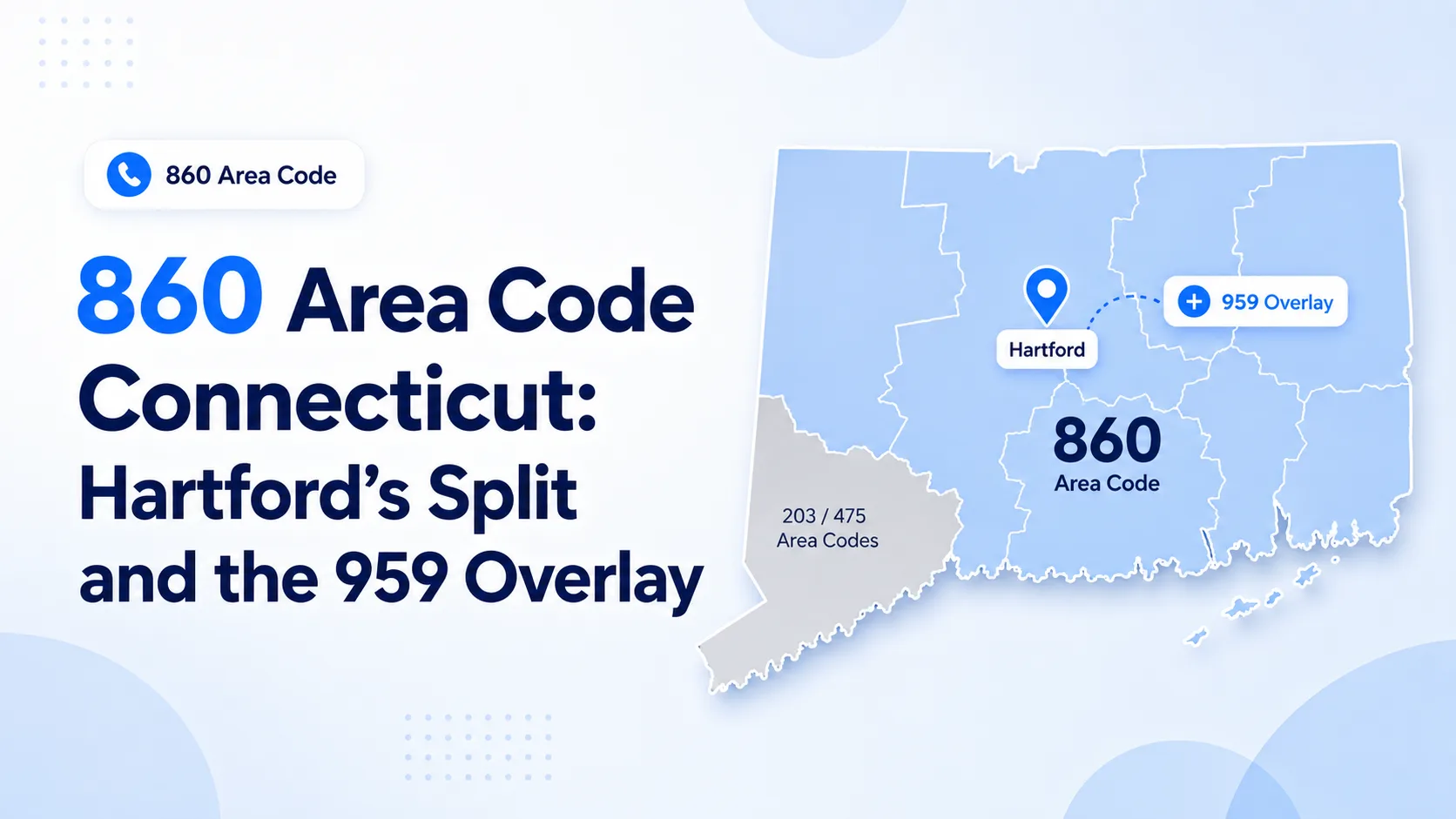
The 860 area code covers most of central and eastern Connecticut, and if you've spotted one, you're probably trying to confirm where it's based or whether your business needs one. This matters because the region now shares its numbering pool with a newer overlay code, which changes how every call gets dialed. In this guide, you'll learn exactly which counties and cities fall under it, how it split away from Connecticut's original area code, and why its overlay took far longer to arrive than most people realize. Stick around, because that fifteen-year delay explains a lot about how Connecticut manages phone numbers today.
Key Takeaways:
- The 860 area code covers Hartford, New Britain, Norwich, Groton, and Torrington across six Connecticut counties.
- It was created on August 28, 1995, when regulators split it away from the original statewide 203 code.
- The 959 overlay was announced in 1999 but wasn't activated until August 30, 2014, a fifteen-year gap.
- Ten-digit dialing became mandatory across the region on November 14, 2009, years before 959 numbers existed.
The Six Connecticut Counties Inside the 860 Area Code
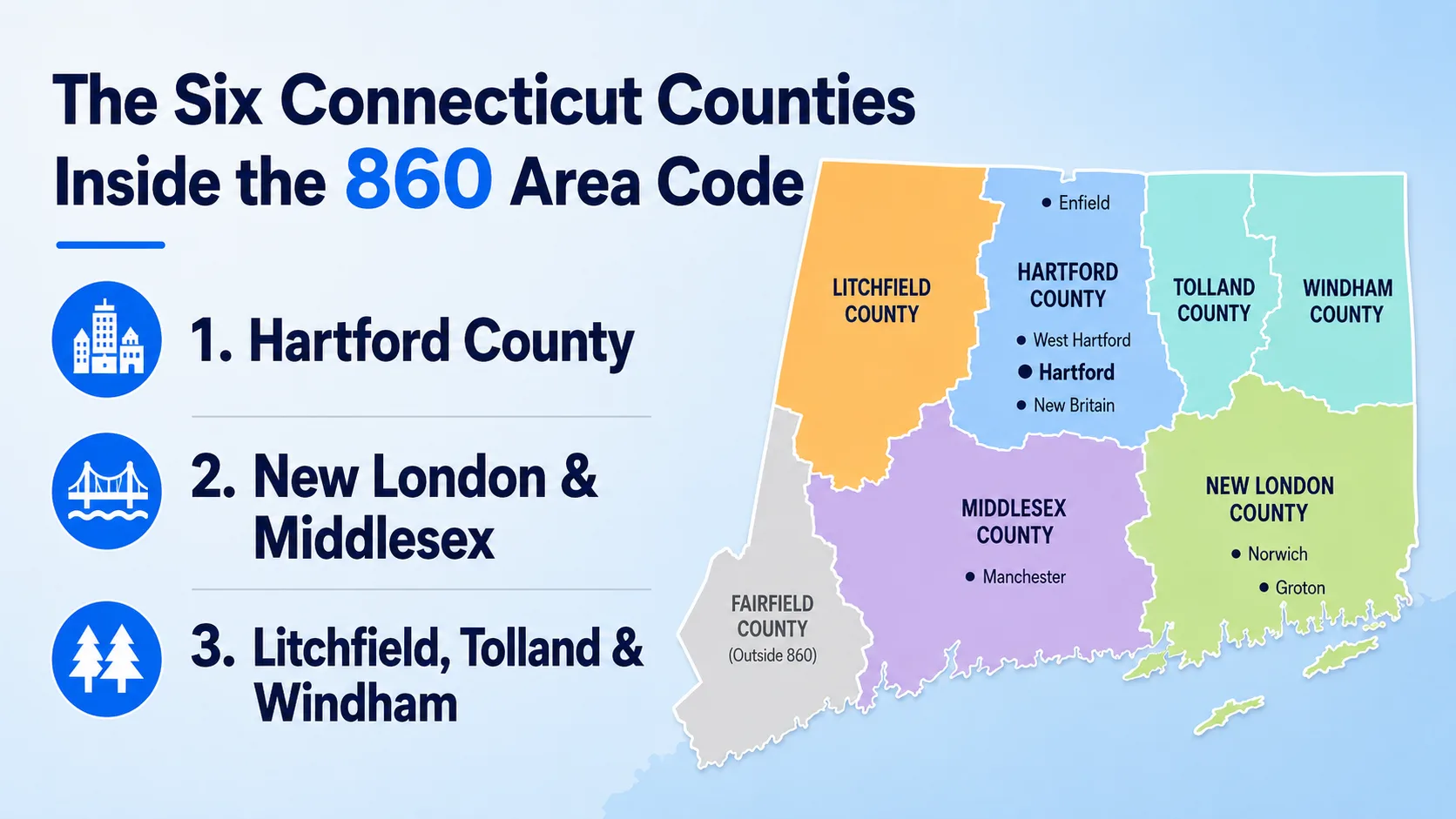
This region stretches across most of the state outside the southwestern corner, making it one of the largest numbering areas in Connecticut by land area. Anyone searching under an area-code-860 listing will notice just how many small towns and mid-sized cities share this single numbering pool.
- Hartford County, including Hartford, New Britain, and West Hartford
- New London County, including Groton and Norwich
- Litchfield County, including Torrington
- Middlesex County, covering the lower Connecticut River valley
- Tolland and Windham counties in the state's northeast corner
- Smaller communities like Manchester, Enfield, and Vernon that share the same numbering pool
Hartford's role as Connecticut's capital and an insurance industry hub keeps demand for new numbers steady, which is part of why the 860 area code eventually needed an overlay to keep up. Government offices, law firms, and insurance headquarters alone account for a meaningful share of the region's business phone lines.
Splitting From 203: How Hartford Got Its Own Code in 1995
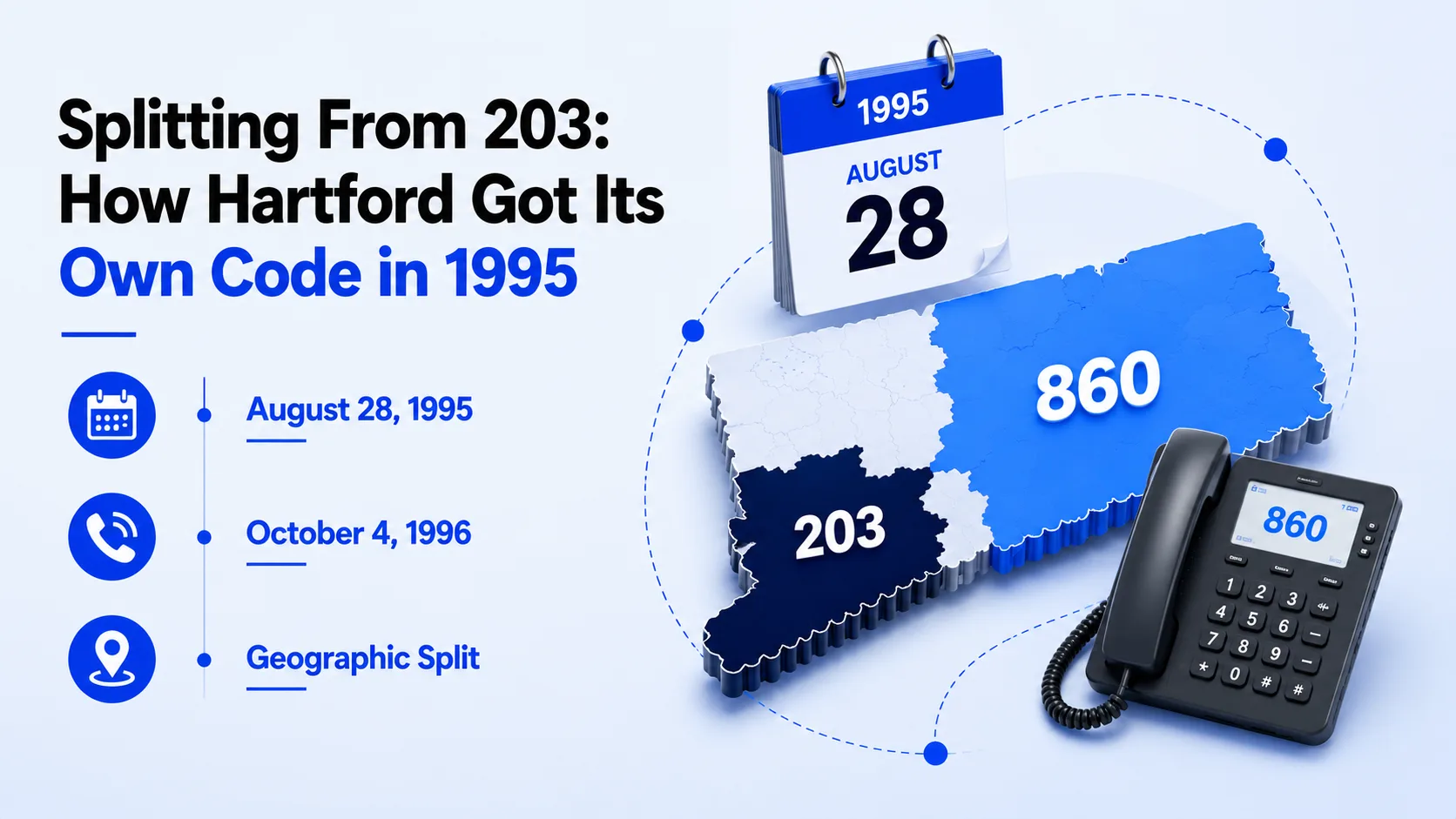
Connecticut's numbering history starts with a single code. Until the mid-1990s, the entire state ran on 203, the original area code assigned when the national system launched. As demand grew statewide, regulators split the state on August 28, 1995, carving out the 860 area code to serve everywhere outside the southwestern corner that kept 203. Dialing with the new code became mandatory on October 4, 1996, after a permissive period gave residents and businesses time to adjust their contact lists and equipment. That split was a geographic division rather than an overlay, meaning every existing customer outside the southwest corner had to learn a brand-new area code almost overnight. It's a very different transition from the overlay approach regulators would later choose for 959, which changed nothing for people who already had a working number.
The Fifteen-Year Wait for the 959 Overlay
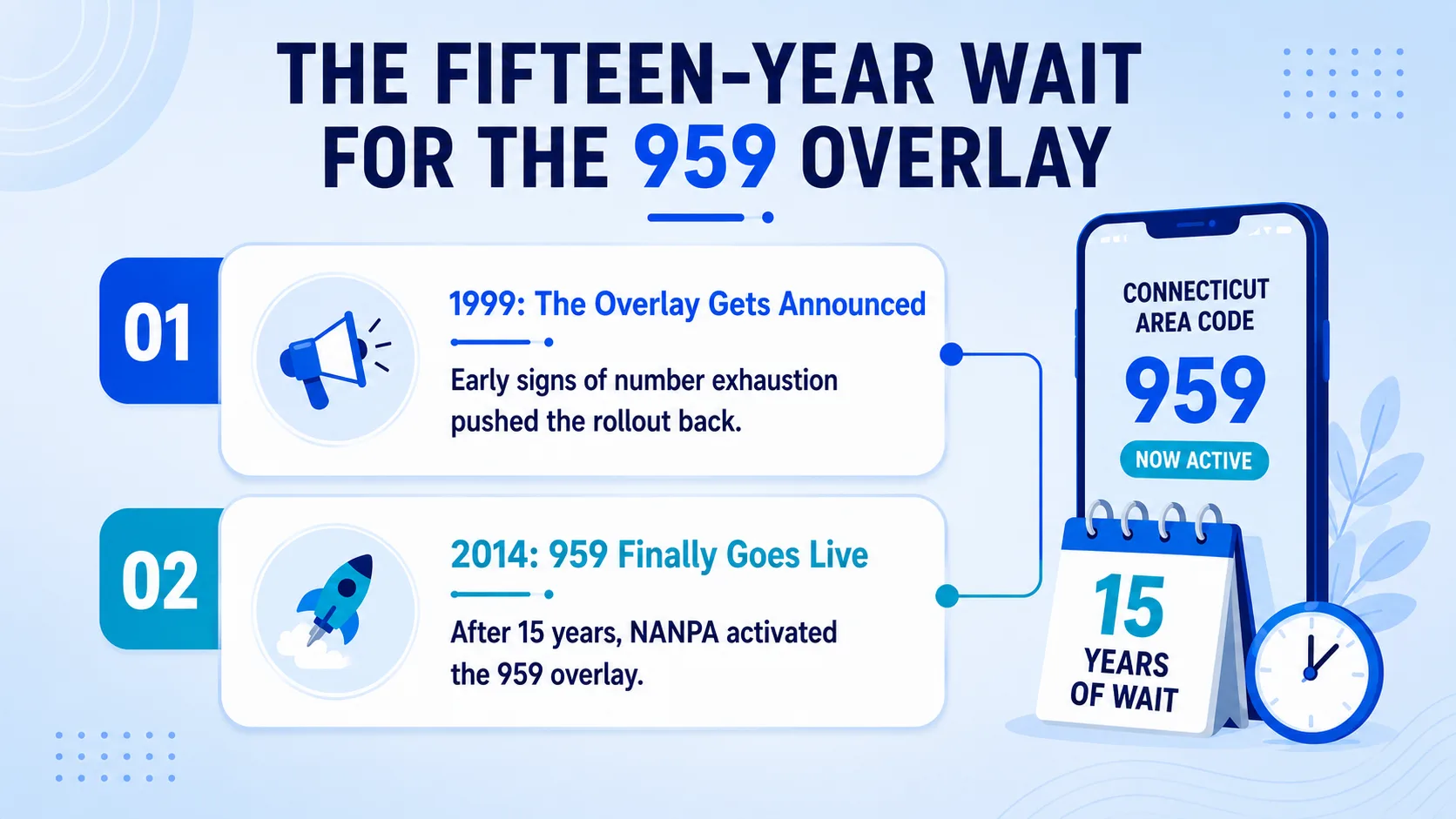
This is the detail most guides skip entirely, and it's the most striking part of the region's history. Regulators first announced plans for an overlay back in 1999, but the 959 area code didn't actually activate until August 30, 2014.
1999: The Overlay Gets Announced
Early signs of number exhaustion prompted the initial proposal, but growth in mobile phones and fax lines through the 2000s kept pushing the actual rollout further back. Regulators wanted solid evidence that the region was genuinely running low before forcing a change on residents and businesses.
2014: 959 Finally Goes Live
NANPA activated the overlay fifteen years after the first announcement, making it the longest gap between proposal and activation of any Connecticut area code change on record. That patience meant the eventual rollout caused almost no disruption, since nearly every phone system in the region had already switched to ten-digit dialing years earlier.
Do You Still Need to Dial Ten Digits Here?
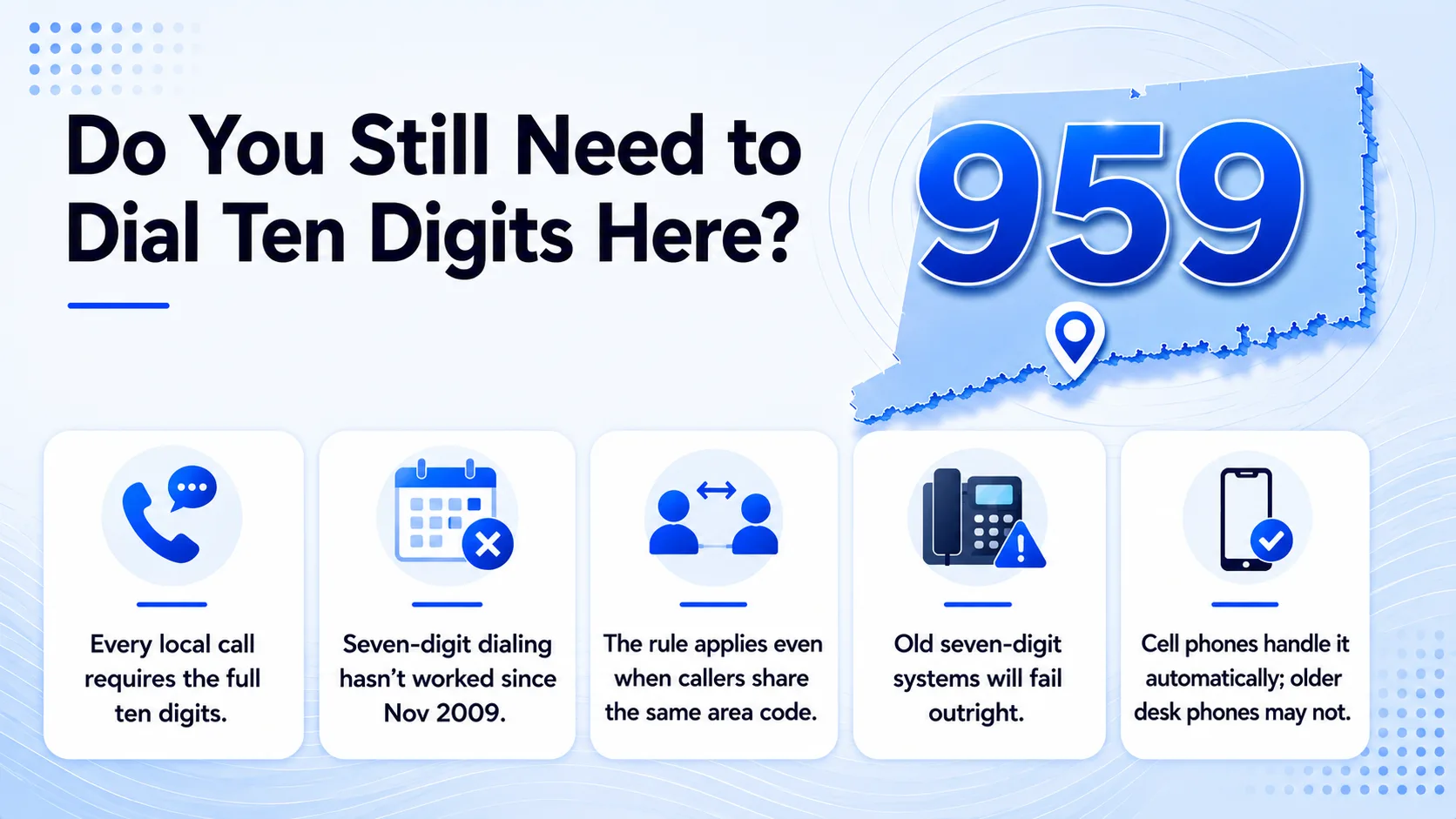
Yes, and this rule predates the 959 overlay itself by nearly five years. Connecticut required ten-digit dialing across the entire 860 area code region starting November 14, 2009, well before a single 959 number existed. Anyone running an area code 860 Connecticut search today will find that this dialing rule, not the overlay itself, is the change most residents actually notice day to day.
- Every local call requires the full ten digits, including the area code
- Seven-digit dialing has not worked here since November 2009
- The rule applies even when both callers share the same area code
- Business phone systems configured for old seven-digit dialing will fail outright
- Cell phones typically handle the switch automatically, but older desk phones sometimes need manual reprogramming
860 Versus 959: Spotting the Real Differences
Since both codes serve the exact same counties and cities, geography never separates them. The real distinction comes down entirely to timing and which numbering pool a line was drawn from. A similar overlay dynamic plays out in Rozper's 970 area code guide, where a second code was layered onto an existing region for the same underlying reason.
What Stays the Same
Call rates, coverage area, and dialing rules are identical no matter which of the two codes a number carries, so customers never notice a practical difference.
What Actually Changes
Only new number assignments come from the 959 pool now, since existing 860 area code numbers were never reassigned or forced to change after the overlay activated. Carriers simply draw from whichever pool still has room left, which means two businesses on the same block could easily end up with different area codes despite opening on the same day.
Claiming a Business Number Before New 959 Numbers Take Over
Local numbers still build trust with Hartford-area customers, and setting one up correctly for a business with an 860 area code takes just a few deliberate steps.
- Contact your carrier or a cloud phone provider like Rozper and request a number in your target Hartford-area exchange.
- Confirm whether the assigned number falls under 860 or 959, since both are equally valid and serve identical territory.
- Test ten-digit dialing across every phone line and device before the number goes live for customers.
- Update your website, directory listings, and printed materials to reflect the new number right away.
- Ask your provider whether overlay dialing is handled automatically, so your team never has to think about it.
- Train front-desk and support staff to treat 860 and 959 numbers as equally local when greeting callers.
Mistakes First-Time Callers Make With Overlay Codes
Even longtime Connecticut residents trip over a few recurring mistakes when dealing with this region's numbering system.
- Assuming a 959 number means a call is coming from somewhere outside the 860 area code region
- Searching only under area-code-860 directories without checking current 959 availability
- Believing existing numbers were changed or reassigned once the overlay activated
- Forgetting that older phone systems may still need ten-digit dialing configured manually
- Treating an area code 860 Connecticut search as covering only Hartford, when it actually spans six counties
- Assuming every provider automatically supports both codes without confirming availability first
Rozper's 475 area code guide covers a nearly identical overlay story in southwestern Connecticut, if you want to compare how the two regions handled number exhaustion differently.
Conclusion
The 860 area code has covered central and eastern Connecticut since its 1995 split from the original statewide 203 code, and that history explains why the region now shares its numbering pool with the newer 959 overlay. Fifteen years passed between the 959 overlay's 1999 announcement and its actual 2014 activation, making it the slowest rollout in state history, yet existing customers never had to change a single digit. Ten-digit dialing, mandatory since November 2009, remains the rule that keeps both codes working together smoothly across Hartford, Norwich, and every town in between. With this guide, you now understand the area code 860 Connecticut situation in more depth than a simple directory listing could ever offer.
Businesses serving Hartford, New Britain, or the surrounding counties should treat their phone setup as part of their growth strategy, not a technical afterthought. Rozper's cloud-based phone system configures ten-digit dialing correctly from day one, so a new number works exactly as expected whether it lands in the 860 or 959 pool.
FAQs
What cities and counties does the 860 area code cover?
It covers Hartford, New Britain, Norwich, Groton, and Torrington across Hartford, Litchfield, Middlesex, New London, Tolland, and Windham counties. That's most of Connecticut outside the southwest corner.
Where did the 860 area code come from?
It was created on August 28, 1995, when regulators split it away from Connecticut's original statewide 203 code. Mandatory dialing with the new code began on October 4, 1996.
When did the 959 overlay actually activate?
NANPA activated the overlay on August 30, 2014, fifteen years after it was first announced in 1999. Existing 860 numbers were never changed or reassigned.
How do I get an 860 area code number for my business?
Contact a carrier or a cloud phone provider and request a number tied to your target Hartford-area exchange. Most providers can activate a working line within a day.
Is calling or receiving calls from an 860 number safe?
Yes, but scammers can spoof any area code, including this one, to look local. Always verify unexpected requests for personal or financial information independently.
What time zone does the 860 area code use?
The entire region runs on Eastern Time year-round, following Connecticut's standard seasonal changes. This applies from Hartford all the way to Norwich and Groton.
Does a 959 number cost more than an 860 number?
No, both codes carry identical local rates since they cover the exact same territory. Pricing depends entirely on your provider and calling plan, not the overlay code.
Why did the 959 overlay take fifteen years to activate after being announced?
Regulators proposed it early but kept delaying activation while monitoring how fast 860 numbers were actually running out. That caution made it the longest overlay wait in Connecticut's numbering history.