Introduction
Area code 832 serves Houston and its surrounding counties, but it shares that exact same territory with three other area codes ringing the same phones. If your business is choosing a number here, that overlap changes the decision more than most guides let on. This article walks through where 832 actually reaches, why Houston ended up with four area codes instead of one, and how to pick a number that still earns trust in one of the most crowded phone markets in Texas. By the end, you will know how to choose, set up, and protect an 832 number so it works for your business instead of just adding to the noise.
Key Takeaways:
- Area code 832 covers the full Houston metro, but that same territory is also served by area codes 713, 281, and 346.
- Houston is one of the few U.S. metros with four overlapping area codes, so picking a number is rarely about geography.
- A local 832 number can still meaningfully raise answer rates, provided it's backed by consistent calling habits.
- Setup now takes minutes through a cloud phone provider instead of the days a traditional carrier once required.
Where Area Code 832 Actually Covers
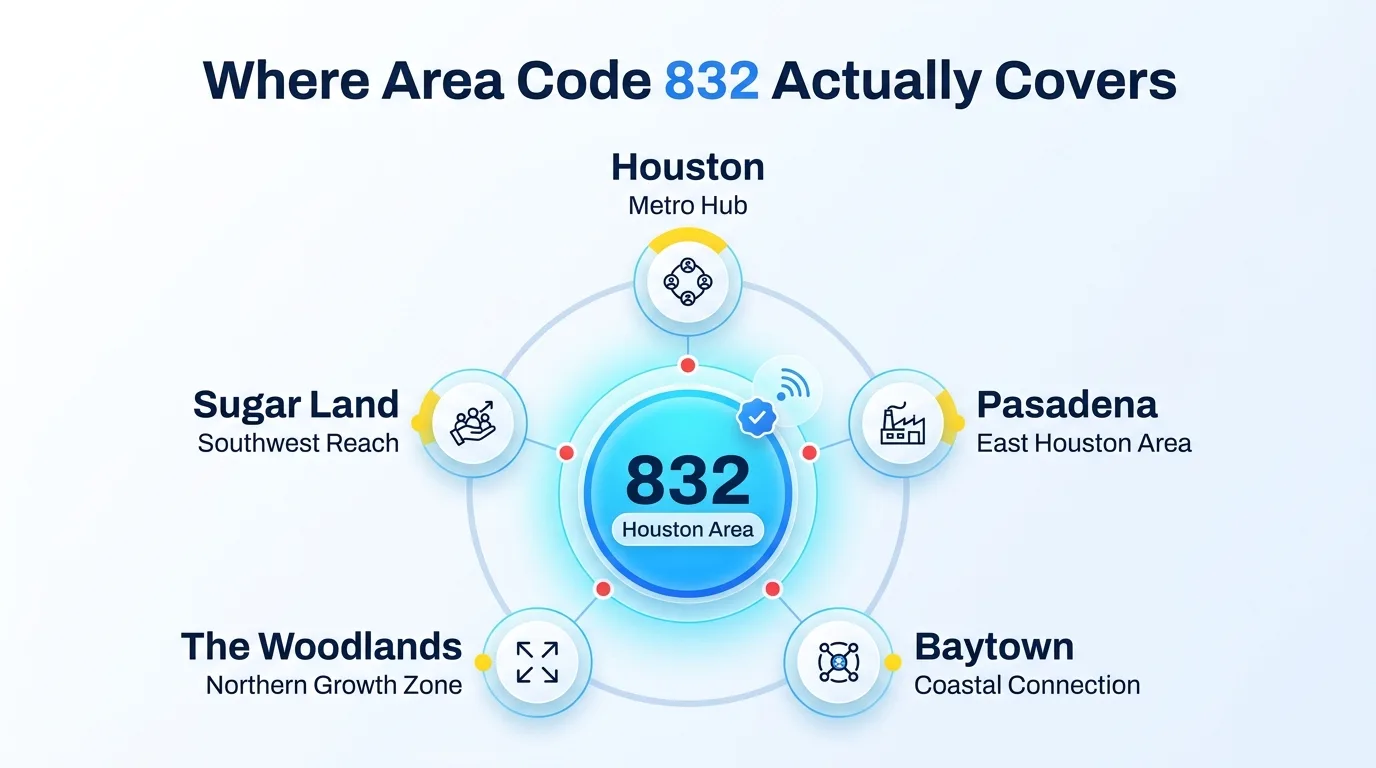
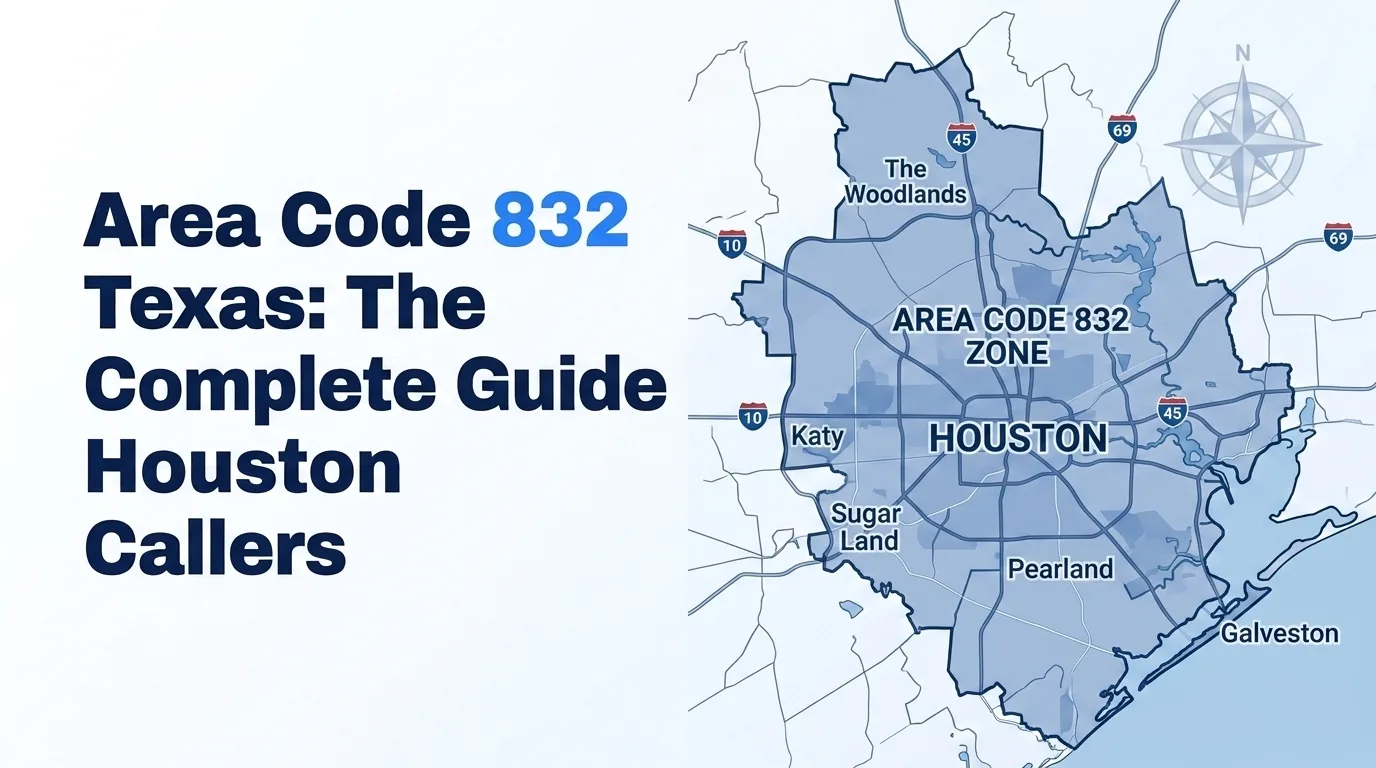
Area code 832 covers Houston and the surrounding metro, spanning ten counties including Harris, Fort Bend, Montgomery, Galveston, and Brazoria. It reaches more than 40 cities, from downtown Houston out to Sugar Land, League City, Conroe, and Baytown.
- Harris County: Houston, Pasadena, Humble
- Fort Bend County: Sugar Land, Missouri City
- Montgomery County: Conroe, The Woodlands
- Galveston and Brazoria Counties: League City, Pearland
This entire footprint is shared with three other area codes, since 832 was added as an overlay rather than a carved-out region of its own. A number in any of the four codes reaches the exact same customers across greater Houston.
Houston's economy is also unusually broad for a single metro, spanning energy, healthcare, aerospace, and logistics. That breadth is part of why the 832 area code keeps showing up in business searches — new companies open a Houston presence every year, and each one needs a local number that fits into an already crowded four-code market.
Why Houston Has Four Area Codes Ringing the Same Phones
Area code 832 exists because Houston's original code, 713, ran out of numbers faster than almost anywhere else in the country. Area code 281 launched first as an overlay in 1996, and just three years later, in 1999, regulators added 832 on top of the same territory because demand had already outpaced the relief that 281 provided.
Even that wasn't enough. By 2014, Houston needed a fourth code, so area code 346 was layered on top of the same region rather than splitting the metro geographically. That makes Houston one of the only places in the country where four separate area codes all ring the identical set of phones, and it's the main reason picking a number here feels more complicated than in almost any other Texas city.
Most Texas overlay codes only carry one extra layer of history. Area code 832 carries two more layered on top of it, which is exactly why so many business owners assume 832 or 346 are somehow newer or less legitimate than 713 when they are simply the pressure valves regulators used to keep pace with Houston's growth.
832 vs. 713 vs. 281 vs. 346: How to Actually Choose
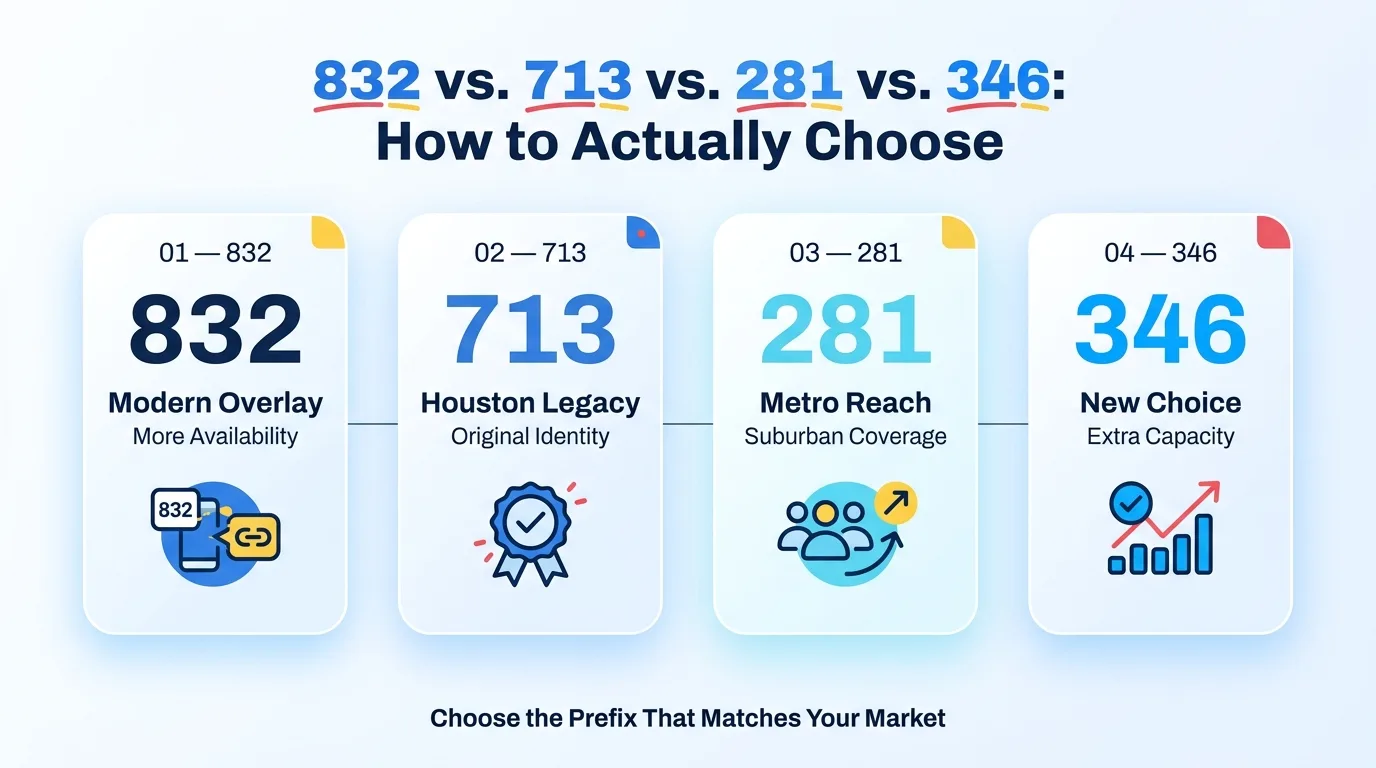
Because all four codes cover identical ground, the decision almost never comes down to location. It comes down to a handful of practical factors instead.
- Availability — 713 is the oldest and most claimed; 832, 281, and 346 generally have more open inventory.
- Perception — 713 still carries the strongest "old Houston" association, while 832 and 346 read as newer without carrying any real disadvantage.
- Dialing — all four codes require ten-digit dialing on every local call, so there's no functional difference for the person receiving it.
- Prefix matching — some providers have deeper inventory in one overlay than another, which can matter more than the code itself.
No single code among the four is objectively better. Businesses that need a specific, memorable prefix often end up choosing whichever overlay actually has it available, and area code 832 frequently wins that comparison simply because its inventory is deeper than the increasingly picked-over 713.
Does a Local 832 Number Still Stand Out in a Four-Code Market?
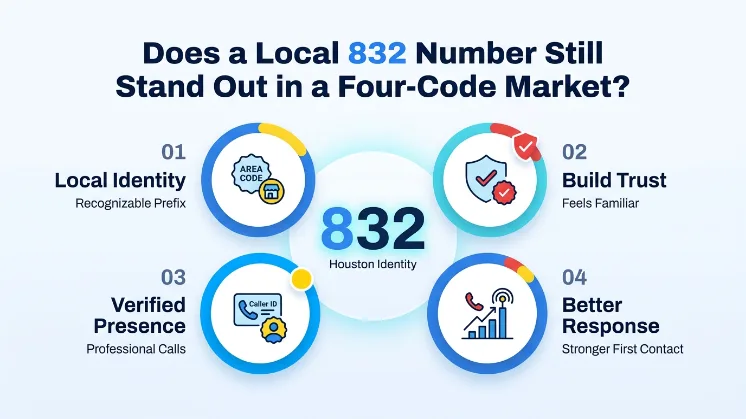
Yes, though the effect works differently than it does in a single-code city. Any of Houston's four local codes reads as familiar to a Houston-based recipient, so the real advantage comes from being local at all, not from picking the "right" one among the four.
- Recipients answer more readily when the area code matches their own metro, regardless of which of the four codes it is.
- A local number cuts down the hesitation that stalls first-touch calls with Houston-based prospects.
- Sales and service teams calling Houston customers benefit most, since any of the four codes signals the same thing.
- The advantage narrows for national campaigns, where a Houston-specific code carries little extra weight.
This is why energy, healthcare, and logistics companies calling into Houston rarely worry about which of the four codes they land on. What matters far more is that the number is local, active, and consistently used. Industry data on outbound calling backs this up: recipients answer unfamiliar area codes at meaningfully lower rates than any code that matches their own metro, regardless of which specific prefix rings through.
A Scenario: An Energy-Sector Recruiter Builds a Houston Presence
Picture a staffing firm based in Dallas trying to place candidates with Houston's energy companies. Calls from a 214 number get screened out by hiring managers who only pick up local traffic. The recruiter adds an 832 line dedicated to Houston outreach, and callback rates from hiring managers climb noticeably within the first few weeks, simply because the number now matches the market it's calling into.
This pattern repeats across every industry built on Houston-based cold outreach — staffing, energy services, and healthcare recruiting all lean on a local area code as a cheap, effective trust signal. Rozper's call routing tools let a team point that 832 line straight to the recruiter who owns the relationship, so the local presence stays consistent no matter how the team grows around it.
The same setup works for inbound support, not just outbound recruiting. A candidate calling back into a Rozper-managed area code 832 number reaches the same familiar caller ID whether the recruiter answering is sitting in Houston, Dallas, or working remotely from somewhere else entirely.
Setting Up an 832 Number Without Losing Caller Trust
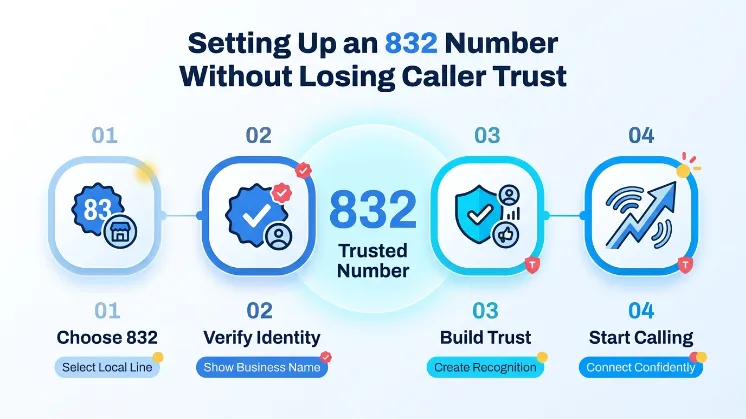
Claiming a number is the easy part, especially in a market with this much overlay inventory to choose from. The habits around it determine whether that local presence actually earns trust.
Same-Day Setup Steps
- Pick a cloud phone provider with Houston-area provisioning across all four overlays.
- Search open 832 prefixes and reserve one that fits your team.
- Connect it to your existing phone, app, or desk system.
- Set a matching caller ID and greeting before taking live calls.
Protecting Your Caller Reputation
A number is only as trustworthy as the calling pattern behind it. High call volume without spam registry registration can get a legitimate 832 number flagged, and inconsistent caller ID confuses returning customers fast in a market this large. Check the FCC's spoofing guidance if a call ever looks suspicious, and register outbound numbers with STIR/SHAKEN-compliant providers to keep your own calls from being mistakenly flagged.
Rozper bundles this reputation monitoring directly into its call management dashboard, so a business running an 832 line can catch a spam flag or caller ID mismatch before it costs answered calls in a market this competitive.
Conclusion
Area code 832 gives businesses a genuine local presence across Houston, even though that same territory is also served by 713, 281, and 346. The history of successive overlays explains why Houston ended up with four area codes instead of one, but the practical decision comes down to prefix availability rather than geography, since all four reach identical customers. A local 832 number can still meaningfully improve answer rates in this market, provided it's backed by consistent caller ID and honest calling patterns. Understanding why the overlap exists is what turns a confusing choice into a confident one.
If your business is calling into or operating within Houston, treat your area code 832 number as a trust asset rather than a technical detail to sort out later. Rozper's call routing and monitoring tools make it straightforward to keep an 832 line reliable as your call volume grows across a crowded metro. Start by checking prefix availability across all four overlays, then build the habits that keep the number credible over time. From there, the only step left is putting it to work on your next call.
FAQs
What cities does area code 832 cover?
Area code 832 covers Houston and more than 40 surrounding cities, including Sugar Land, League City, Conroe, and Baytown. It spans ten counties across the greater Houston metro.
Where is area code 832 located?
It covers Harris, Fort Bend, Montgomery, Galveston, and Brazoria counties, centered on Houston. Area codes 713, 281, and 346 all share this exact same footprint.
When was area code 832 created?
It was activated on January 16, 1999, as an overlay to relieve the exhausted 713 area code. Area code 346 was added on top of the same region again in 2014.
How do I get an 832 phone number for my business?
Sign up with a cloud phone provider that offers Houston-area provisioning, then search and reserve an open 832 prefix. Most numbers connect to your existing phone or app the same day.
Is a call from an 832 area code safe to answer?
Answering is safe, but any area code, including 832, can be spoofed by scammers. Call back a published business number if a request involves money or sensitive information.
What time zone does area code 832 use?
The entire 832 region runs on Central Time, following the same daylight saving shifts as the rest of Houston. This matters when scheduling calls with contacts outside the region.
Does an 832 number cost more than a 713 or 281 number?
No, pricing depends on your provider's plan rather than which of the four overlay codes you choose. Most cloud phone platforms charge the same rate for 832 numbers as any other local number.
Why does Houston have four area codes instead of just one?
Rapid population and business growth exhausted 713, then 281, then 832 in succession, so regulators layered each new code on top of the same territory instead of splitting the metro apart. It's one of the few U.S. cities where four codes all ring identical phones.