Introduction
Area code 660 is one of the most thinly populated area codes in the country. It covers more farmland than freeway across northern and western Missouri. If a call has landed in your inbox from this prefix, or you are a business owner weighing a local number, it helps to know what the 660 area code covers, where it came from, and how dialing rules work today. This guide walks through the geography, origin story, cities served, and the dialing details residents and businesses need.
Where Is the 660 Area Code Located?
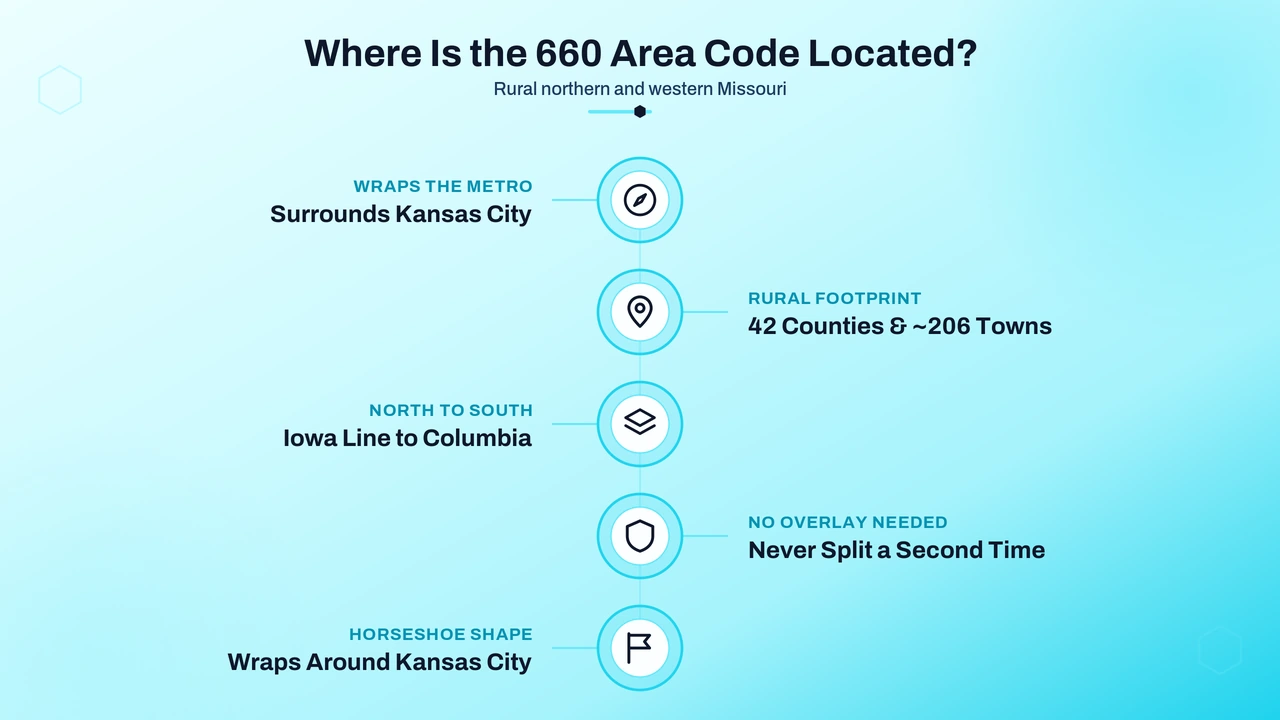
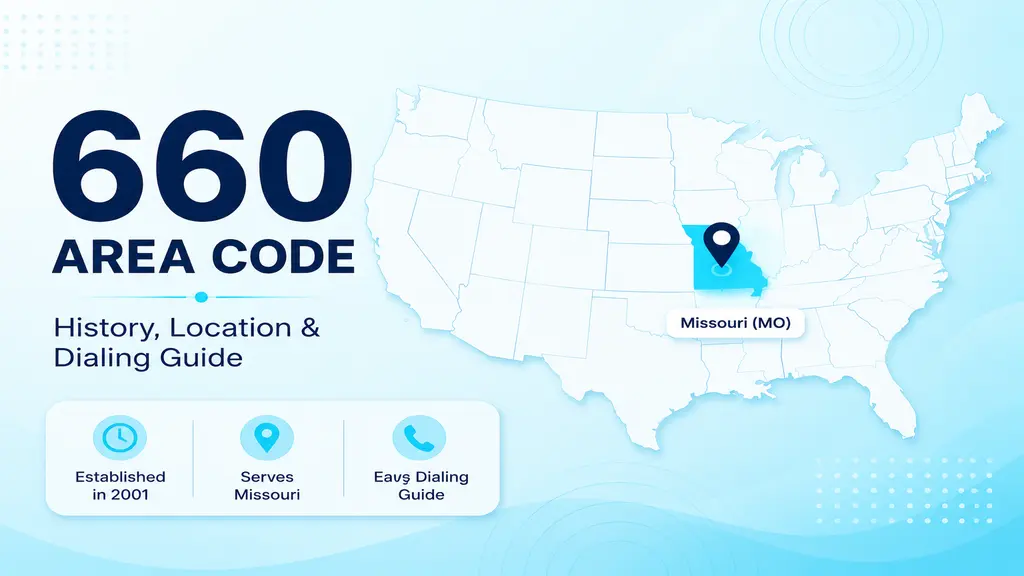
This area code wraps around the Kansas City metro area. It covers the rural counties of northern and western Missouri, not the city itself. Towns in this footprint sit across 42 counties and roughly 206 small cities and towns. It is a mix of farmland and county seats, not dense suburbs. The 660 area stretches from the Iowa border in the north down through the open land west of Columbia. It is the only area code covering this slice of the state. The region never needed a second overlay code the way busier metro areas have. This code forms a wide horseshoe around Kansas City. It takes in the rural fringe that the metro's own code left behind.
History and Origin of the 660 Area Code
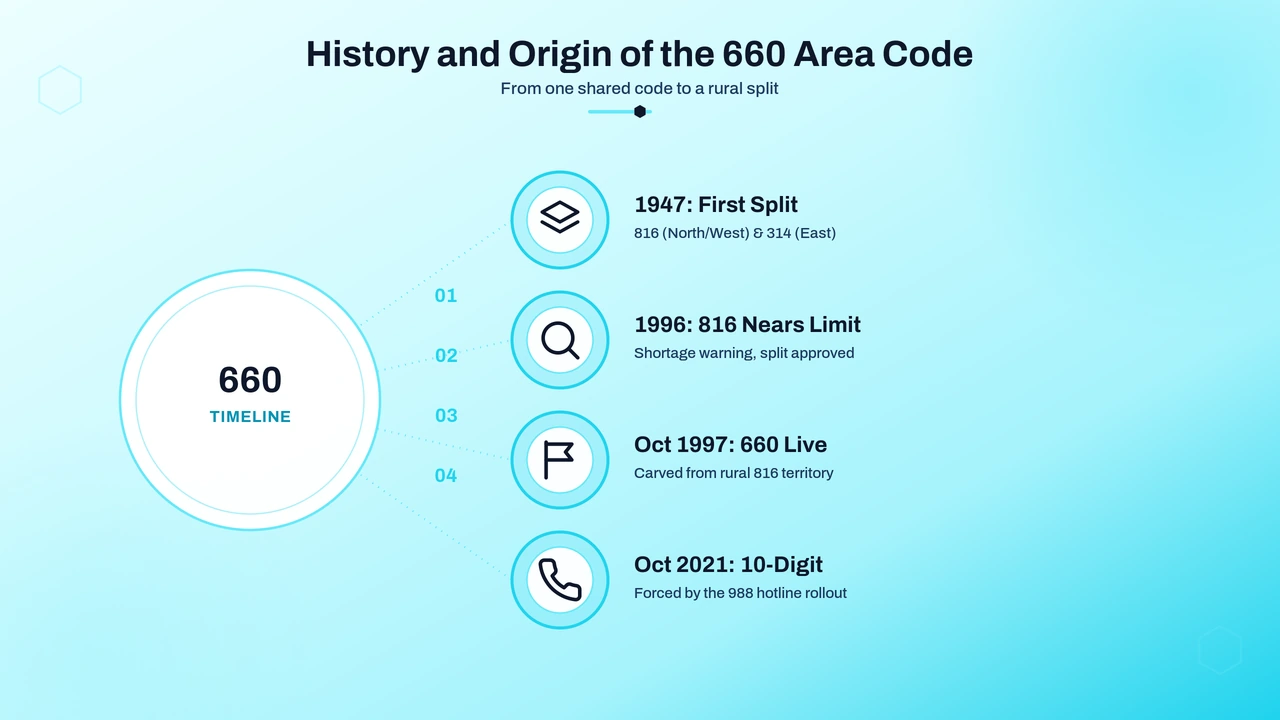
Before 1947, Missouri had no area codes at all, since the numbering plan did not exist yet. When it was made that year, the state split into just two parts: area code 816 for the north and west, including Kansas City, and area code 314 for the eastern third, including St. Louis. In 1951, planners carved out area code 417 for the southwest corner. That trimmed 816 down to the northern third of the state.
By late 1996, cell phone growth and new rules from a 1996 federal law pushed 816 close to its limit. Southwestern Bell gave a formal warning that April. Regulators then approved a split that July. Readers who want to compare can check the 816 area code blog to see how the Kansas City metro kept its own code. For a fuller record of how the lines changed, Wikipedia's overview of the 660 split lays out the full story.
Area code 660 went into service on October 12, 1997. It took the rural east and northwest parts of the old 816 area. That way, the busier Kansas City core would not have to change numbers. Even Lexington and Warrensburg, towns many think of as part of Kansas City, moved to 660 to keep the split simple. A grace period let callers use either code until April 19, 1998. More recently, the 660 area code had to switch to full 10-digit dialing by October 2021. This happened after regulators made 988 the nationwide crisis line number. That new number clashed with a local exchange already in use.
How the 660 Area Code Compares to Nearby Missouri Codes
Missouri runs on six area codes. Code 660 is the only one covering this rural stretch without an overlay partner. To the west, 816 and its 975 overlay serve the Kansas City metro that 660 split away from in 1997. To the east, 573 covers the corridor between Columbia and the Mississippi River. To the south, 417 handles the Ozarks and southwest Missouri. Across the state line, Iowa's 319, 641, and 712 codes sit to the north. Kansas's 785 and 913 codes and Nebraska's 402 and 531 codes border the region to the west. Unlike the crowded metro codes nearby, this one has never needed a second overlay. Demand across its rural counties has stayed light for decades.
Cities and Communities Served by the 660 Area Code
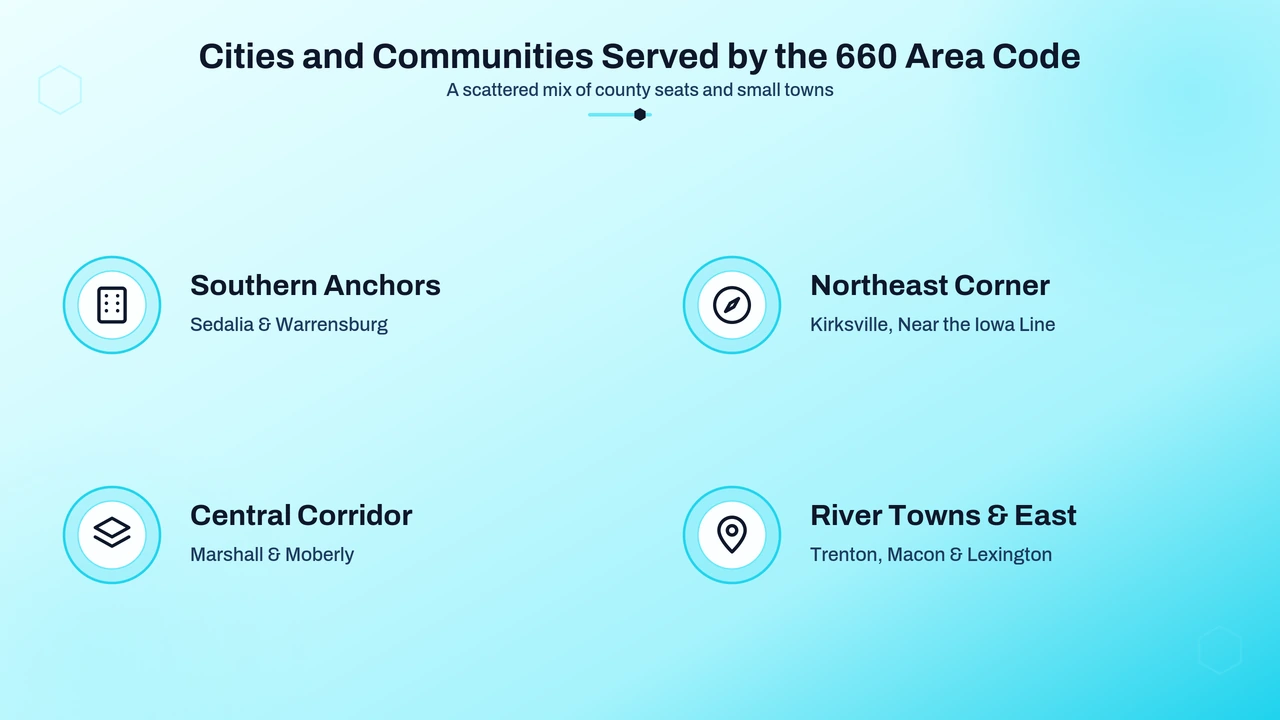
This area code reaches a wide, scattered mix of county seats and small towns rather than one hub. Sedalia and Warrensburg anchor the south part of the territory, while Kirksville serves as the business center for the northeast corner near the Iowa border. Marshall and Moberly round out the central corridor with a mix of farm processing and small manufacturing.
Further out, Trenton, Carrollton, and Higginsville dot the land between the Missouri River towns. Macon, Marceline, and Lexington carry the footprint toward the east edge. Smaller towns like Bethany, Princeton, Unionville, Clinton, and Butler round out a territory built more on farmland and county fairs than skylines.
Time Zone and Dialing Rules for the 660 Area Code
Every town under this area code runs on Central Time. It uses Central Standard Time in winter and Central Daylight Time each summer, along with the rest of Missouri. Unlike many nearby metro codes, this one did not need 10-digit dialing because of an overlay. Instead, the shift happened after 988 became the nationwide crisis number in 2020. That conflicted with an existing local exchange and forced every call in the region to use all 10 digits by October 2021. Skipping the area code on a local call here simply will not connect.
Why Businesses Choose a 660 Area Code Number
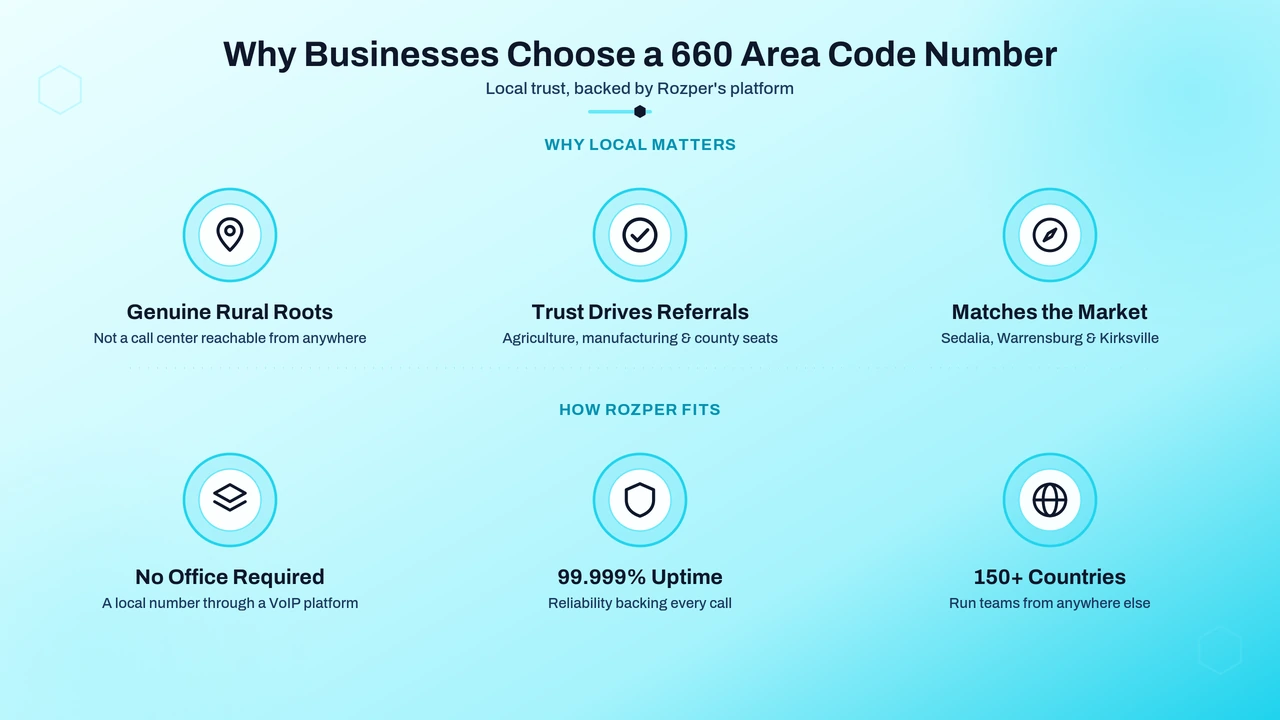
A local number in this area code signals real roots in rural Missouri, not a call center reachable from anywhere. That matters in a region built on farming, small factories, and county-seat trade. Local trust still drives referrals here. Firms growing into Sedalia, Warrensburg, or Kirksville often pick up a matching 660 number so their listing does not look out of place to a local crowd.
This is where a cloud phone provider like Rozper fits in. Rozper lets a business set up a local number through a VoIP platform, with no need for a physical office in the region. This keeps the local presence while routing calls anywhere the team works. Rozper backs that setup with 99.999% uptime and coverage across 150+ countries. A business can claim a Missouri 660 number for its rural footprint. It can still run support or sales teams from anywhere else. It is a solid middle ground for firms that want a rural Missouri presence without buying rural Missouri real estate.
How to Get a 660 Area Code Number
Getting a new number here usually means going through a phone provider, not the firm that first gave out the block decades ago. VoIP providers can often issue one in minutes. Pick a provider, search for an open number, confirm it, and the line is usually live the same day.
Moving a number from an old provider needs a standard porting request. That takes a few business days. It is worth checking that the old number keeps working during the switch.
Conclusion
Area code 660 has anchored rural Missouri's phone identity since 1997. It grew from a careful split of a full numbering plan into one of the least crowded area codes in the country. Its story of a careful split and a later dialing change tied to 988 shows how rural regions grow in a different way than their metro neighbors. That is also why 10-digit dialing reached even the quiet corners of the state. Maybe you are just curious about a missed call. Maybe you are shopping for a local number. Either way, knowing this area code's geography, history, and dialing rules makes the choice easier. For residents, it is simply the prefix tied to home. For businesses eyeing rural Missouri, a 660 number is a small but real sign of local presence.
FAQs
When did the 660 area code go into service?
It went into service on October 12, 1997, when regulators split it from area code 816 to relieve a shortage of phone numbers across northern and western Missouri.
What cities fall under this area code?
It covers Sedalia, Warrensburg, Kirksville, Marshall, Moberly, Trenton, Carrollton, Higginsville, Macon, Marceline, and Lexington, along with smaller towns like Bethany, Princeton, and Unionville.
Do I need to dial 10 digits for local calls in this area code?
Yes. Since October 2021, every call in the region needs 10-digit dialing, a change driven by the nationwide rollout of 988 rather than a local overlay.
Does this area code share an overlay with a nearby region?
No. Unlike the crowded 816 and 975 overlay next door, this region has never needed a second code, since its rural counties have stayed well below exhaustion for decades.
What time zone does this region use?
The whole region runs on Central Time. It uses Central Standard Time in winter and Central Daylight Time each summer, the same schedule followed across the rest of Missouri.
Why did dialing rules change in this area code if it is not crowded?
The change was not about running out of numbers. When 988 became the national crisis line number in 2020, it conflicted with an existing local exchange, forcing mandatory 10-digit dialing by October 2021.
Can a business outside Missouri get a 660 area code number?
Yes. VoIP providers can issue a number in this area code to any business no matter its location. This lets companies build a local rural Missouri presence without a local office. Rozper, for example, can set one up along with call routing, voicemail, and support for remote teams.