Introduction
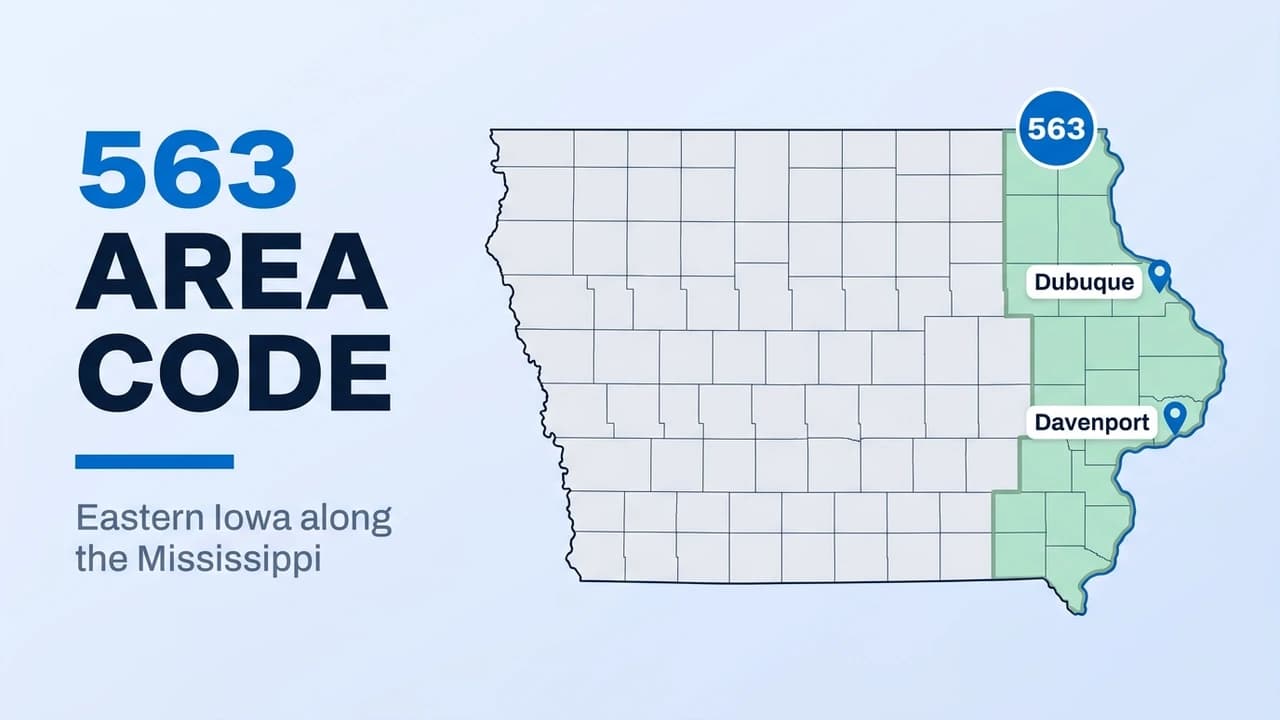
The 563 area code covers east-central and northeast Iowa, tracing the Mississippi River from Muscatine north to the Minnesota border. Anyone dealing with the 563 area code quickly notices something unusual, because this region shares its daily commerce with two neighbouring states across a river rather than looking inward to the rest of Iowa. This guide maps the river cities it serves, explains how a single metro ended up split between two states and two codes, sets out why seven-digit dialing survived here, and covers what the prefix signals. A border code behaves differently from an inland one, and those differences matter every day.
Key Takeaways:
- The 563 area code covers eastern Iowa along the Mississippi River corridor.
- It was created in 2001 by splitting the older 319 code rather than overlaying it.
- Seven-digit local dialing still works because no second code was ever added.
- The Quad Cities metro spans two states, so 563 faces Illinois numbers across the water.
The Code That Follows The River
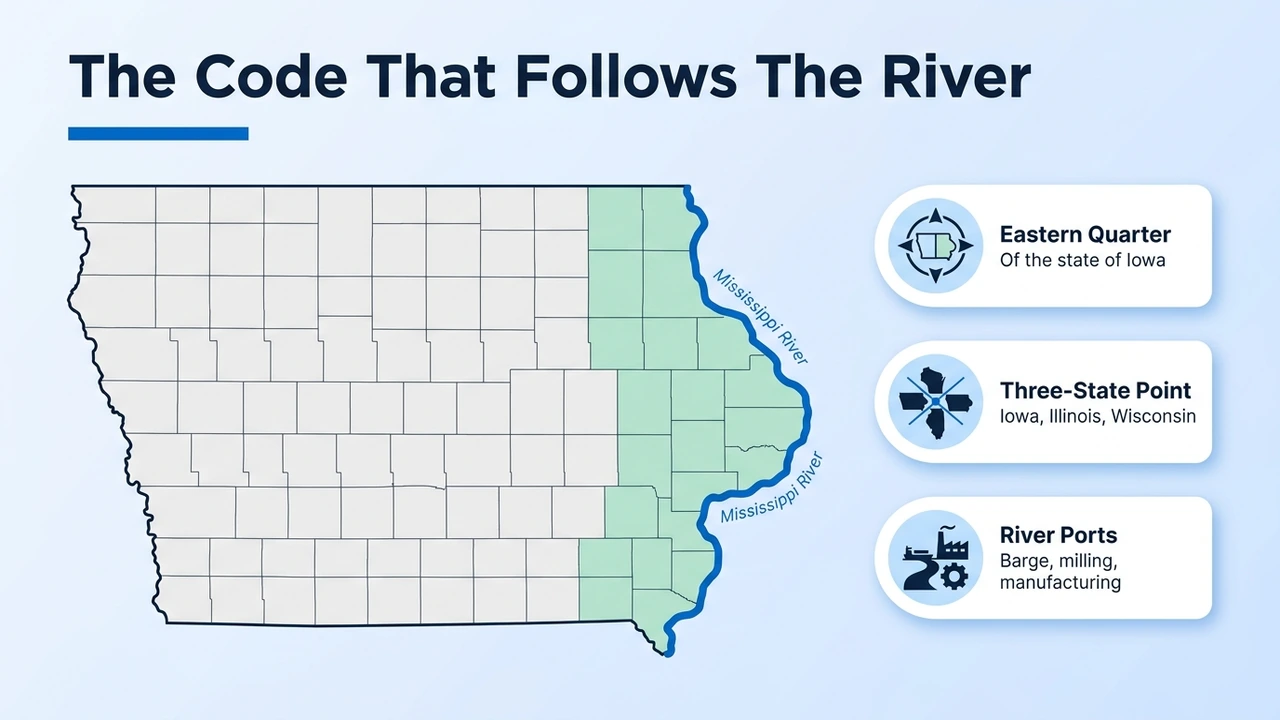
Geography defines this numbering plan far more directly than population does. The eastern boundary is not a surveyed straight line but a river, and that river has shaped settlement, industry, and calling patterns across the 563 area code for the better part of two centuries. Towns here grew up facing the water, not the interior.
- The territory runs the full length of Iowa's eastern border along the Mississippi.
- It reaches from Muscatine in the south to the Minnesota line in the north.
- Barge traffic, milling, and manufacturing built most of the river towns.
- Dubuque marks the northern end of the 563 area code, where three states meet.
- Inland counties in the northeast corner are farming country by contrast.
That long river frontage gives the 563 area code a very different character from the rest of the state. Central Iowa's 515 area code faces inward toward a single dominant metro core, while this region orients outward across the water toward Illinois and Wisconsin. It is a subtle distinction that shapes everything from commuting patterns to which television news a household watches.
One Metro, Two States, Two Codes
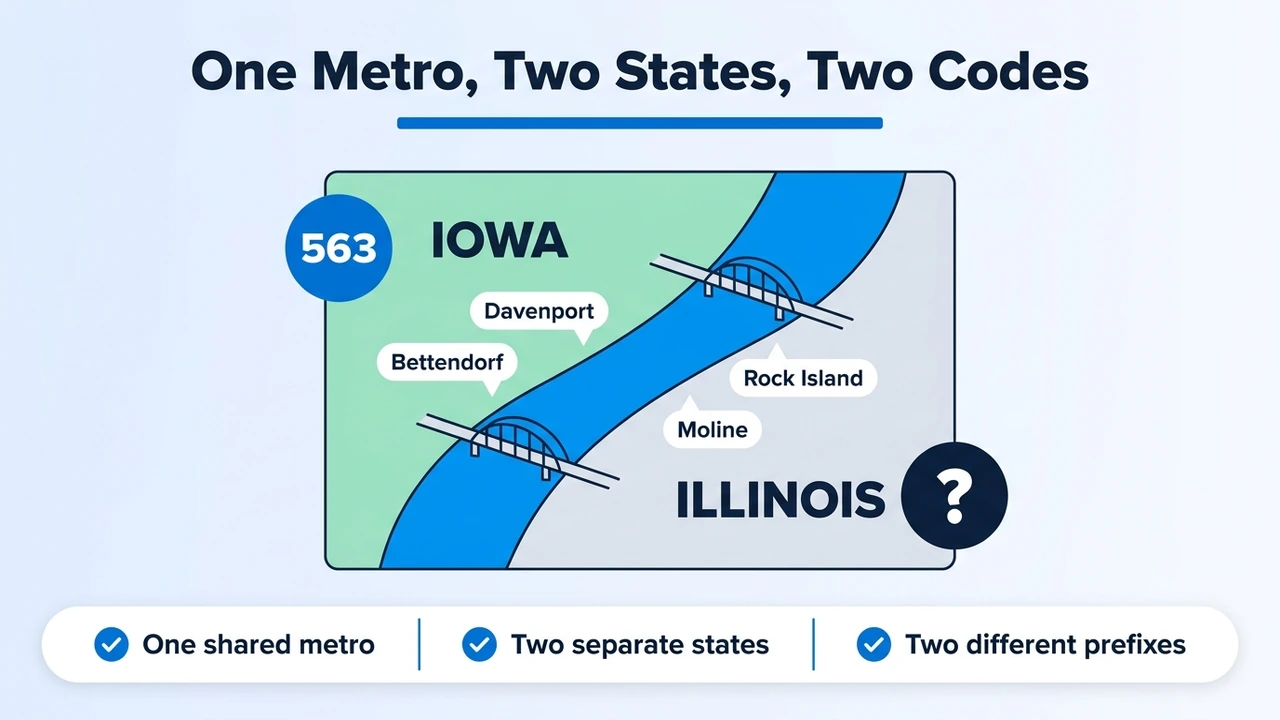
The Quad Cities is the clearest illustration anywhere of what a border code means in practice. It functions as a single metropolitan area, with shared employers, shared media markets, shared sports teams, and thousands of people crossing the bridges every working day, yet it sits in two different states under two entirely different prefixes. Very few metros in the country are divided this cleanly by a numbering boundary.
Which side of the river you are on
Davenport and Bettendorf sit on the Iowa bank and carry the 563 area code. Directly opposite them, Rock Island, Moline, and East Moline sit in Illinois under a completely different code. A caller reading a number here therefore learns which side of the river someone is on before they learn anything else about them, which is a form of information most prefixes simply cannot convey.
What that means for local businesses
Companies serving the whole metro end up with customers under two prefixes and two separate state jurisdictions. Presenting the right local identity to each side genuinely matters, because a recipient in Davenport reads an Iowa prefix as nearby and an Illinois one as somewhere else, even when the caller is five minutes away over a bridge. Rozper lets one team present a consistent local presence on both banks without maintaining separate phone systems or duplicating staff.
How To Dial A 563 Number
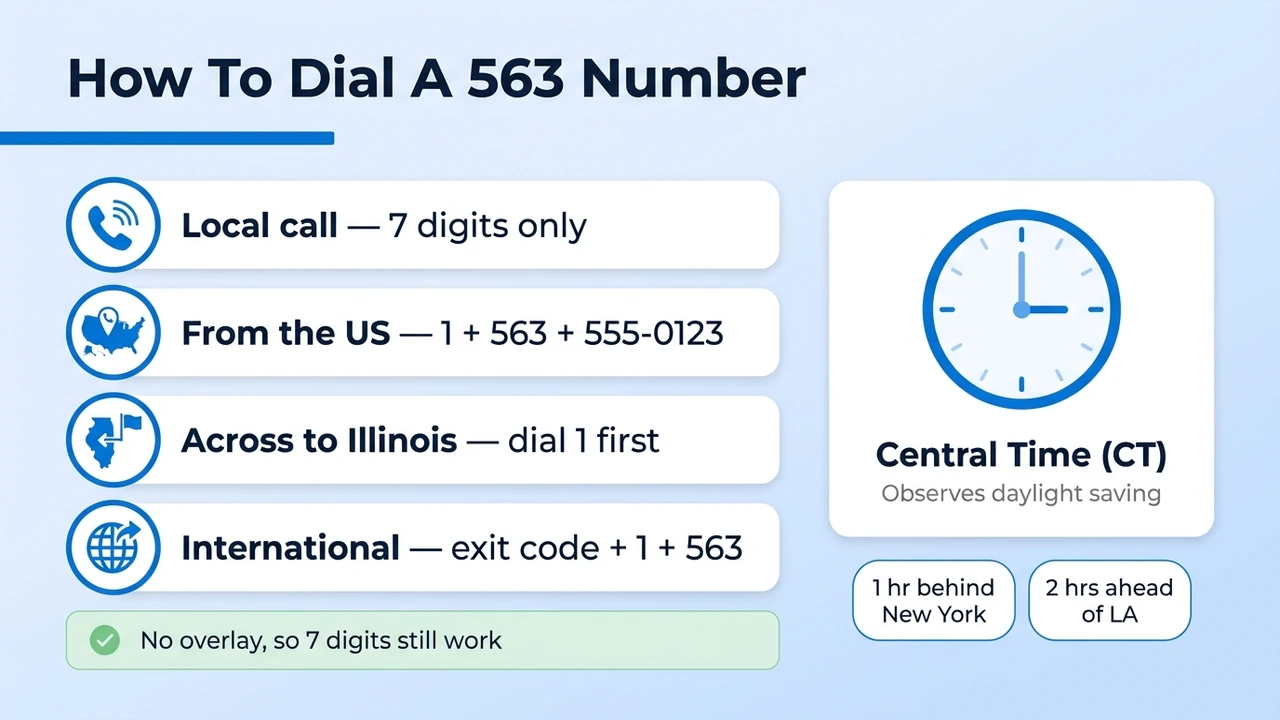
The dialing rules here are a direct consequence of a decision taken back in 2001, and the reasoning behind it is worth understanding properly. Eastern Iowa sits in the Central Time zone and observes daylight saving each year, putting it one hour behind New York and two hours ahead of Los Angeles.
- Calling locally inside eastern Iowa: seven digits alone will still complete the call.
- Calling from elsewhere in the US: dial 1, then 563, then the seven-digit number.
- Calling across to Illinois: dial 1 plus that state's code, since it is a separate region.
- Calling from abroad: dial your exit code, then country code 1, then 563, then the number.
When relief became necessary, mobile carriers pushed hard for an overlay, largely because it would spare them the expense of reprogramming handsets across the region. The public pushed back just as hard, mainly because an overlay forces ten-digit dialing on absolutely everyone, and regulators ultimately chose a geographic split instead. That single decision, taken a quarter of a century ago, is the reason the 563 area code still permits seven digits today while many comparable regions do not.
Eastern Iowa was also not among the regions required to change when 988 became the national crisis lifeline, unlike some neighbouring codes that did have to convert. The FCC guidance lists exactly which areas were affected and why. Cloud platforms such as Rozper normalize stored numbers automatically, so a contact saved in either format still connects on the first attempt.
From Dubuque Down To Muscatine
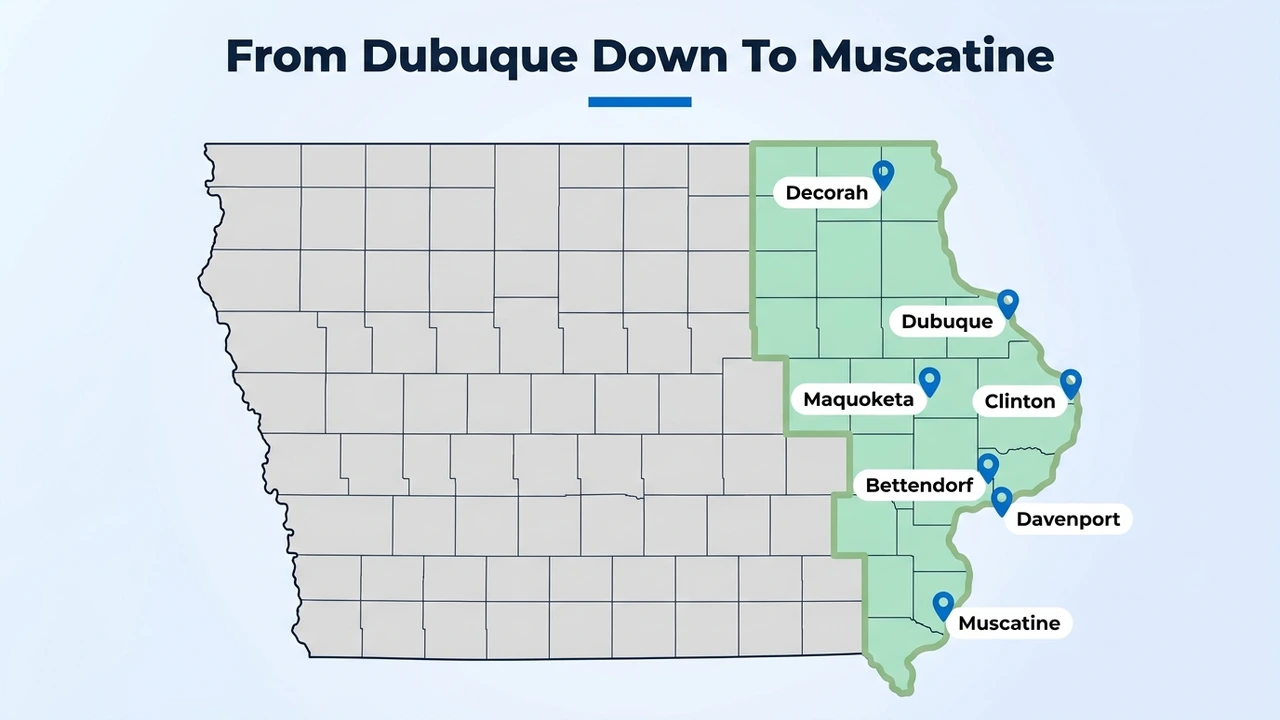
Coverage takes in roughly the eastern quarter of Iowa, a mix of long-established river ports and quiet agricultural counties further inland. Population concentrates heavily along the water and thins noticeably as you move west from the bank, which is why most call traffic under area code 563 clusters along that single narrow strip.
- Davenport and Bettendorf — the largest cities and the Iowa half of the Quad Cities.
- Dubuque — the northern anchor of the 563 area code, where three states meet.
- Clinton and Muscatine — long-established industrial towns on the water.
- Maquoketa, DeWitt, and Le Claire — the smaller communities between the ports.
- Decorah, Waukon, and Cresco — the northeast corner near the Minnesota line.
- Manchester, New Hampton, and Oelwein — the inland farming and rail towns further west.
The pattern is quite unlike western Iowa, where the 712 area code spreads thinly across open farmland with no comparable urban anchor at either end. Here the river does the concentrating, stacking most of the subscribers along a single north-south line barely a few counties wide. That shape has a practical consequence: a business with one number in Davenport is already within local reach of a corridor running most of the length of the state.
Calling Across the River Without Sounding Distant
Serving a bi-state metro creates a practical problem that inland businesses never have to think about. Your market may sit half in one state and half in another, separated by a few hundred metres of water but by an entire numbering region on caller ID. That gap is invisible on a map and obvious on a phone screen.
The mistake businesses make
Many companies pick a single number and use it everywhere, which quietly costs them answered calls on the opposite bank without ever showing up as a line item. Recipients in both states screen unfamiliar prefixes aggressively, and an out-of-region number reads as a cold call regardless of how close the office actually sits. Distance on a map and distance on caller ID are simply not the same measurement, and only one of them decides whether the phone gets picked up.
A more practical approach
Presenting a genuine local identity to each side of the river solves the problem without duplicating staff, hardware, or carrier contracts. A consistent, verifiable number also makes spoofed calls considerably easier to spot, since scammers rely on faking a familiar prefix for a single afternoon rather than holding one for years. Established businesses across area code 563 keep the same numbers for decades, and that continuity is itself a signal of legitimacy. Rozper signs outbound traffic with carrier-level authentication so genuine calls from area code 563 Iowa stay trusted right across the network.
Conclusion
The 563 area code covers east-central and northeast Iowa, following the Mississippi from Muscatine north toward the Minnesota border. Created in 2001 through a split of the older 319 code, it has never received an overlay, which is precisely why seven-digit local dialing still works throughout the region. The Quad Cities remains its defining feature, a single metro divided between two states and two prefixes by the river running through it. Those few facts explain nearly every question people ask about calls in eastern Iowa.
The river corridor will keep drawing manufacturing, logistics, and river tourism for years to come. Businesses working both banks should establish a recognizable local presence before their next season of outreach begins. Whether you serve Dubuque in the north or the Quad Cities further south, the right calling setup makes a two-state market feel like one. Rozper can have that presence running well before your next campaign starts.
FAQs
Where is the 563 area code located?
It covers east-central and northeast Iowa along the Mississippi River. Davenport, Dubuque, Clinton, and Muscatine are among the largest cities.
What time zone does area code 563 use?
Eastern Iowa observes Central Time and follows daylight saving each year. That is one hour behind New York and two hours ahead of Los Angeles.
Can you still dial seven digits in eastern Iowa?
Yes. No overlay was ever added to the region, so local calls still complete on seven digits alone.
Which area code did 563 split from?
It was split from 319 in 2001, taking the eastern portion. The change became mandatory in December of that year.
Does the Quad Cities share one area code?
No. The Iowa cities use 563 while the Illinois cities across the river use a separate code entirely.
Which cities use the 563 area code?
Davenport, Bettendorf, Dubuque, Clinton, and Muscatine are among the largest. Maquoketa, Decorah, and Manchester cover the inland communities.
Why was a split chosen instead of an overlay?
Overlays force ten-digit dialing on everyone, which met strong public resistance in 2001. Regulators chose a geographic split instead.
Can a 563 number be spoofed by scammers?
Yes. Neighbor spoofing fakes a local caller ID, so verify unexpected callers by hanging up and dialing back on a number you looked up.