Introduction
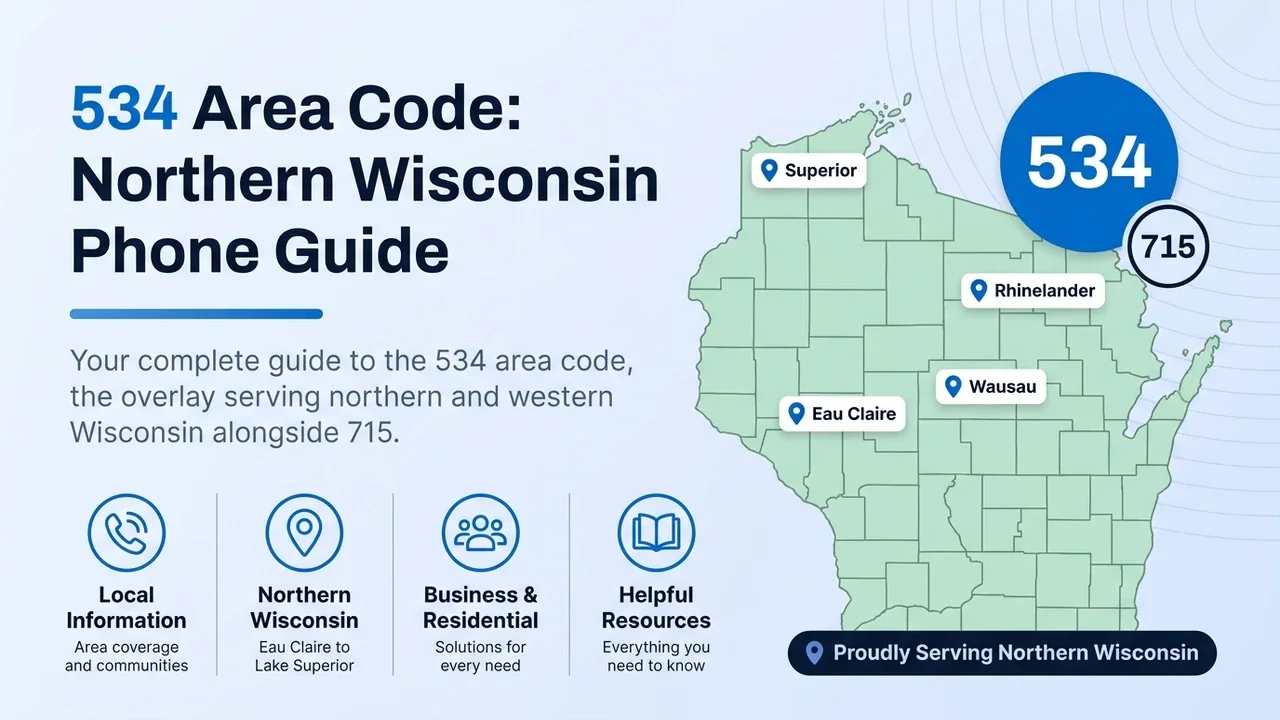
The 534 area code covers northern and western Wisconsin, sharing its entire territory with the older 715 code that came before it. Anyone seeing the 534 area code for the first time usually assumes it belongs somewhere far away, when in fact it rings in the same North Woods towns their neighbors have called for decades. This guide explains what an overlay is, maps the counties involved, sets out the ten-digit dialing rules, and answers whether a 534 number is truly local. Understanding this one detail clears up nearly every question people ask about calls in the northern half of the state.
Key Takeaways:
- The 534 area code shares its map with 715 across roughly 39 Wisconsin counties.
- It entered service in August 2010 when the older code ran short of numbers.
- Mobile devices, not population growth, drove that shortage in a thinly settled region.
- Ten-digit dialing has been mandatory across both codes since the overlay began.
An Overlay in the North Woods, Not a Big City
Overlays are normally an urban solution. Crowded metros run out of prefixes, regulators add a second code on top of the existing one, and residents adjust within a year or two. Northern Wisconsin broke that pattern completely, because the same fix landed on a region of lakes, forests, and small county seats rather than a dense city. That mismatch is the single most useful thing to understand about the 534 area code.
What an overlay actually does
Instead of splitting a territory in half and forcing one side to change numbers, an overlay adds a second code across the whole existing area. Nobody gives up a number they already have. New lines simply receive the newer prefix as older supplies run low.
Why that choice suited this region
A split would have drawn an arbitrary line straight through the North Woods, separating towns that have always called each other locally. Regulators avoided that outcome entirely. Every existing number under the 715 area code stayed exactly as it was, and the 534 area code simply began filling in behind it as new lines were ordered.
Thirty-Nine Counties, Two Codes
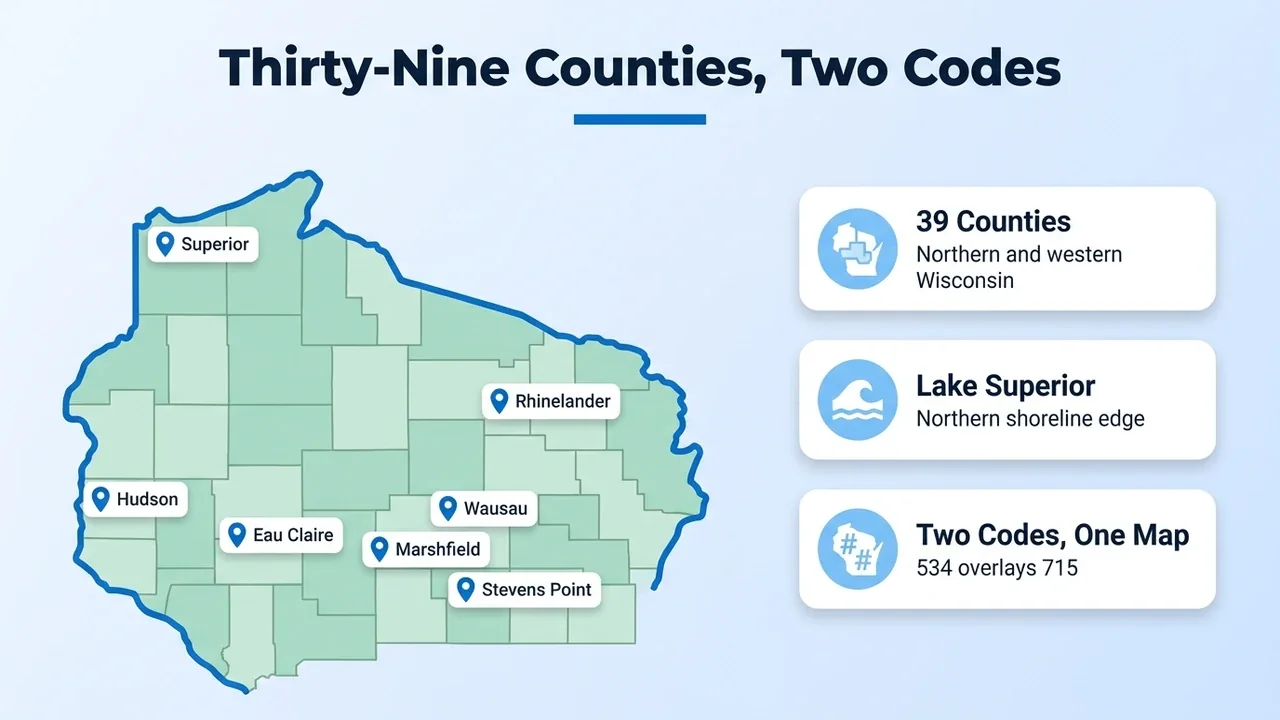
Coverage stretches across roughly 39 counties, taking in the northern and western portions of the state. That footprint runs from the Minnesota border on the west all the way to the Michigan border on the east, and reaches north to the Lake Superior shoreline. It is an enormous area measured by land, though quite modest by population, which is exactly what makes an overlay here so surprising. Every community below sits inside the 534 area code territory.
- Eau Claire and Chippewa Falls — the largest population center in the western half.
- Wausau, Marshfield, and Stevens Point — the central Wisconsin manufacturing corridor.
- Superior and Ashland — the Lake Superior shoreline across the far northern edge.
- Rhinelander, Minocqua, and Tomahawk — the northern lakes and tourism belt.
- Hudson, River Falls, and New Richmond — the growing western edge near Minnesota.
- Rice Lake, Hayward, and Ladysmith — the northwestern forest counties.
Compare that with a compact metro code and the contrast is stark. The 414 area code packs a similar subscriber count into one county, while area code 534 Wisconsin spreads its numbers across land larger than several entire US states.
Why Cellphones, Not People, Filled Up 715
Here is the part most guides skip entirely. Northern Wisconsin did not experience a population boom in the 2000s. What changed was how many numbers each person needed, and that shift alone exhausted a code that had lasted more than sixty years.
One person, several numbers
A household that once held a single landline gradually acquired mobile phones for each family member, plus pagers, fax lines, alarm circuits, and later data connections. Every one of those consumed a number drawn from the same finite pool. Multiply that across an entire region and the supply drains quickly, even when the population itself stays completely flat.
Why rural areas run out too
Prefixes are handed out in large blocks rather than one number at a time, so even a sparsely populated exchange can tie up thousands of numbers it will never actually use. That allocation method punishes rural regions far more than dense ones, because the wasted capacity is proportionally much larger. By 2010 the older code had almost nothing left to assign anywhere in the territory, and the 534 area code arrived that August as the approved relief plan.
How To Dial A 534 Number
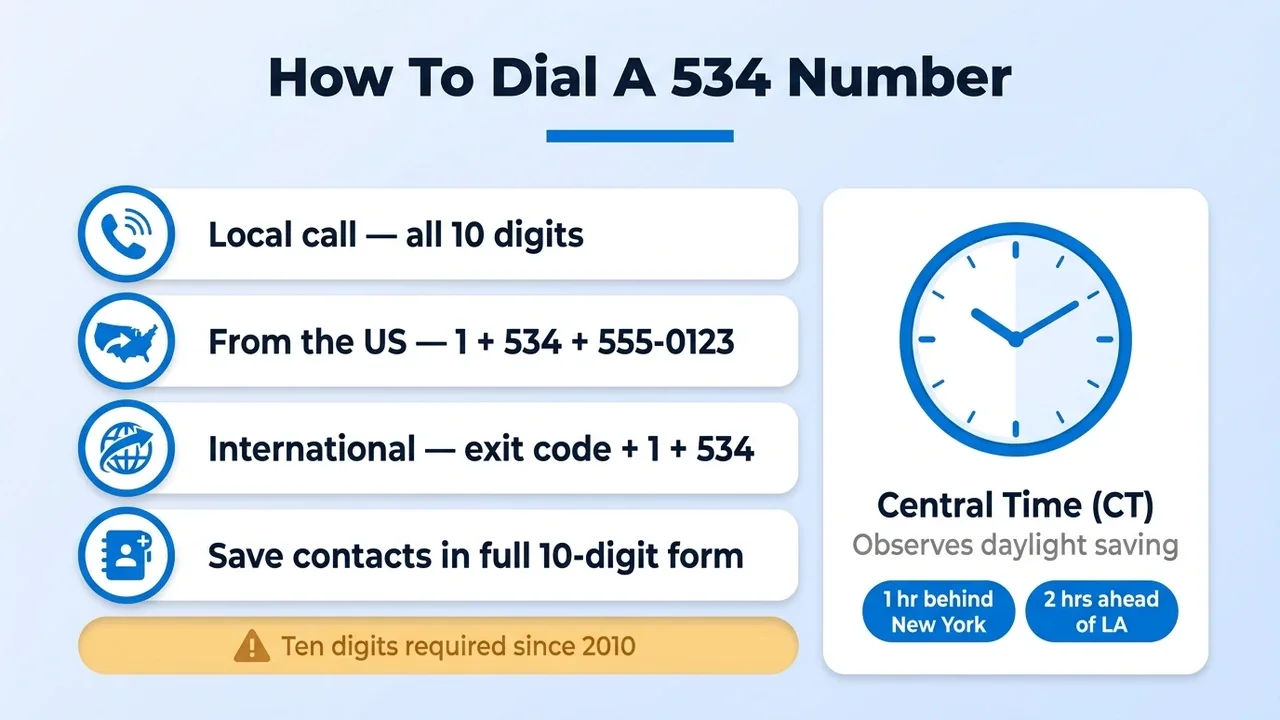
The overlay carried one unavoidable consequence for everyone in the region. Once two codes share a single map, a seven-digit number becomes ambiguous, because the exact same seven digits could plausibly exist under either prefix. Northern Wisconsin therefore moved to mandatory ten-digit dialing when the 534 area code launched, and the whole region runs on Central Time with daylight saving observed each year.
- Calling locally inside northern Wisconsin: dial all ten digits, including 534 or 715.
- Calling from elsewhere in the US: dial 1, then the three-digit code, then the number.
- Calling from abroad: dial your exit code, then country code 1, then the code and number.
- Storing contacts: save every northern Wisconsin number in full ten-digit format.
Separately, more than eighty codes nationwide were later pushed onto ten-digit dialing when 988 became the crisis lifeline. Northern Wisconsin had already made that change years earlier, so nothing shifted here. The FCC guidance explains the national rules in detail. Cloud platforms such as Rozper normalize stored numbers automatically, so an old seven-digit entry still connects.
534 And 715 Share One Map
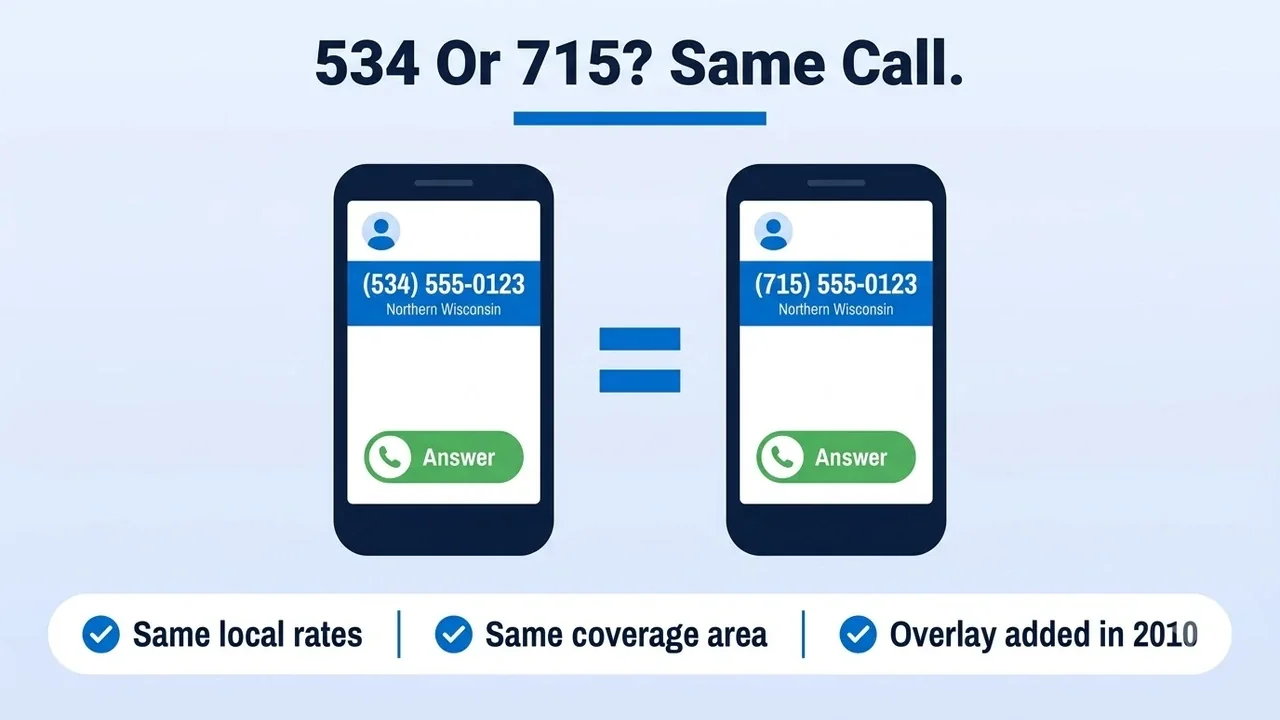
This is the question that brings most people to this page, and the answer is refreshingly simple. A 534 number is every bit as local as a 715 one, because the two codes describe an identical territory down to the street address. Calls between them are local calls, billed at local rates, with no long-distance charge involved on either side.
- Both codes serve the same counties, towns, and street addresses.
- Neither carries a different rate, routing path, or carrier requirement.
- The only real difference is when the number was originally issued.
- A newer business often receives 534 simply because 715 supplies ran low.
- Letting a 534 call ring out means missing a genuine neighbor.
That said, a familiar prefix proves nothing about the caller. Neighbor spoofing lets scammers fake a local caller ID, so treat unexpected urgency or payment demands as warning signs, hang up, and dial back on a number you looked up yourself. Rozper signs outbound calls with carrier-level authentication so genuine traffic stays verified.
One Number Across A Huge Region
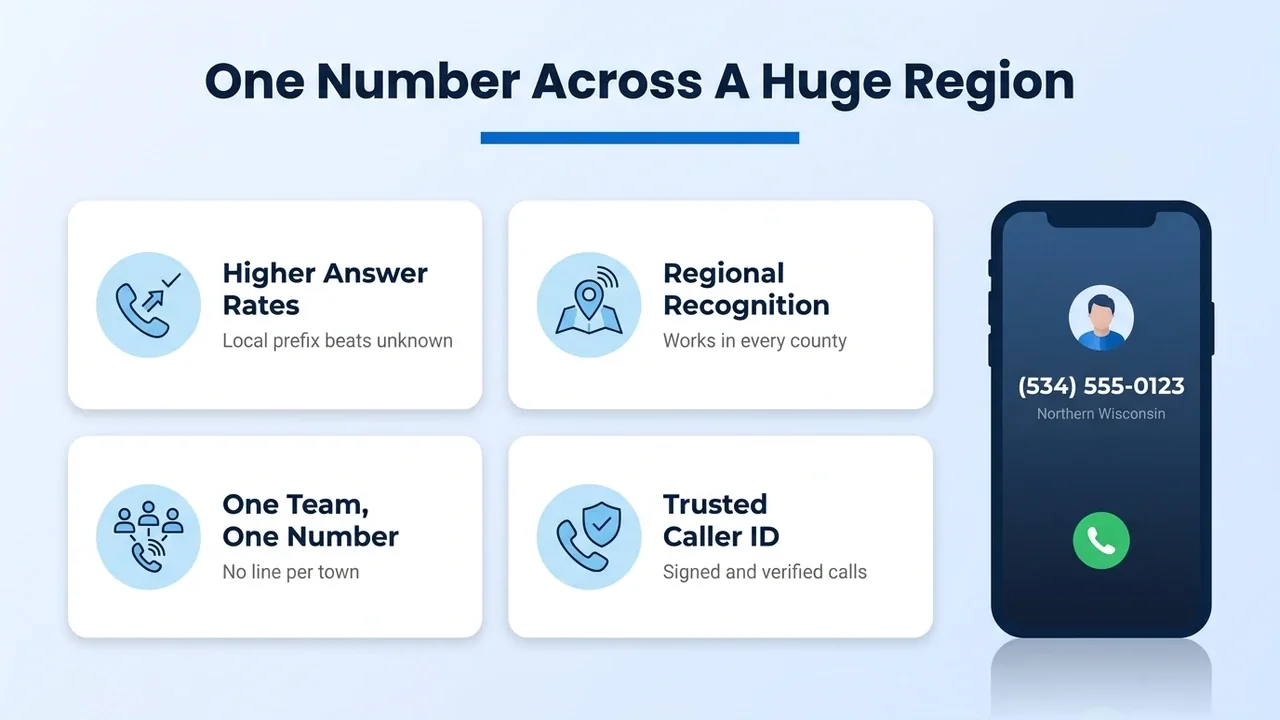
Businesses serving the northern half of Wisconsin face a genuine geographic problem. A single sales territory here can span several hours of driving, and customers up in Superior have little in common with those down in Stevens Point. A recognizable local number is one of the very few things that works consistently across that entire distance, which is why the 534 area code matters commercially.
Why one number beats many
Maintaining a separate number for every town fragments your identity and quietly confuses returning callers who cannot remember which line they used last time. A single presence covering the entire region keeps things simple for customers and for your own team. Rozper lets distributed staff share one northern Wisconsin identity on every outbound call they place.
What local recognition buys you
Tourism operators, contractors, healthcare networks, and manufacturers all rely on being reachable across county lines. Presenting an area code 534 number signals regional presence rather than an out-of-state call center. In a place where people genuinely notice where a call comes from, that distinction still earns pickups.
Conclusion
The 534 area code covers northern and western Wisconsin, sharing roughly 39 counties with the older 715 code rather than replacing it. It entered service in August 2010, brought about by an explosion of mobile devices rather than any surge in population across the region. Because two codes now share one map, ten-digit dialing became mandatory throughout area code 534 Wisconsin from the very beginning. Knowing that single fact answers nearly every question a caller might have about numbers in the North Woods.
Northern Wisconsin will keep drawing new residents, businesses, and seasonal visitors to its lakes and forests for years to come. Companies building a presence there should secure a recognizable local number before their next season begins. Whether you serve customers along the Lake Superior shore or through the central manufacturing corridor, the right calling setup makes a vast region feel close. Rozper can have that presence running well before your next campaign starts.
FAQs
Where is the 534 area code located?
It covers northern and western Wisconsin, roughly 39 counties reaching from the Minnesota border to Lake Superior. Eau Claire and Wausau are among the largest cities.
Is 534 the same as 715?
Yes, in practical terms. The two codes overlay the same territory, so both serve identical towns at identical local rates.
What time zone does area code 534 use?
Northern Wisconsin observes Central Time and follows daylight saving each year. That is one hour behind New York and two hours ahead of Los Angeles.
Why does northern Wisconsin need ten-digit dialing?
Once two codes shared one map in 2010, seven digits became ambiguous. Every local call therefore requires the full ten-digit number.
When did the 534 area code start?
It entered service in August 2010 as relief for the older 715 code. Existing customers kept their numbers unchanged.
Which cities use this code?
Eau Claire, Wausau, Superior, Stevens Point, Marshfield, Rhinelander, and Hudson are among them. Dozens of smaller towns share the same territory.
Can a 534 number be spoofed?
Yes. Scammers fake local caller IDs regularly, so verify unexpected callers by hanging up and dialing back on a number you looked up.
Should a new business accept a 534 number?
It works exactly like 715 and reaches the same customers. Availability depends on your provider and what supply remains when you order.