Introduction
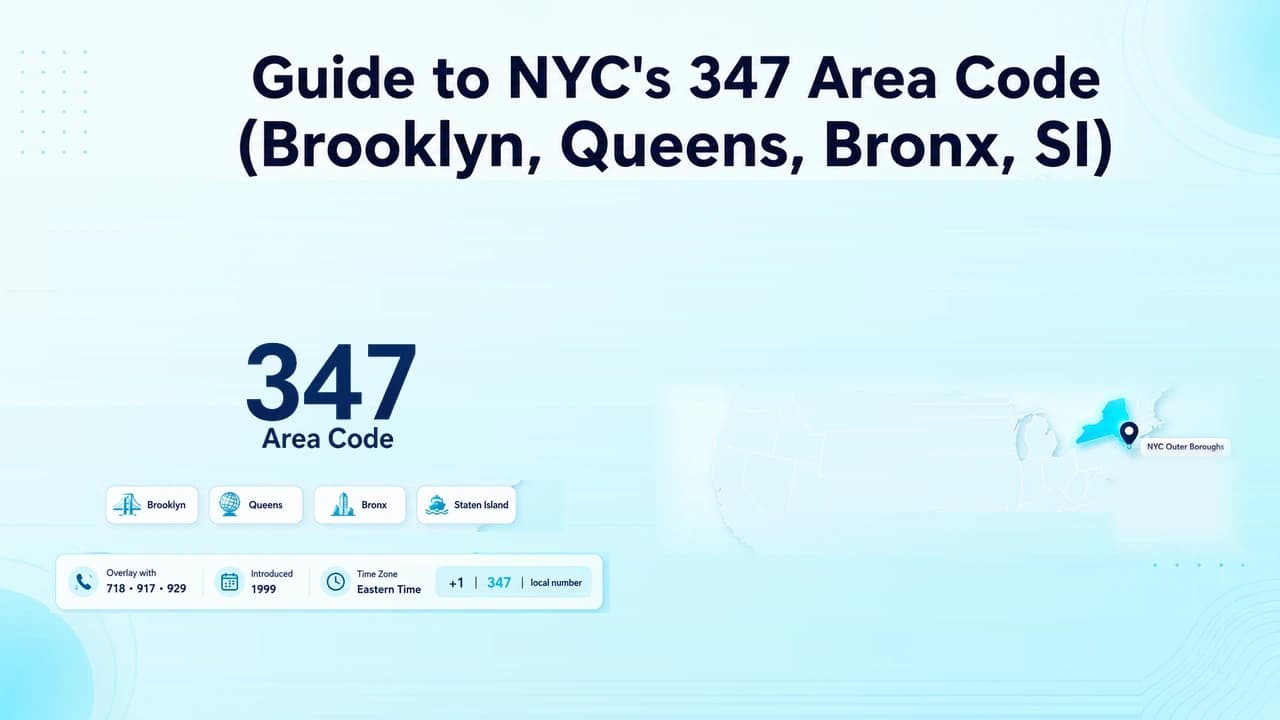
The 347 area code signals one thing right away: New York City, beyond Manhattan. It works alongside three overlay partners — 718, 917, and 929. Together, these four codes handle everyday calls across Brooklyn, Queens, the Bronx, and Staten Island. More than seven million people live in these boroughs. The area also holds one of the densest small-business economies in the country.
For any company hoping to win trust here, the phone number prefix matters a lot. New Yorkers are far more likely to pick up a call from a code they recognize as local. They are less likely to answer an unfamiliar toll-free or out-of-state number. This guide explains where the 347 prefix works, how its overlay system runs, and its history. It also shows how any business can get a local outer-borough number, no matter where the team sits. Maybe you run a home services business in Queens. Maybe you run a healthcare practice in the Bronx. Maybe you ship e-commerce orders from Staten Island. In each case, matching your caller ID to the borough you serve removes a small but real bit of friction from every customer call.
What Is the 347 Area Code?
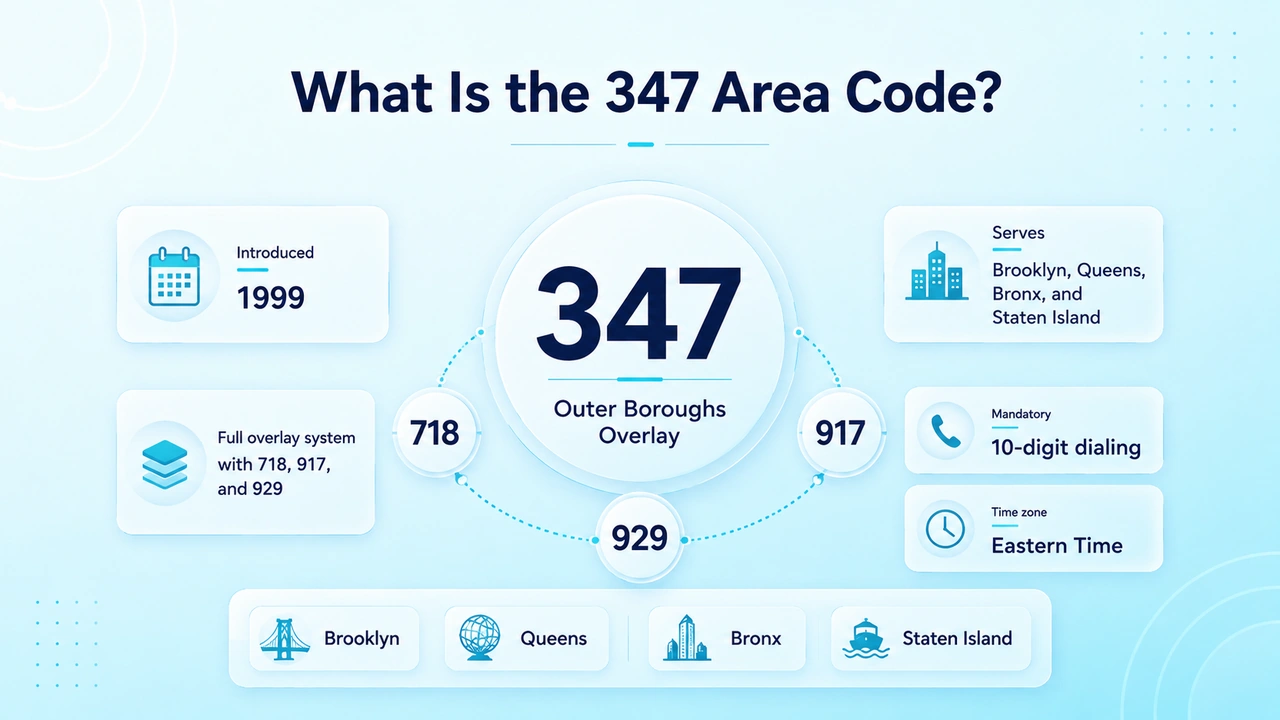
The 347 area code started in 1999. It was added as an overlay for New York City's outer boroughs. Instead of splitting the region into new zones, planners layered 347 on top of the existing 718 code. This overlay approach let existing 718 customers keep their numbers. New lines got the 347 prefix instead, as demand for phone numbers kept growing.
Today, this prefix is one of four overlay codes: 718, 917, 929, and 347. All four codes cover the same area — Brooklyn, Queens, the Bronx, and Staten Island — inside one local calling area. Because of this overlay setup, every call in the region needs all 10 digits. Residents of the outer boroughs are used to seeing all four prefixes mixed together in their contacts and caller ID history. So a 347 number feels just as local as a 718 or 917 line.
The region runs on Eastern Time (ET). That means UTC-5 during Eastern Standard Time, from early November through mid-March. It means UTC-4 during Eastern Daylight Time, from mid-March through early November. Businesses calling in from Central, Mountain, or Pacific time zones should plan around this gap. That way, calls land during normal working hours.
For businesses also targeting Manhattan alongside the outer boroughs, our 332 area code guide covers the borough's overlay prefix and its commercial districts.
Where Does the 347 Area Code Cover?
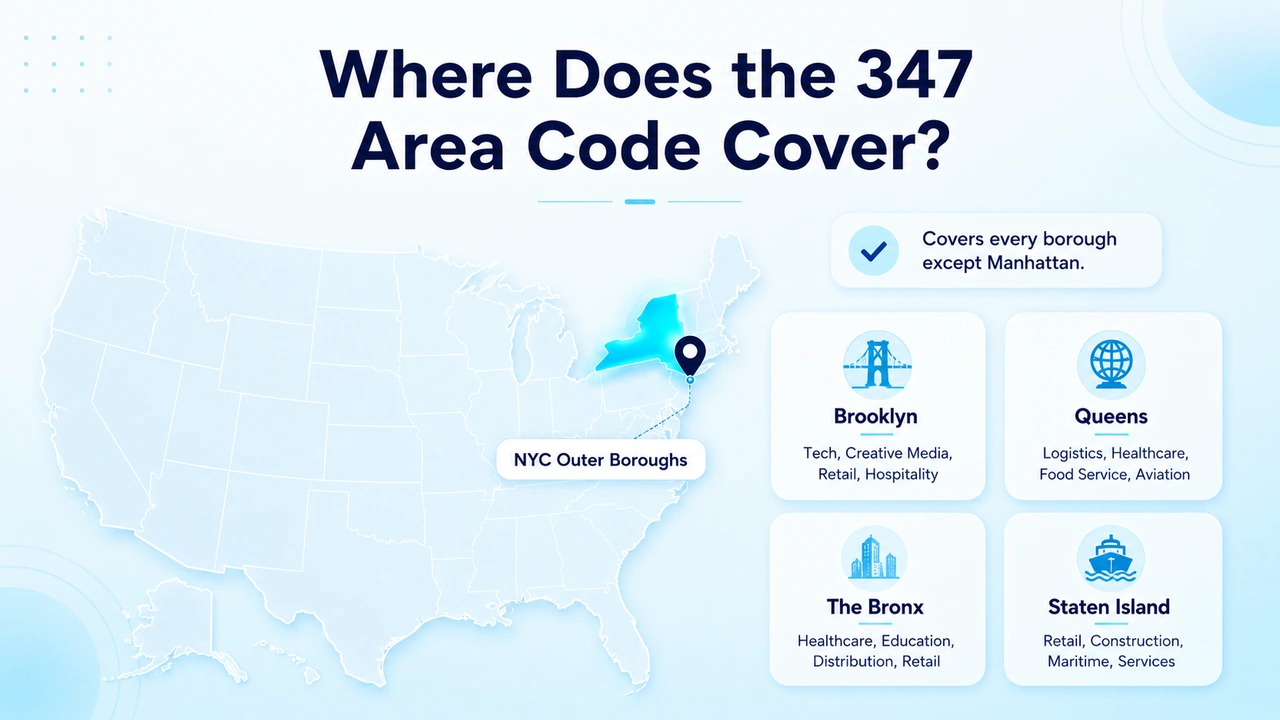
The 347 area code covers four of New York City's five boroughs. That means every borough except Manhattan. Here is a quick look at each borough and its main industries.
| Borough | Key Industry Focus |
|---|---|
| Brooklyn | Tech, Creative Media, Retail, Hospitality. |
| Queens | Logistics, Healthcare, Food Service, Aviation. |
| The Bronx | Healthcare, Education, Distribution, Retail. |
| Staten Island | Retail, Construction, Maritime, Services. |
This local prefix builds quick trust across all four boroughs. A local number tells customers that your business belongs to the neighborhood. It does not sound like a call center in some other state. Brooklyn's tech and creative scene is booming. Queens has many small, family-run businesses. The Bronx has strong health and school systems. In all of these places, a local number can mean the gap between a call that gets picked up and one that gets ignored.
For businesses expanding north into the lower Hudson Valley and Westchester County, the 914 area code covers Yonkers, White Plains, and the surrounding suburban market.
History of Area Code 347
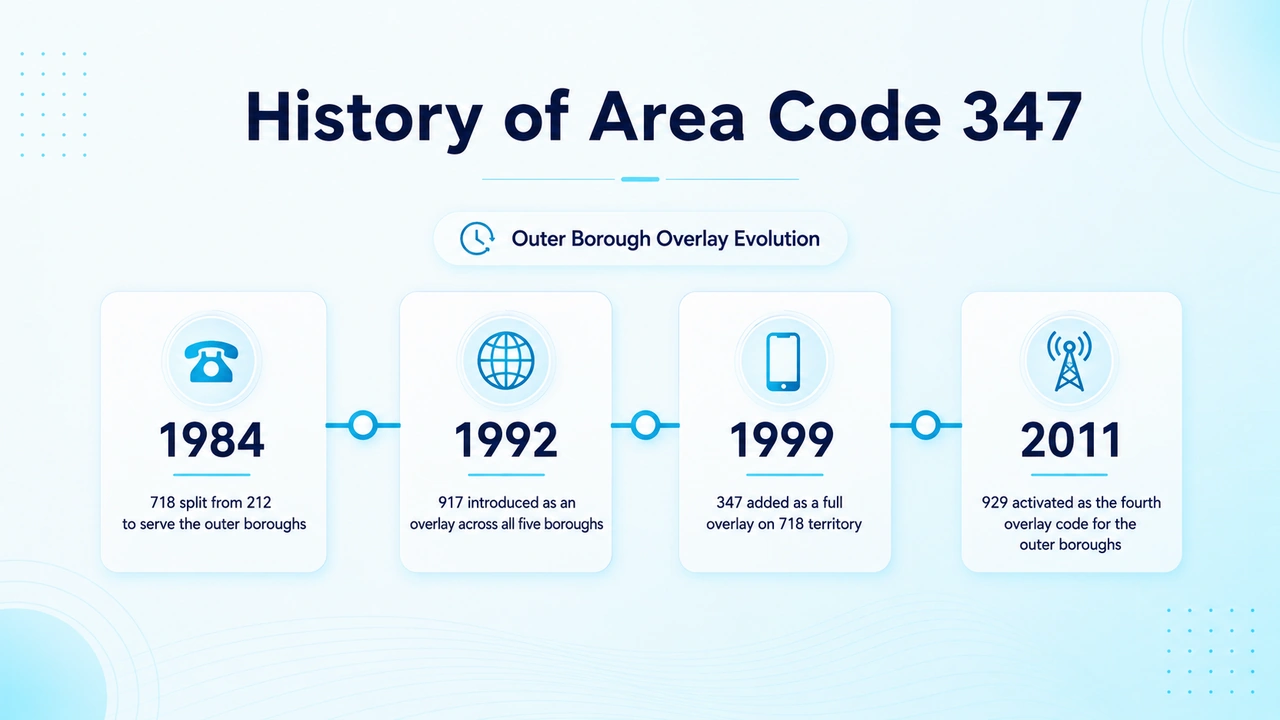
Area code 347 went live on October 1, 1999. It was the second code to serve New York City's outer boroughs. The original 718 code had covered Brooklyn, Queens, the Bronx, and Staten Island since 1984. That's when these boroughs split off from Manhattan's 212 code.
The rollout of overlays in the outer boroughs shows just how fast demand for new numbers grew:
- 1984: Area code 718 splits from 212 to serve the outer boroughs.
- 1992: Area code 917 arrives as an overlay for all five boroughs. At first, it's mainly for mobile phones and pagers.
- 1999: The 347 code is added as a full overlay on the 718 territory.
- 2011: Area code 929 activates as the fourth overlay code for the outer boroughs.
By the time 347 was assigned, mobile phones, fax lines, and second home lines had pushed 718 close to running out of numbers. The overlay solution solved this. It kept existing numbers safe while adding new capacity. You can find official rules on overlay systems and mandatory 10-digit dialing in the FCC's consumer dialing guide.
How to Get a 347 Area Code Number
Getting a 347 area code number does not require a New York City office. You don't even need a physical address in the boroughs. VoIP (Voice over Internet Protocol) technology lets any business get and run a local outer-borough number from anywhere in the world. Calls route to whatever devices your team already uses.
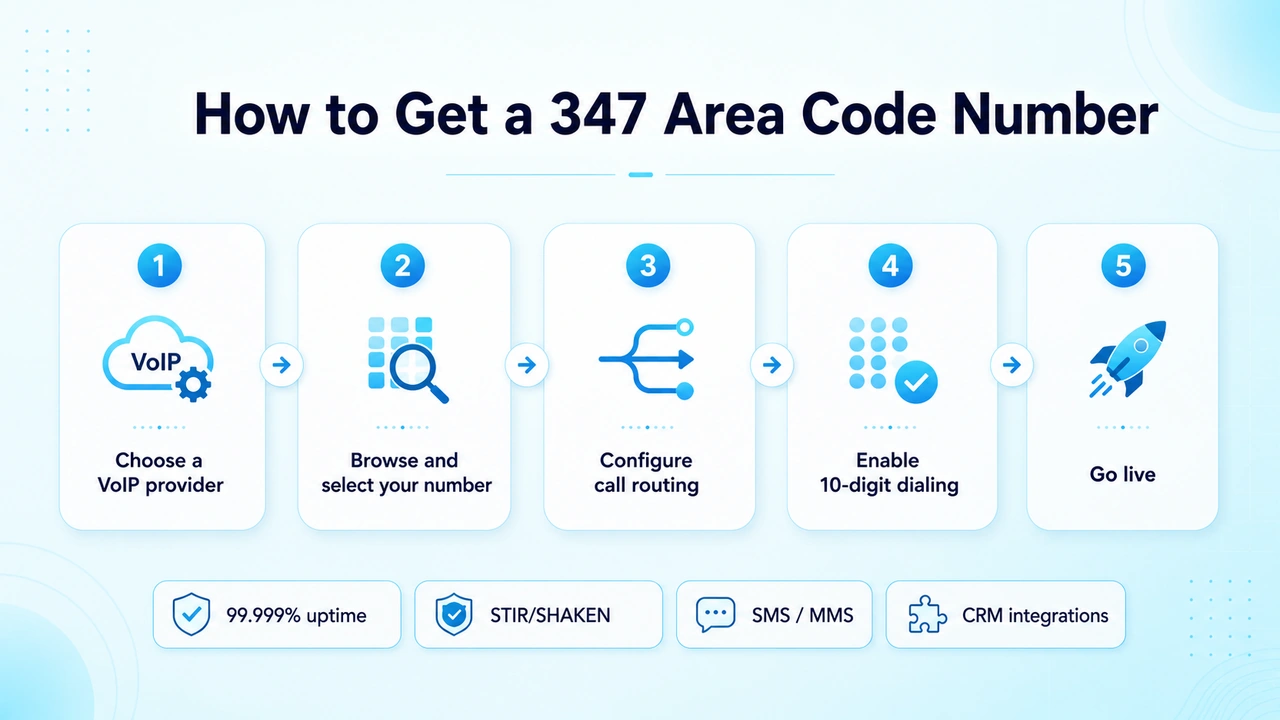
Steps to get started:
- Choose a VoIP provider with live 347 number inventory. Confirm availability before you commit to a plan.
- Browse and select your number. Search for memorable patterns or vanity sequences that fit your brand.
- Configure call routing. Forward calls to mobile devices, desk phones, or call queues based on your hours and team setup.
- Enable 10-digit dialing across every CRM system and outbound dial-out setting. This is required in the overlay region.
- Go live. Most providers finish setup in minutes. There's no hardware to install and no technician visit needed.
What to look for in a provider:
Look for platforms with 99.999% uptime SLAs. New York City is a fast, busy market. A missed call often means a lost customer. STIR/SHAKEN caller ID checks verify your number at the carrier level. This stops it from getting flagged as spam. That matters a lot in a place where people screen their calls.
Business SMS and MMS support helps you reach past voice calls. Outer-borough customers more and more expect text scheduling and confirmations. CRM links with Salesforce, HubSpot, or Zoho log every 347 call against contact records right away. That keeps your New York customer chats tracked with no manual data entry. It also gives your team a full view of each customer. Voicemail-to-text and call recording add one more useful layer. Managers can check calls for quality and training. They do not need to sit in on every single call.
Conclusion
The 347 area code has stood for New York City's outer boroughs since 1999. People across Brooklyn, Queens, the Bronx, and Staten Island recognize it instantly. If your business wants customers in these neighborhoods, getting a number with area code 347 is a smart, low-cost move. It builds local credibility, lifts answer rates, and earns trust before you say a word. With a modern VoIP platform, getting an outer-borough number takes minutes. You need no New York address at all. Competition for attention in these boroughs keeps growing. Businesses that pair a recognizable local number with reliable call handling get a real edge over out-of-state competitors dialing in from unfamiliar prefixes.
FAQs
What boroughs does the 347 code serve?
It serves four of New York City's five boroughs: Brooklyn, Queens, the Bronx, and Staten Island. That covers everything except Manhattan. It's part of a four-code overlay with 718, 917, and 929. All four share the same territory within one local calling area, and that area requires 10-digit dialing.
What is the difference between 347, 718, 917, and 929?
All four are overlay codes that cover the exact same outer-borough area. New York residents see all four as equally local. 718 was the first outer-borough code. Then 917, 347, and 929 were added to meet the growing need for new numbers. Area code 347 is one of the best known of these. It carries a strong neighborhood feel for businesses building a local New York presence.
Do I need a New York address to get a 347 number?
No. VoIP providers let businesses anywhere get and run a local outer-borough number, with no need for a physical New York address or office. Calls route to any device your team uses — mobile, desktop, or desk phone. It does not matter where your staff sit. That makes this great for remote and spread-out teams.
What time zone is the 347 code in?
The 347 code sits in the Eastern Time Zone (ET). That's UTC-5 during Eastern Standard Time and UTC-4 during Eastern Daylight Time. Businesses in Central, Mountain, or Pacific time zones should plan outer-borough outreach during Eastern business hours. Aim for roughly 8 AM to 6 PM ET to get the most answered calls.
Is 10-digit dialing required for the 347 code?
Yes. The 347 code shares its territory with 718, 917, and 929 in an overlay setup. Because of that, every call in the region needs the full 10-digit number. Dialing only seven digits leads to a failed call. So businesses should set up all phone systems, CRMs, and dial-out strings to use the complete 10-digit format.