Introduction
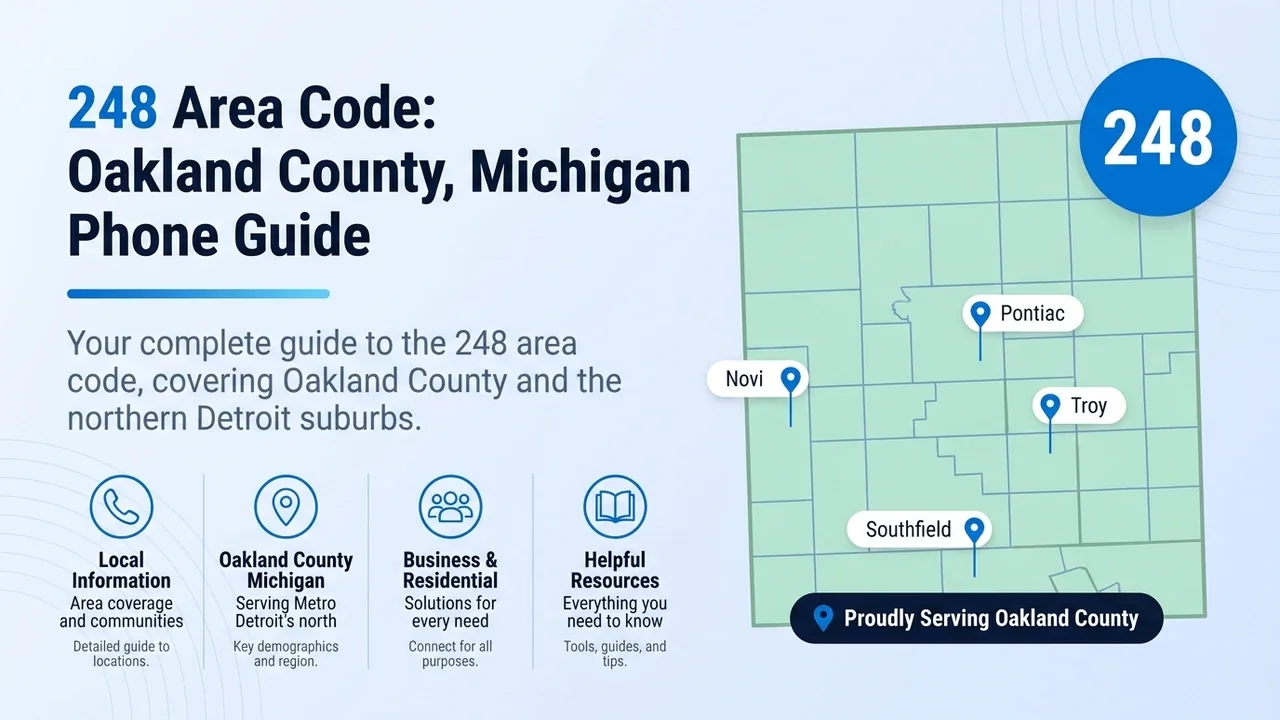
The 248 area code covers Oakland County, Michigan, the affluent ring of suburbs stretching north and west of Detroit. Anyone who lives or sells into this region eventually hits the same confusion: the 248 area code no longer sits alone, because a second code shares its exact boundaries. This guide maps the cities it serves, explains the 1997 split that created it, sets out the ten-digit dialing rules, and clears up what a 947 number actually means. Get these details straight and you will read every incoming Oakland County call correctly from now on.
Key Takeaways:
- The 248 area code serves Oakland County plus a small slice of northwest Wayne County.
- It was created in 1997 when Michigan split the older 810 code in two.
- The 947 overlay shares the same map, which made ten-digit dialing mandatory in 2002.
- A 947 number is exactly as local as a 248 one, despite what many callers assume.
Two Codes, One County: Understanding 248 and 947
Most area codes own their territory outright. Oakland County works differently, because two separate codes now sit on top of one another across the identical geography. Numbers issued under 947 ring in the same towns, on the same streets, as numbers issued under 248. Nothing about the caller's location changes when the first three digits do.
What an overlay actually does
When a region runs out of available prefixes, regulators can either split it in half or lay a second code over the whole thing. A split forces half the population to change their numbers, which businesses hate. An overlay leaves every existing number untouched and simply issues new lines under the new code, which is the route Michigan chose here.
Why residents rarely notice
Because the overlay arrived gradually, the 248 area code still holds the large majority of established lines in the county. Households and businesses in place since the nineties almost all kept their original numbers, and nobody was ever asked to give one up. Newer lines, second mobile numbers, and recently opened offices are where 947 tends to surface. The result is a county where the older code reads as established and the newer one reads as recent, even though the 248 area code and its overlay are functionally identical.
From 810 to 248: The 1997 Split That Redrew Detroit's Suburbs
Oakland County has not always had its own code. For most of the twentieth century the northern Detroit suburbs dialed under 313, then under 810 after a 1993 reorganization. Explosive suburban growth burned through prefixes far faster than planners expected, and by the mid-nineties a second relief plan was already unavoidable. The sequence below shows how the county arrived at today's arrangement.
- 1993 — Michigan creates 810, pulling Oakland, Macomb, and the northern suburbs out of 313.
- 1997 — 810 splits again, and Oakland County receives 248 as its own dedicated code.
- 2000 — Regulators assign 947 as relief, this time as an overlay rather than another split.
- 2002 — Permissive dialing ends in January, and ten digits become mandatory countywide.
Two relief events in under a decade tell you how quickly this county grew. By comparison, a rural code like the 712 area code has needed no relief at all since 1947. Density, not land area, is what exhausts a numbering plan, and the 248 area code exhausted its supply faster than almost anywhere else in Michigan.
Where The 248 Area Code Reaches
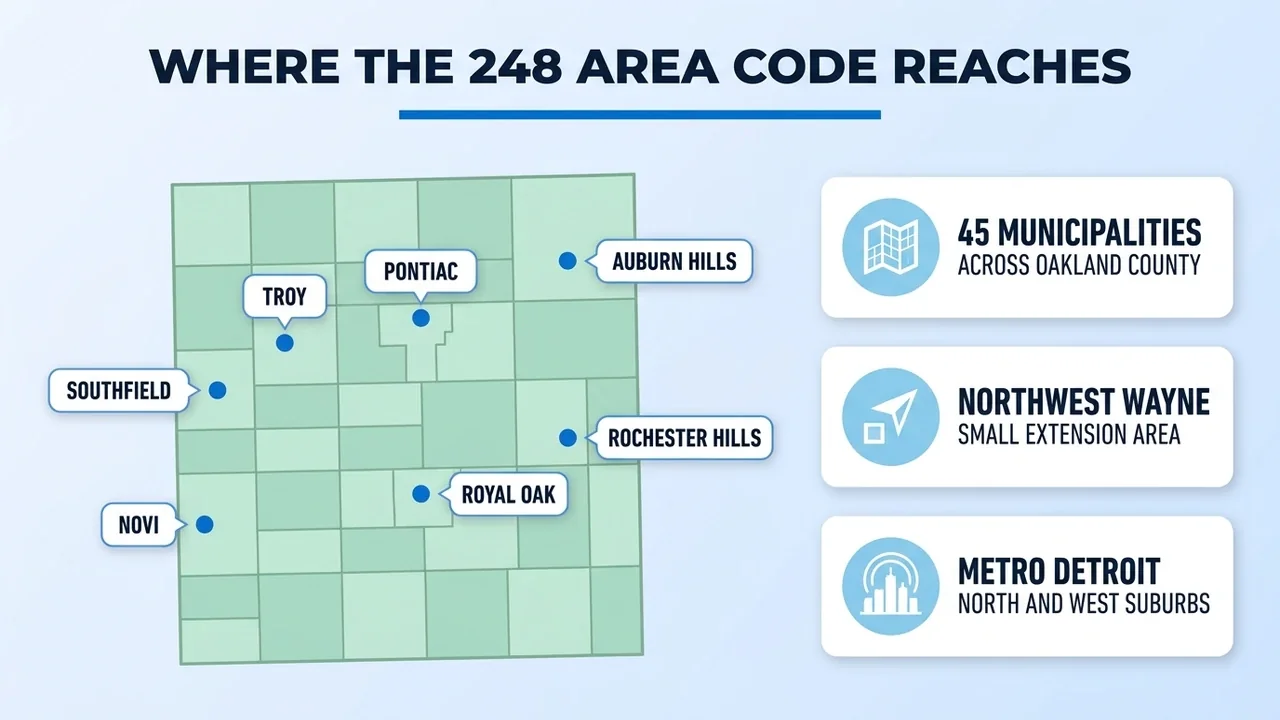
Coverage centers almost entirely on Oakland County, with a thin extension into northwest Wayne County. Roughly forty-five municipalities fall inside the boundary, ranging from dense office corridors to lakefront townships. The county ranks among the wealthiest in the United States, and its business density is the real reason the numbering plan filled up so quickly.
- Southfield and Troy — the two largest office markets, dense with corporate headquarters.
- Pontiac and Auburn Hills — the automotive and motorsport core of the county.
- Novi, Farmington Hills, and Livonia's edge — retail and technology corridors along I-96.
- Royal Oak, Ferndale, and Birmingham — walkable downtowns with heavy small-business activity.
- Bloomfield Hills, Rochester Hills, and West Bloomfield — established residential communities.
- Waterford, Milford, and Highland — lake country on the county's western edge.
Michigan's other codes cover very different ground. The 269 area code to the southwest is spread across farmland and small cities, while area code 248 Michigan concentrates a comparable population into a fraction of the space.
How To Dial A 248 Number
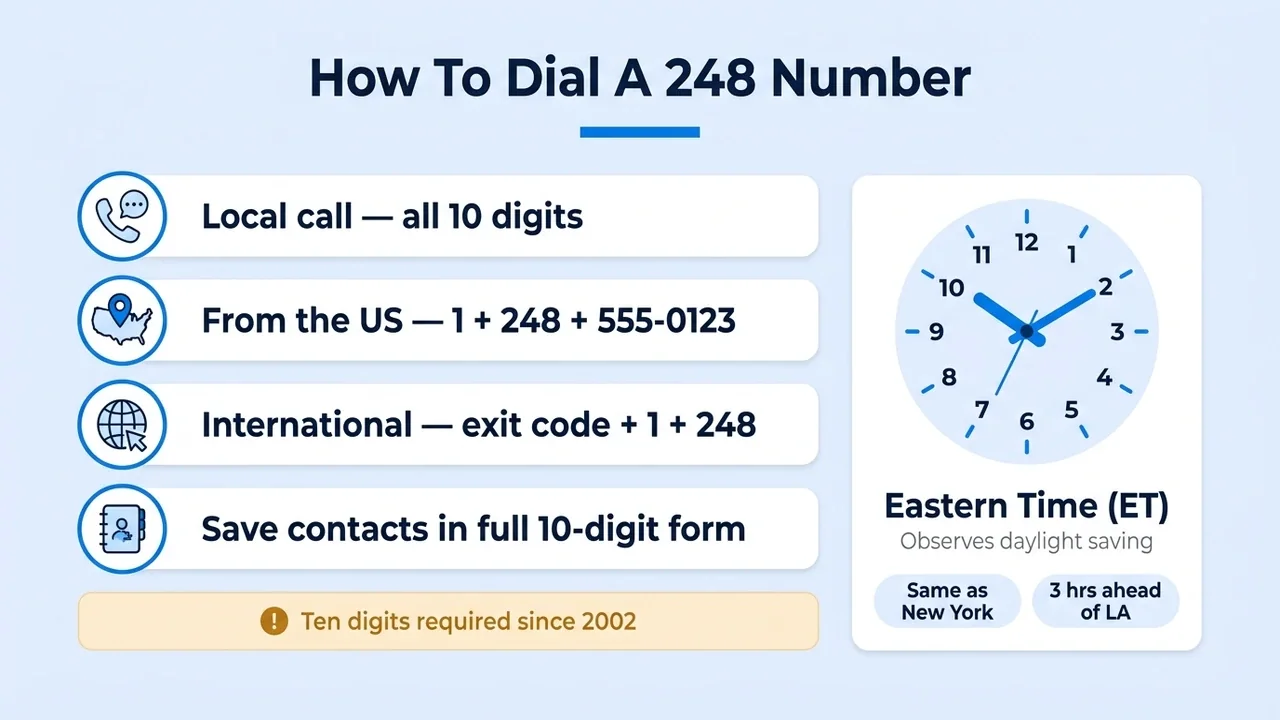
Oakland County sits in the Eastern Time zone and observes daylight saving, putting it three hours ahead of Los Angeles and on the same clock as New York. Dialing here has been strict since January 2002. Because the overlay put two codes on one map, seven-digit local dialing was retired entirely, and every local call now needs all ten digits.
- Calling locally inside the county: dial all ten digits, including 248 or 947.
- Calling from elsewhere in the US: dial 1, then the three-digit code, then the number.
- Calling from abroad: dial your exit code, then country code 1, then the code and number.
- Programming speed dials: store every Oakland County contact in full ten-digit format.
Nationwide, more than eighty codes were pushed onto mandatory ten-digit dialing when 988 launched as the crisis lifeline. Oakland County had already made that switch two decades earlier, so nothing changed here when the national deadline arrived. The FCC guidance explains the national rules in full. Cloud platforms such as Rozper normalize numbers automatically, so a mis-stored seven-digit contact still connects on the first try. Anyone scheduling across time zones should remember that area code 248 Michigan runs on Eastern Time all year.
248 And 947 Share One Map
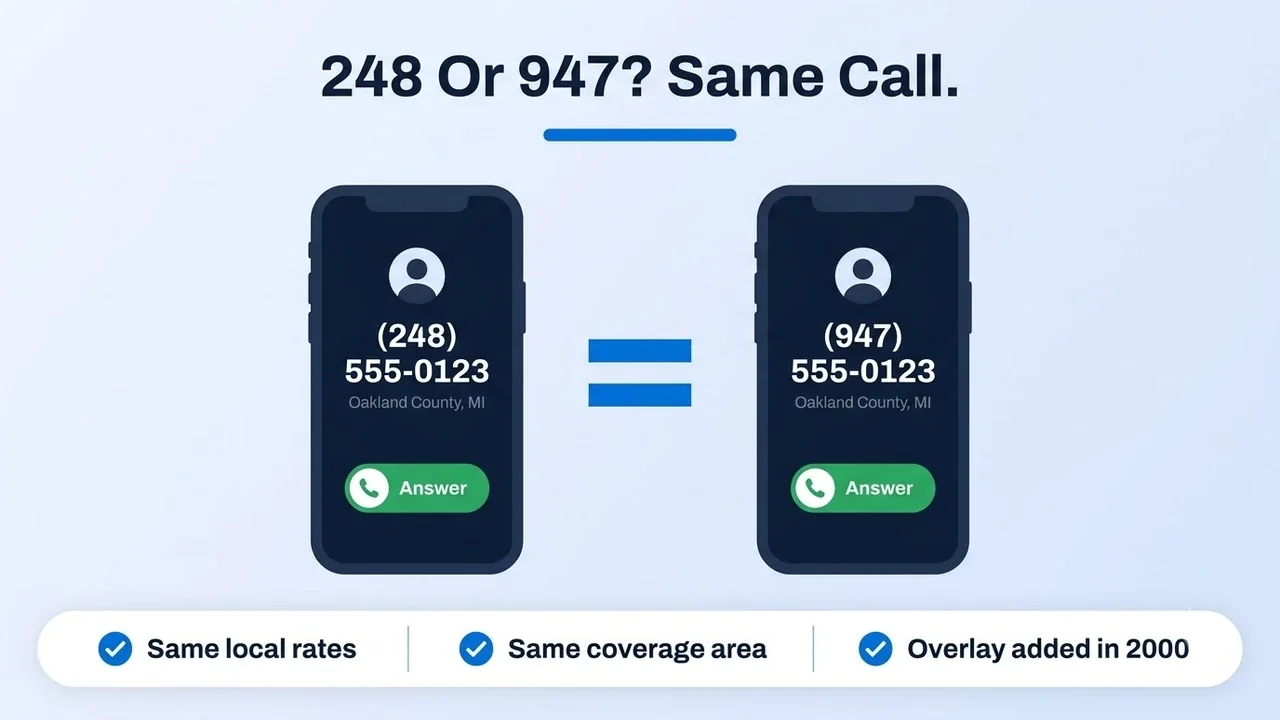
Plenty of Oakland County residents still treat 947 as an out-of-town code, and some will let those calls ring out. That instinct is understandable but wrong, and it costs local businesses real conversations every week. Both codes describe precisely the same forty-five communities.
What the two codes share
Rates, routing, and coverage are identical between them. A call from a 947 line to a 248 line is a local call in every sense that matters, and no carrier treats one as long distance. The only practical difference between them is the year each number happened to be issued.
Where the confusion causes damage
A newer business assigned a 947 number often sees lower answer rates than an established competitor holding a 248 area code line. That gap has nothing to do with service quality or price. It is pure caller-ID bias, and it is the strongest argument for choosing your number deliberately rather than accepting whatever a carrier hands you at signup. Businesses that care about pickup rates treat their choice within the 248 area code as a marketing decision, not a technical one. Providers like Rozper let you request a specific code at signup instead of leaving that outcome to chance.
Why A Local 248 Number Wins
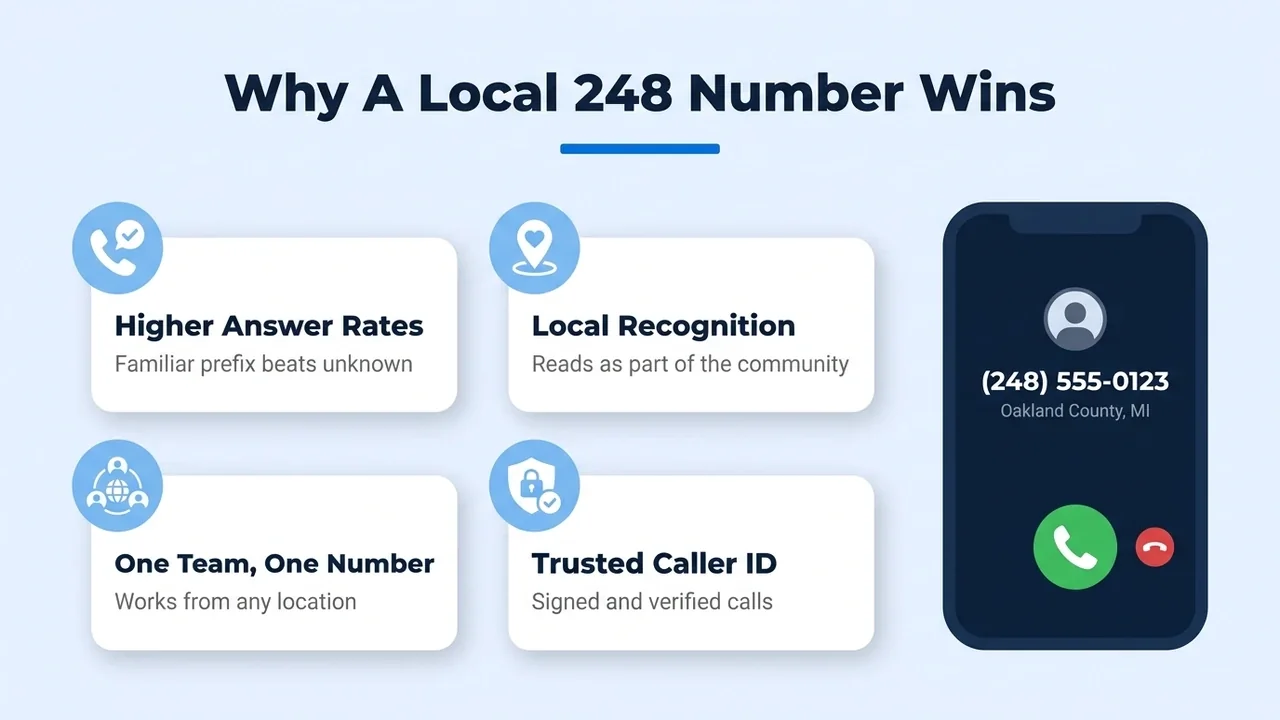
Oakland County anchors the engineering side of the American automotive industry, and the supplier network built around it is enormous. Firms in Troy, Southfield, and Auburn Hills negotiate daily with buyers who have worked inside the same few square miles for decades. In that environment, a familiar prefix on caller ID is a genuine commercial asset rather than a cosmetic detail.
- Purchasing teams answer known local numbers noticeably faster than unknown ones.
- Engineering support lines benefit from sounding close to the plant they serve.
- Out-of-state suppliers use a local presence to compete with in-county incumbents.
- A consistent number outlasts staff turnover on both sides of the relationship.
- Rozper lets a distributed team share one Oakland County identity on every outbound call.
That is why an established 248 area code line rarely gets surrendered, even when a company relocates its headquarters somewhere else entirely. The number travels with the relationship, and in a supplier market built on decades of repeat business, that continuity is worth more than the cost of keeping the line open.
Conclusion
The 248 area code covers Oakland County, Michigan, along with a narrow strip of northwest Wayne County, taking in roughly forty-five communities. It arrived in 1997 through a split of the older 810 code, then gained the 947 overlay three years later when prefixes ran short again. That overlay is why ten-digit dialing has been mandatory across area code 248 Michigan since January 2002. Understanding it explains almost every question people ask about calls in this county.
Oakland County will keep growing, and its numbering plan will keep reflecting that. Businesses selling into the region should decide deliberately which local identity they present, rather than leaving it to chance. Whether your team sits in Troy or three time zones away, a recognizable Oakland County number changes how often your calls get picked up. Rozper can put that presence in place before your next quarter starts.
FAQs
Where is the 248 area code located?
It covers Oakland County in southeast Michigan, immediately north and west of Detroit. A small portion of northwest Wayne County is also included.
What time zone does area code 248 use?
Oakland County observes Eastern Time and follows daylight saving each year. That matches New York and sits three hours ahead of Los Angeles.
Is 947 the same as 248?
Yes, in every practical sense. The 947 overlay covers the identical geography, so both codes serve the same cities at the same local rates.
Why do I have to dial ten digits in Oakland County?
The 947 overlay made seven-digit dialing impossible once two codes shared one map. Ten-digit dialing became mandatory in January 2002.
Which cities use the 248 area code?
Southfield, Troy, Pontiac, Auburn Hills, Novi, Royal Oak, Birmingham, and Rochester Hills are among the largest. Roughly forty-five municipalities fall inside it.
What area code did 248 come from?
It was split from 810 in 1997 as suburban growth exhausted the available prefixes. Before 810 existed, the region dialed under 313.
Can a 248 number be spoofed by scammers?
Yes. Neighbor spoofing fakes a local caller ID, so verify unexpected callers by hanging up and dialing back on a number you looked up.
Should a new business pick 248 or 947?
Either works technically, though 248 carries stronger local recognition with long-established residents. Availability depends on your provider at the time you order.